Despite efforts by Lula’s government to reduce deforestation, forest fires in October have been worse than ever, as field burns get out of control and land-owners, land thieves and criminals use fire to clear ever wider swathes of forest. Meanwhile, this year’s El Niño event is exacerbating the drought, thus fueling further fires. The run-off presidential election on 25 October, is a contest between Flávio the climate-change denier who wants to ‘develop our Amazon’, and Lula, who has at least reduced deforestation.
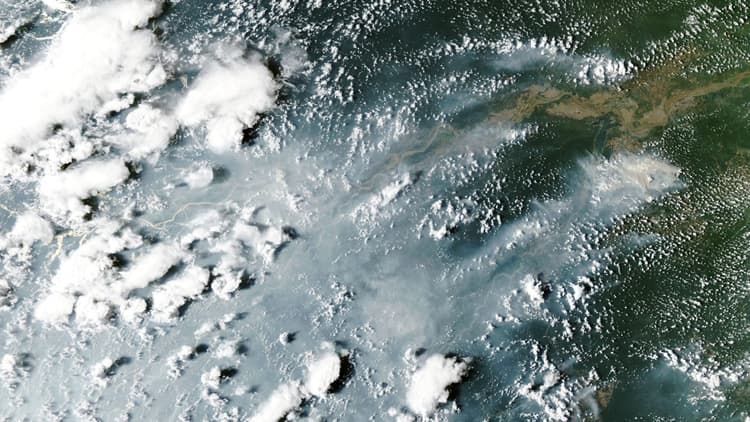
Thick smoke from widespread fires drifts across the Amazon rainforest on 12 October 2026. Credit: NASA Earth Observatory 16 October, 2026)
In mid-October, dense smoke covered Manaus, the capital of Amazonas state, where about two million people live. Schools were closed and public events cancelled. NASA’s satellite, which orbits the world, recorded large plumes of smoke on both sides of the Amazon river.
The smoke spread across much of the region, with 1,900 fire ‘spots’ identified in October, creating fear among traditional and Indigenous communities. ‘It’s reaching areas where we hunt, where we plant crops, and where our ancestors are buried’, said tuxaua Mura, the leader of the Indigenous village of São Félix in Amazonas state. ‘The fires scare us, because they are getting close to our homes.’
According to Douglas Morton, an Earth system scientist at NASA’s Goddard Space Flight Center, many of the larger blazes were started by landowners using fire for removing shrubs from grazing land or clearing crop residues from fields.
It is a technique that has been used for many years for managing cleared land. But this year, because of the drought, he said, the flames often escaped and spread into the rainforest’s parched understorey, the layer of vegetation growing beneath the taller trees.
Intentional fire setting
However, Jair Schmitt, the president of IBAMA (Brazilian Institute of the Environment and Renewable Natural Resources), believes that many of the fires were caused deliberately. ‘People are setting fire to the forest, without authorisation, to clear it’, he said.
This is because under Brazilian agrarian law, it is necessary to show effective, productive use of occupied public land in order to acquire a land title for it. Grileiros (land thieves) often clear the land and bring in a few head of cattle to demonstrate this.
‘According to the reports we’ve received from the state’s intelligence forces, over 95 per cent of the people responsible for the fires are criminals’, said Colonel Anésio Brito de Paiva, head of public security for the state of Amazonas. ‘Fire fighters are arriving and people are telling them: ‘It’s no use fighting the fires. Once you’ve gone, we’ll set fire to the forest again.’
The fires have done huge damage. ‘You see this soil here, where we used to plant. It’s only cinders’, said tuxaua Mura. ‘There is no more organic matter here. This used to be our larder, where we got our food and hunted. It’s so sad. My heart is aching.’
The affected area extends eastward to the town of Santarém and then down river toward the estuary. The fires are particularly dangerous this year because they are occurring during a severe drought. Brazil’s National Institute of Meteorology reported that rainfall in Manaus was 95 per cent below normal in August and 60 per cent below normal in September.
Morton and his colleagues anticipate that fire activity will expand northward during November and December. The regions at risk include the Brazilian states of Roraima and Amapá, northern Pará, and portions of Venezuela, Guyana, and Suriname.
They then expect the pattern to shift southward. By August and September 2027, drought conditions and wildfire danger could reach their highest levels in the south of the Amazon basin and in Paraguay.
One particularly troubling aspect of the current crisis is that many of the threatened forests have burned before, as they caught fire in 2015 and 2023, both El Niño years, as is 2026. ‘It’s so striking — and frustrating — that this is happening all over again,’ said Morton.
From deforestation to drought to fire…
Wildfires are especially destructive in tropical rainforests because most of the plants and animals living there have not evolved to withstand frequent burning. Unlike ecosystems where fire is a regular natural process, Amazon forests can suffer severe and lasting damage when flames move through them.

As ecologists have been warning for years, deforestation is exacerbating the risk of drought, thus increasing the risk of fire. Tree cover in the southern Amazon basin shrank by about 16 per cent between 1980 and 2019, mainly because the forest was slashed and burned for cattle ranching.
During the same period, the amount of rain declined by 8 to 11 per cent. The northern Amazon basin suffered far less deforestation and saw only a slight decrease in precipitation, which was not statistically significant.
However, a recent study carried out among others by Dominick Spracklen at the University of Leeds, suggests that this isn’t always the case. It showed that destroying rainforest can lead to drier weather in areas 3,000 kilometres away, hurting ranches and soya farms. This is far further than had been imagined earlier.
‘Some people in agribusiness might see a bit of forest as wasted land [they] could go clear,’ he said. But ‘that bit of forest is working really hard to maintain regional rainfall that [their] bit of agriculture is benefiting from.’
The flying rivers dry up
Global warming is undoubtedly drying out the Amazon forest, but what is happening locally is the bigger causal factor in the reduction of rainfall. Modelling carried out by Spracklen and his colleagues suggests that deforestation causes 52 to 75 per cent of the decline in precipitation.
Deforestation disrupts the Amazon’s famous ‘flying rivers’. These play a key role in maintaining rainfall at the high level needed to preserve the rainforest. About three-quarters of the rain falling on the forest returns to the atmosphere through evaporation and plant transpiration, forming these rivers. In other words, the rain is ‘recycled’.
When forest is cleared, more than half of the rainwater runs into streams and flows back to the ocean, ending these airborne moisture flows and thus reducing rainfall.
The smoke over Manaus has not persuaded voters to support stronger action against deforestation. In the first round of the presidential election, 54 per cent of voters in Manaus opted for Bolsonaro, who has repeatedly denied climate change, while 38 per cent backed Lula, who has pledged to end deforestation.
However, in the poorer areas of Amazonas state outside Manaus, Lula won 62 per cent of the vote. Much of this support was probably due to his policies for reducing poverty and hunger.
Main image: Thick smoke from widespread fires drifts across the Amazon rainforest on 12 October 2026. Photo: NASA Earth Observatory 16 October, 2026.