Babassu nut breakers in Brazil’s Amazon call the palm ‘mother’: it sustains their food, livelihoods, and cultural traditions. Drawing on published research, agronomist Bernardo Tomchinsky examines the knowledge and practices of women in Pará, and their struggle for access to babassu groves, territorial protection, and recognition of their rights. This article was translated for LAB by Stanton Geyer. You can read the original, published by Amazônia Latitude in Portuguese, here.
Babassu (Attalea speciosa) plays a central role in the lives of traditional communities in the Amazon. A pioneer species resistant to environmental degradation, it provides multiple resources: oil from its seeds, flour from its mesocarp (the fruit’s starchy, fibrous pulp), and gongo larvae. Its endocarp, the hard inner shell, provides material for charcoal and jewellery, while its leaves are used in housing and handicrafts.
Among the Indigenous Peoples, Quilombola communities, riverine communities, family farmers, and urban populations who use the plant, the quebradeiras de coco-babaçu, women who gather and break babassu nuts, stand out. These women have developed a distinctive relationship with the palm, which they call ‘mother’ because of its importance in sustaining their ways of life, both materially and culturally.
The Movimento Interestadual das Quebradeiras de Coco Babaçu (MIQCB – Interstate Movement of Babassu Nut Breakers) represents these women in organized collectives across Maranhão, Piauí, Tocantins, and Pará. It brings together their demands for free access to babassu, conservation of the palm, education, land-tenure regularization, and social rights. It also strengthens sociobiodiversity, the relationships between biodiversity, and the knowledge and livelihoods of the communities that depend on it.

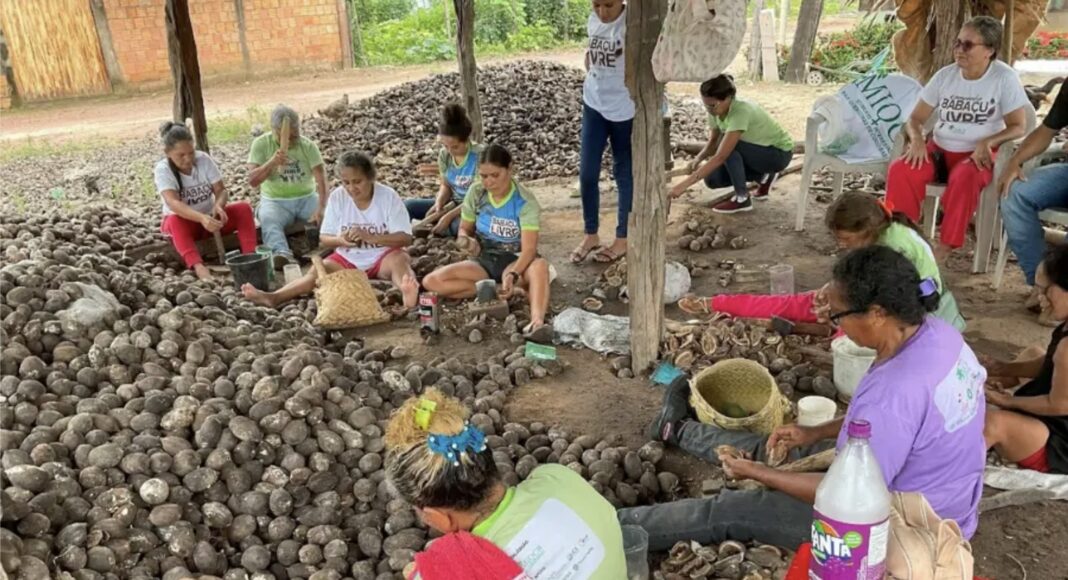
In the state of Pará, women from five south-eastern municipalities belong to the movement. They face restrictions on access to private land, obstacles imposed by farmers, and competition from steelworks and ceramics manufacturers that use the nuts to make charcoal. Despite these hurdles, they maintain collective practices such as mutirões: communal nut-breaking sessions that strengthen social ties, pass knowledge on to new generations, and preserve sustainable methods of production.
For these women, important sustainable food uses of babassu include eating gongo, a nutritious larva found in the fruit, and producing oil, gluten-free mesocarp flour, and milk extracted from the kernels. These products have considerable potential to strengthen food security. However, cultural barriers, prejudice, and a lack of technical knowledge hinder their inclusion in institutional food purchasing.
Practices surrounding the fruit extend beyond its purely utilitarian value, encompassing traditional ecological knowledge, songs, cultural expression, and communities’ own systems of environmental management. Yet the quebradeiras’ way of life is constantly threatened by land conflicts, the deliberate poisoning of palms, rural violence, and a lack of effective public policies.
Although Babaçu Livre laws providing for free access to babassu have already been passed in some states and municipalities, and the women’s knowledge is recognized as part of Pará’s intangible cultural heritage, these advances still lack concrete safeguards.
Defending babassu means defending the existence of the women who break its nuts, their knowledge, territories, and ways of life, which offer sustainable alternatives for the Amazon’s future. Seen as a provider by these communities and as a pest by sections of agribusiness, the palm encapsulates the tensions between different development models and reveals the contradictions between rendering traditional populations invisible and the urgent need to recognize their rights and knowledge.
Babassu: a symbol of resistance

Babassu occurs naturally across a vast transition zone between the Amazon, Cerrado, and Caatinga, known as the Mata dos Cocais. In the Amazon, it grows in dense and open vegetation, as well as in human-modified areas and pastures. It is a pioneer species well adapted to environmental degradation.
It is immensely important to the region’s population. Its fruit provides oil from its seeds, nutritious flour from its pulp, and jewellery, handicrafts, and charcoal from its endocarp. People use the leaves to make houses, baskets, and handicrafts. In the Tucuruí region of Pará alone, researchers have recorded 60 uses of babassu.
Various traditional peoples and communities in the Amazon have used it, including Indigenous Peoples, Quilombola communities, forest-product gatherers, riverine communities, small-scale farmers, urban populations, and, above all, babassu nut breakers. These women constitute a traditional community that uses the fruit sustainably for its survival and cultural continuity. They have a unique relationship with the palm, which they call ‘mother’. Access to it is vital to their existence.
Women’s self-determination and shared struggles led to the creation of MIQCB, bringing together collectives from Maranhão, Piauí, Tocantins, and Pará. In Pará, affiliated groups are present in five municipalities in the state’s south-east: São Domingos do Araguaia, São João do Araguaia, Palestina do Pará, Itupiranga, and Brejo Grande do Araguaia. Organized collectively, they have been pressing shared demands, including free access to babassu, its conservation and sustainable use, access to institutional procurement markets, land-tenure regularization, education, and other rights.
The total number of quebradeiras is uncertain. MIQCB has estimated their number in the hundreds of thousands across Maranhão, Piauí, Pará, and Tocantins. Much of this forest-product gathering economy remains invisible in official statistics. In south-eastern Pará, however, the entire population has some relationship with the palm.
The knowledge and practices of the babassu nut breakers
MIQCB prioritizes sustainable food uses, particularly the production of oil and mesocarp flour from the nuts.
Making these products requires gathering the fruit, which falls naturally to the ground. Younger nuts provide pulp and seeds for oil, while older ones are used only for oil.
The palms are often on private land and in pastures. The women therefore need to ask permission from the owner and often put themselves at risk in areas where animals roam freely. Even today, many farmers obstruct the quebradeiras by prohibiting entry, switching on electric fences, charging fees to use the plant, or simply selling the nuts to ceramics manufacturers and steelworks that use fruit-based charcoal in their furnaces.
Each woman generally gathers fruit in a particular place she already has access to. They collect the fruit in cofos, baskets woven from the babassu palm’s own leaves, and raffia sacks, and carry it over long distances to the nut-breaking site. Women affiliated with MIQCB in Pará avoid breaking nuts in pastures to prevent cattle from injuring themselves on the broken fruit.
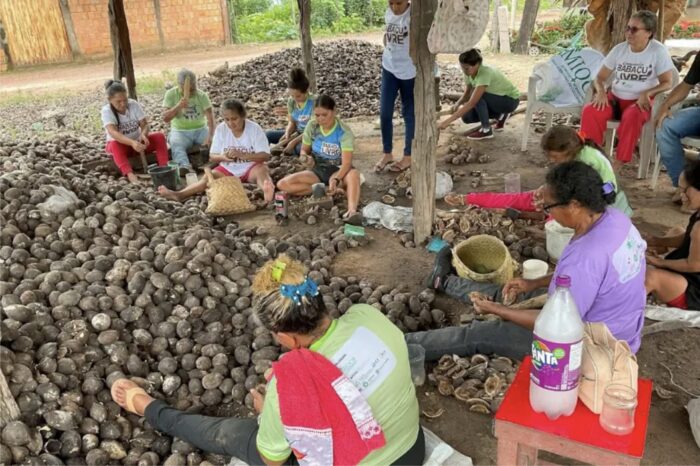
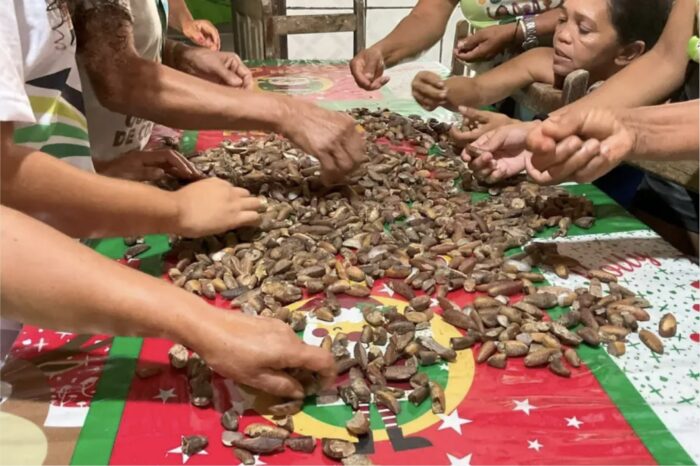
The work usually takes place in mutirões. During this time, women talk, sing, and exchange knowledge. Older women encourage young people to take part to involve them and help them learn. However, the participation of children and young people in babassu processing has also prompted disputes over what constitutes child labour.
During breaking, workers support the nut on an axe blade and strike it with a hardwood club to split it. After a few blows, the fruit is opened, and the resulting products are separated: the kernel, used to produce oil; the shell, which can be made into charcoal; and the gongo, a nutritious beetle larva used as food for people and animals, and also as a remedy.
Once separated, the kernels are washed and taken to a table for sorting. They discard spoilt kernels, while the more intact ones are set aside for oil extraction. The quebradeiras in Pará currently use two methods. One involves cooking and, the other, pressing in motorized machines.
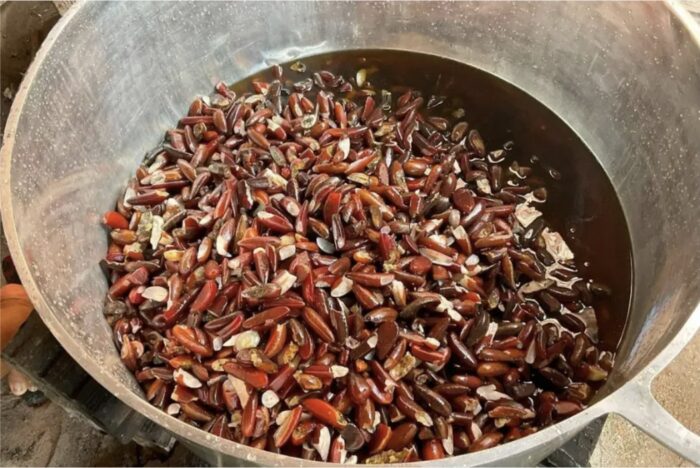
To produce oil from kernels, the kernels are roasted in a pan with previously extracted babassu oil. They then crush the kernels in a mortar or forage-processing machine, and place the resulting paste in a pan with water. As the temperature rises, the water evaporates, and the oil rises to the surface, where it is collected. The residue left at the bottom of the pan is mixed with more water for another extraction.
Mechanically pressed oil comes from younger kernels, which are broken up and dried. They are then heated in an oven and taken to a press, where the clear oil is separated from the remaining residue. In both processes, the final residue can be used as animal feed or to make a basic soap.
To make mesocarp flour, people wash and peel younger nuts to expose the pulp. The nut is struck with a wooden club to separate the mesocarp from the endocarp. The pulp is sun-dried and then ground in a forage-processing machine. This process still allows kernels to be extracted from the fruit.
Although it has no established market, babassu gongo is highly prized. After being separated during nut breaking, it is washed and fried in a pan, releasing a fat used in traditional remedies. The fried gongo can be eaten on its own or with flour.
Another food product is the babassu palm heart. Prized by Indigenous Peoples, the quebradeiras view it as something to use cautiously, only in managed areas with a high density of young palms, so as not to harm the palm population.
Babassu products form the basis of various recipes. The oil is used in a range of dishes, and the nutritious, gluten-free mesocarp flour is well received in sweet and savoury dishes served as school meals. Young kernels can also be used in sweet dishes or to extract babassu milk for numerous culinary preparations.
Although babassu products are well received in south-eastern Pará, they still face resistance to incorporation into everyday school meals. Women interviewed by Cabral et al. (2024) identified programme managers’ acceptance as a major difficulty. One also reported prejudice against babassu products. These barriers persist despite legislation requiring a minimum share of federal funding under Brazil’s national school feeding programme to be spent on purchases from family farming.
It is striking how a lack of knowledge about babassu’s potential, or a regional prejudice associating the plant with poor people’s food, limits its purchase.

Challenges facing babassu in the Amazon
The knowledge and practices associated with babassu extend beyond the plant’s practical uses, essential though these are to the quebradeiras’ survival. They also encompass the exchange of knowledge, songs, cultural expression, medicinal practices, agroecological calendars, and a vast range of ancestral ecological knowledge.
The fruit embodies the dilemma of development models in the Amazon: sustainable management by traditional populations contributes not only to their survival and cultural continuity, but also to environmental conservation. It provides environmental services and benefits species of fauna and flora, as well as the surrounding population.
Research in south-eastern Pará has found that Indigenous lands and conservation units contain the region’s largest remaining areas of native vegetation.
Unfortunately, several factors still threaten this way of life. Put simply, without the plant, there are no quebradeiras, and without the quebradeiras, babassu groves are unlikely to survive. The main threats are the felling and poisoning of babassu palms, being barred from areas where they gather the nuts, rural violence, competition from steelworks and ceramics manufacturers that use charcoal made from the fruit, a lack of access to appropriate public policies, and land conflicts.
As traditional communities, the babassu nut breakers have established rights that should guarantee their existence and access to the resources and territories necessary for their survival and cultural continuity. The laws protecting them include the International Labour Organization’s Convention No. 169 (1989) and the Política Nacional de Desenvolvimento Sustentável dos Povos e Comunidades Tradicionais (National Policy for the Sustainable Development of Traditional Peoples and Communities; Decree No. 6,040 of 2007).
Some quebradeiras have benefited from public programmes such as the Política de Garantia de Preços Mínimos para Produtos da Sociobiodiversidade (PGPM-Bio – Minimum Price Guarantee Policy for Sociobiodiversity Products), succeeded in 2025 by Sociobio Mais, and the Programa de Aquisição de Alimentos (PAA – Food Acquisition Programme). Others have supplied the Programa Nacional de Alimentação Escolar (PNAE – National School Feeding Programme). The Estratégia Nacional de Bioeconomia (National Bioeconomy Strategy) provides a broader policy framework.
Yet despite this wide range of laws, the quebradeiras’ rights remain under threat, particularly in the Amazon, where the state frequently renders them invisible. Aware of their vulnerability and working with various partners, these women have therefore sought new approaches.
One is the demand for Babaçu Livre laws, advanced by MIQCB. Maranhão and Piauí have adopted protections with differing provisions on access and conservation, although MIQCB reports ongoing obstacles to implementation. In Pará, similar laws have been passed in the municipalities of São Domingos do Araguaia and Itupiranga. They seek to guarantee the quebradeiras’ rights in their territories by facilitating access to the palm and its conservation.
In April 2025, the women’s knowledge was recognized as part of Pará’s intangible cultural heritage under Law No. 10,930, which also established a state day honouring babassu nut breakers. However, the law does not itself establish specific safeguarding measures. Recognition alone does not provide the protection these groups need.
At the time of reporting, the Pará collective was developing a biocultural protocol to record its knowledge and detail the inputs needed for its practices. The group also intended to create a community protocol for free, prior, and informed consultation to protect its territories from large-scale projects.
At the same time, it was formalizing an association to operate in the state and had been securing resources through specific funding calls to improve living and production conditions.

The knowledge and practices of these traditional communities, particularly the quebradeiras, reveal babassu as a symbol of the possibilities and contradictions of development in the Amazon.
The fruit means life and food for the quebradeiras, but is seen as an obstacle by the neo-extractivist economy, which renders traditional ways of life invisible. That invisibility deepens when these communities’ very existence and rights are denied. Defending babassu means defending ways of life, memories, and Amazonian women’s right to exist.
Bernardo Tomchinsky holds a degree in Agronomy from the Faculdade de Ciências Agronômicas de Botucatu (Botucatu Faculty of Agronomic Sciences, 2011), a master’s degree in Agronomy-Horticulture from FCA/Unesp (2014), and a doctorate in Agronomy-Horticulture from FCA/Unesp (2017). He undertook postdoctoral research at INEAF/UFPA (2022).
Original publication credits: copy-editing and page production, Juliana Carvalho; editorial direction, Marcos Colón.
Translator’s note: This article was translated and edited for LAB by Stanton Geyer, with factual updates, contextual clarifications, and additional source links. The original Portuguese article was published by Amazônia Latitude on 18 March 2026.
In June 2026, after the article’s original publication, Federal Law No. 15,431 recognized the work of babassu nut breakers in Tocantins, Maranhão, Piauí, and Pará as a manifestation of national culture.