
A Facebook advert for an Amazon farm led Subsolo journalist Ruan Martins to Ivanildo Canuto Soares, a convicted murderer with a history of drug trafficking who faked his own death. Mining records showed gold sales attributed to a permit area where satellite images revealed no visible signs of extraction. Martins follows the buyers and refiners into the supply chains reported by major international companies.
This investigation was originally published in Portuguese as Chapter 4 of Subsolo’s series. Translated by Stanton Geyer.
Cars, mobile phones, and laptops are among the many consumer goods that contain small quantities of gold. An investigation by Subsolo found that some of this gold may be contaminated by fraud, armed violence, and environmental destruction from its origins on protected land in the heart of the Amazon rainforest.
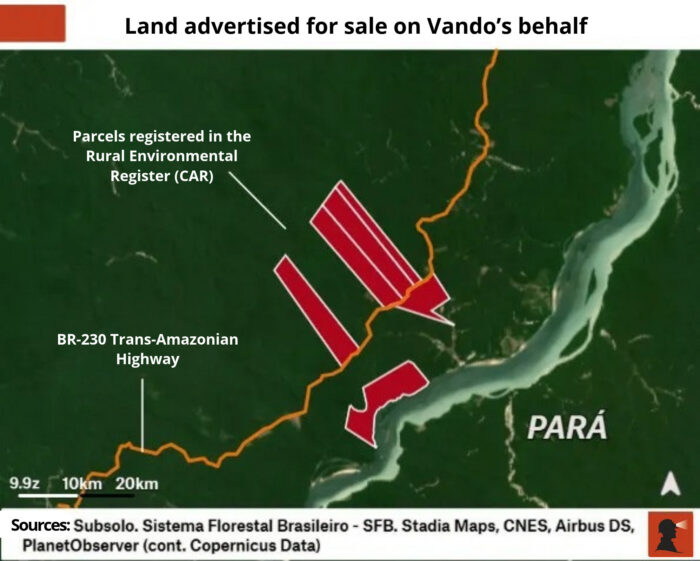
The discovery began with an advertisement posted on Facebook Marketplace in December 2023. In it, estate agents offered an 11,310-hectare farm in Itaituba, Pará, Brazil’s gold capital. The advertisement described a property with substantial infrastructure, including airstrips, houses, dams, and enough pasture to feed 1,000 head of cattle. The property also contained an area of untouched forest and two gold deposits, a common find on properties in the region.
Posing as a foreign investor interested in buying the farm, a Subsolo reporter spoke to some of the estate agents handling the sale. The conversation yielded images and documents relating to the property, which revealed that only 1,092 hectares, less than 10 per cent of its area, have ownership titles. The rest is public land registered in the Cadastro Ambiental Rural (CAR – Rural Environmental Register) in third parties’ names. This strategy is commonly used in the region to disguise the concentration of landholdings and circumvent the legal restriction preventing areas larger than 2,500 hectares from being regularized under the Terra Legal programme.
The files obtained by Subsolo also helped reveal the identity of the man behind the land. Known as ‘Vando’, Ivanildo Canuto Soares conceals a past very different from that of other farmers in the Amazon.
What follows is Subsolo’s account of his journey from São Paulo’s favelas to the gold-mining sites in the forest.
Between escapes and arrests
In the early 2000s, when he was 29, Vando was considered the most powerful drug trafficker in São Paulo’s eastern districts. From there, he managed the distribution of cannabis and cocaine from Paraguay and Bolivia. The drugs entered Brazil through intermediaries based in the border states of the Centre-West. They were then taken to major consumer markets such as Rio de Janeiro and São Paulo.
Vando’s criminal career had begun at a lower rank in the drug trade’s chain of command, as a ‘soldier’. In the criminal underworld, a soldier’s duties range from providing armed security at drug-selling points to transporting narcotics. As he rose through the hierarchy, his personal wealth grew considerably. Within a few years, he had accumulated five imported cars, two houses with swimming pools and tennis courts, and a smallholding in Ourinhos, in São Paulo state’s interior.
This ostentatious lifestyle, however, had been hanging by a thread since Vando and his accomplices murdered a civil police officer and the man accompanying him in 1997 in the Elba favela in eastern São Paulo.
Sentenced to 21 years in prison for the double murder, he managed to escape and put a risky plan into action. Although he is white, he arranged for an unidentified Black man to be buried as though he were Vando and also paid 100,000 reais for a false death certificate to make the deception official.
At first, the plan worked. With the fugitive declared dead, the courts closed the case and police stopped investigating his whereabouts. Just a year after he had supposedly been buried, however, the story took a turn. After separating from Vando in 2001, his partner went to the police to expose the faked death. Her testimony prompted police to resume their investigations and open a new inquiry into the offence of making false statements in an official document.
Despite these setbacks, Vando did not abandon his main objective to stay out of prison and protect the wealth he had amassed through crime. In another brazen move, he left for Mato Grosso state, where he underwent three plastic surgery procedures to change his face. The transformation would then be completed with a false identity document. In the new document, his name would be João Vitor Soares.
Alongside this change of identity, Vando allegedly bribed staff at the Departamento de Inquéritos Policiais, the police investigations department, to dispose of the three-volume investigation file against him. Without that file, the courts would be unable to authorize the freezing of his assets. This was the third time that police investigation files relating to Vando had disappeared from public offices in São Paulo. Months before the latest disappearance, two sheets containing his fingerprints and personal identification details had gone missing.
After an intensive investigation, the Polícia Federal (PF – Federal Police) finally captured Vando in Cuiabá in 2003. At the time of his arrest, he was organizing the transport of 20 kg of cocaine that had recently arrived in Brazil. He admitted to police that he sent the same quantity to São Paulo every week.
At the time of the arrest, Federal Police investigation chief Diógenes Curado Filho explained to Diário de Cuiabá:
The drugs came from Bolivia in the petrol tank of a Monza. When the car arrived in Cuiabá, the tank was taken out and put into another Monza, and that was how the cocaine was transported to São Paulo.
A few months before this arrest, police in São Paulo had seized four tonnes of cannabis belonging to Vando. At the time, it was considered the largest seizure of the drug in the state’s history.
His time behind bars, however, would not last long. In 2005, Vando left prison under escort by two prison officers for a hospital visit. On the way back, the officers allowed him, without court authorization, to stop at his flat in the Mato Grosso capital, on the grounds that he needed to collect documents left there. From the flat, Vando escaped once again.
Another arrest in 2008 was followed by another escape. While Vando was on the run, his lawyer was trying to have the proceedings against him annulled. In a habeas corpus application submitted to the Supremo Tribunal Federal (STF – Federal Supreme Court), the defence argued that, once the courts had closed the case on the basis of the submitted death certificate, Vando was legally dead, and the dead cannot be ‘resurrected’. The Court’s First Panel rejected the application by a majority, with the then justice Marco Aurélio Mello dissenting.
From fugitive to gold miner
When Vando was finally captured by the Polícia Militar, the state military police, in February 2024, he was no longer the same criminal who had led the distribution of illegal drugs in a densely populated part of São Paulo. During more than a decade on the run, he had diversified his businesses. He was now a farmer and artisanal gold miner, raising hundreds of cattle and mining gold in the Amazon’s interior.
At least, that was what the Facebook advertisement and the files shared by the estate agents suggested. Among the documents relating to the land advertised for sale was an authorization to mine gold granted to Vando by the Agência Nacional de Mineração (ANM – National Mining Agency). Since Brazil’s mineral resources belong to the federal government, anyone wishing to extract them must first apply to the ANM for authorization, whether for industrial or artisanal purposes.
Artisanal mines are known as garimpos. A permit to operate one is called a Permissão de Lavra Garimpeira (PLG) and can be granted to an individual or cooperative. PLGs were created in 1989 to recognize and protect this form of mining, at a time when thousands of people had migrated to the Amazon in search of gold.
Individual miners, or garimpeiros, can obtain PLGs for areas of up to 50 hectares. Organized into cooperatives, however, they can obtain permits to operate in larger areas in the Amazon, covering up to 10,000 hectares. The legislation places no limit on the number of PLGs an individual or cooperative may obtain.
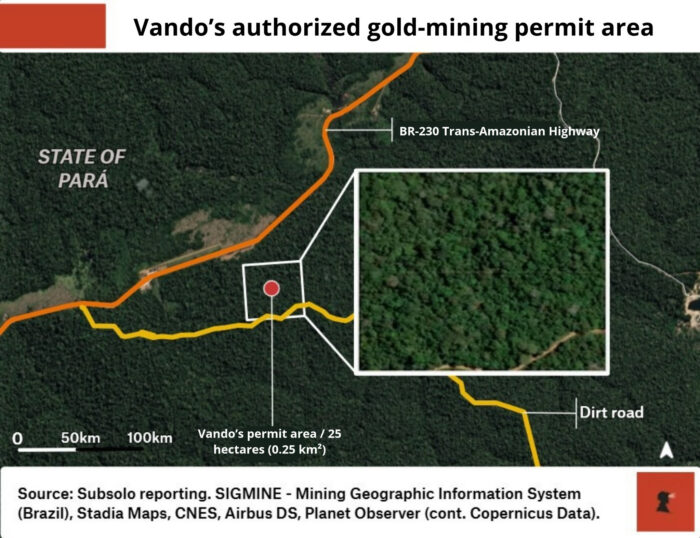
In March 2020, Vando applied to the ANM for authorization to extract gold from a 25-hectare area within the property that would be advertised on Facebook three years later. Documents analysed by Subsolo show that, three months after the application was formally submitted, the then regional manager of the ANM’s Belém office forwarded it to the Divisão de Pesquisa e Recursos Minerais (Mineral Research and Resources Division) with a request for urgent processing. The ANM told Subsolo that the official had not recorded a reason for the urgency request in her written instruction.
Since Vando was on the run, the entire process was handled under a power of attorney by Guilherme Willi Aggens, a forestry engineer frequently described in the press as a pro-garimpo lobbyist in Brasília. ANM records also identify Aggens as the legal representative of one of the few garimpos authorized by the agency in Roraima, 35 km from Yanomami Indigenous Territory.
Contacted by Subsolo, Aggens said he was not a lobbyist and considered the description inaccurate and pejorative. He said that his work as a consultant was ‘technical and institutional, always public, transparent’, and conducted through official channels. He said he had taken part in a public hearing in the Câmara dos Deputados, the Chamber of Deputies, to discuss updating mining legislation, as well as meetings at the ANM to defend his clients’ interests or discuss improvements to industry regulations.
He also said that, when he applied for the PLG, he did not know Vando was on the run, adding that ‘mining legislation does not require a criminal record certificate for the person in whose name the PLG is being sought’. His full response can be found here, under item 4.A.
Thanks to Aggens’s services, Vando was granted his PLG in August 2020. Satellite images examined by Subsolo, however, show the permit area covered in dense native forest, apart from a short stretch of dirt road crossing its south-eastern part. The images show no signs of gold-mining activity, such as clearings in the forest or tailings deposits.
Nevertheless, records for the Compensação Financeira pela Exploração de Recursos Minerais (CFEM), Brazil’s mining royalty, attribute sales of 6.5 kg of gold to this permit area. For minerals extracted under a PLG, CFEM is payable by the first buyer.
The records attribute almost all this gold to purchases by D’Gold, a company registered and better known by the name F.d’Gold. Its CFEM records report purchases of 6.34 kg of unprocessed gold attributed to this garimpo between February 2021 and September 2022, with approximately 25,000 reais paid in CFEM. The remaining 196 grams were purchased by Ourominas in November 2020.
Both F.d’Gold and Ourominas operate as Distribuidoras de Títulos e Valores Mobiliários (DTVMs – securities distributors), the only type of financial company authorized by Brazil’s central bank to buy gold directly from garimpos. DTVMs are the first traceable link in the gold supply chain. In the Amazon, these companies maintain buying outlets in the main producing areas, including Itaituba, Jacareacanga, and Novo Progresso, municipalities in western Pará. Locally, these outlets are known as bancas.
Researchers from the Universidade Federal de Minas Gerais (UFMG – Federal University of Minas Gerais) and investigators from the Ministério Público Federal (MPF – Federal Prosecution Service) cross-referenced CFEM data with satellite images of ANM-authorized garimpos and discovered something curious. Some of the areas identified as the source of gold in CFEM records are completely covered in forest. According to the study, this is a strong indication that the permit was used to launder gold extracted elsewhere. In such cases, ore extracted from protected land or without authorization is declared as having come from an authorized garimpo that shows no signs of mining.
The research identified indications of irregular origin in approximately 49 tonnes of gold produced in Brazil in 2019 and 2020, equivalent to 28 per cent of national production during that period. Of those 49 tonnes, 6.3 tonnes were classified as illegally sourced. According to the MPF, three DTVMs – F.d’Gold, Ourominas, and Carol – purchased 71 per cent of those 6.3 tonnes.
An estate agent who spoke to Subsolo said that the easiest part of illegal mining in protected areas is selling the gold. In Novo Progresso, for example, he said, ‘there are plenty of bancas that buy gold extracted from protected areas’, such as the Floresta Nacional do Jamanxim, the Jamanxim National Forest, where, according to him, two clandestine garimpos are operating in the northern part of the reserve. ‘You just have to watch out for inspections [inside the forest],’ he warned.
The Gold King
The links between Vando and F.d’Gold appear to predate the transactions recorded in the CFEM data. ANM files identify the geologist Alain Daniel Lestra as the professional with technical responsibility for Vando’s PLG. From August 2007 to November 2022, Lestra was a partner in D’Gold Pesquisa e Exploração Mineral, a now-defunct arm of F.d’Gold, alongside the businessman Dirceu Santos Frederico Sobrinho, known as the ‘Gold King’.
Sobrinho has 123 PLGs registered in his name. For eight years, from 2014 to 2022, he was president of the Associação Nacional do Ouro (Anoro – National Gold Association), the most important organization in Brazil’s mining sector and one of the leading advocates of legalizing garimpo mining in protected areas of the Amazon.
Sobrinho’s relationship with gold began more than 30 years ago. His father ran a fruit and vegetable shop near Serra Pelada in south-eastern Pará, where more than 100,000 men gathered in search of gold, creating the world’s largest open-pit garimpo. It was there that Sobrinho obtained his first PLG in 1990, marking the start of his career as a garimpeiro. Two decades later, he founded F.d’Gold, which would become one of the leading buyers of gold extracted from Brazil’s garimpos. Its headquarters in a 17-storey building on São Paulo’s Avenida Paulista bear no resemblance to Sobrinho’s modest origins in the interior of Pará.
As notable as his business success is his ability to fend off the accusations brought against him. In 2011, the Ministério Público, the prosecution service, brought charges against Sobrinho for allegedly receiving gold illegally extracted from a conservation unit in Amapá state. The courts, however, ordered the proceedings terminated, considering the purchases legal because, after all, they had been duly recorded in invoices.
Four years later, in 2015, the prosecution service brought charges against Sobrinho for allegedly laundering money from the illegal gold trade in Pará. Once again, however, the courts ordered the proceedings terminated after the defence submitted accounting reports on gold purchases and sales to justify the suspicious transactions.
In August 2021, the MPF brought an Ação Civil Pública (ACP – a public civil action), seeking to hold F.d’Gold responsible for allegedly purchasing 1.3 tonnes of gold showing indications of irregular origin in the Legal Amazon. The lawsuit was dismissed at first instance, but the Tribunal Regional Federal da 1ª Região (Federal Regional Court of the First Region) overturned the ruling because F.d’Gold had filed its defence under seal, preventing the MPF from responding to its arguments. The proceedings therefore returned to the stage for the claimant’s reply to the defence.
Sobrinho was also charged with allegedly contaminating the environment with cyanide, a toxic substance used to extract gold from ore. In September 2022, he was placed in temporary detention by the Federal Police after investigations indicated connections between F.d’Gold and illegal garimpos in the Terra Indígena Yanomami, the Yanomami Indigenous Territory.
Despite the many proceedings, Sobrinho has never been convicted. Neither he, F.d’Gold, nor the geologist Alain Daniel Lestra responded to Subsolo’s requests for comment.
Accounting manoeuvres
For a long time, fraud involving CFEM was facilitated by outdated legislation that presumed gold was legally sourced and its buyer was acting in good faith, provided the information supplied by the seller was kept on file. When paying CFEM, buyers supplied the ANM with information about the purchase, including the quantity of gold in grams, the process number identifying its declared source, and the municipality where the garimpo was located.
The entries discussed here distinguish minério de ouro, or unprocessed gold, from ouro, gold that has undergone some purification at the garimpo.
Subsolo analysed 17,945 CFEM records relating to F.d’Gold, registered between February 2010 and June 2025 and extracted in September 2025. The registration dates indicate when the payment declarations entered the ANM’s system, rather than necessarily when the purchases occurred. Some of the findings are intriguing.
The seven largest quantities recorded for F.d’Gold follow the same pattern: each quantity of unprocessed gold, expressed in grams, reproduces the six-digit part of the source garimpo’s ANM process number followed by ‘20’. The entries identify seven different garimpos. Two of these declarations were registered in June 2025, after the STF declared the presumption unconstitutional in March that year. The rule had already been suspended in 2023.
Two examples help explain this formula.
A CFEM declaration registered in January 2025 records a purchase by F.d’Gold of 86,610,320 grams of unprocessed gold attributed to a 10-hectare garimpo in Peixoto de Azevedo, Mato Grosso. This quantity reproduces the six-digit part of the source garimpo’s ANM process number, 866103, followed by ‘20’.
In the second case, a CFEM declaration registered in March 2021 records a purchase by F.d’Gold of 85,022,720 grams of unprocessed gold attributed to a 9.4-hectare garimpo in Itaituba. This quantity follows the same formula: the six-digit part of the process number, 850227, followed by ‘20’.
The quantities reported and the minerals authorized for extraction raise further questions.
For the 10-hectare garimpo, excluding the exceptional entry, CFEM records from March 2018 to June 2025 show an average of 4.7 kg per record across the minério de ouro and ouro categories.
In the second case, the 9.4-hectare garimpo is licensed to extract cassiterite, not gold. Cassiterite is the principal ore of tin, a metal widely used in solder and alloys.
All seven entries following the accounting pattern identified by Subsolo concern unprocessed gold. The recorded quantities range from roughly 85 to 87 tonnes each, equivalent in weight to about three 30-tonne tipper-truck loads. Together, they amount to about 603 tonnes. Transporting that combined weight in trucks carrying up to 30 tonnes each would require at least 21 loads.
Apart from these seven entries, none of the 17,945 CFEM records analysed for F.d’Gold lists a comparable quantity. The next-largest entry, registered in January 2025, records about 22.7 tonnes of unprocessed gold and does not follow the numerical pattern.
The same phenomenon occurs on the other side of the counter. Each of the seven entries also records the largest quantity attributed to its source garimpo in the data analysed.

Of F.d’Gold’s seven largest recorded purchases of unprocessed gold, five are attributed to garimpos operated by cooperatives. The principal supplier is the Cooperativa de Garimpeiros do Vale do Rio Peixoto (Coogavepe – Rio Peixoto Valley Miners’ Cooperative). Considered the sector’s largest association, it has 7,000 members and controls 197 PLGs covering 207,000 hectares in the Amazon. At least three of the seven entries identified by Subsolo record purchases of unprocessed gold attributed to garimpos operated by this cooperative.
At a mining industry event in 2024, Coogavepe president Gilson Camboim declared that ‘our work focuses on caring for people and the environment’. A Federal Police operation that year, however, called the sincerity of this commitment into question. The organization was targeted by a search and seizure warrant during Operation Hermes II on suspicion of irregular mercury purchases. The highly toxic metal is commonly used in garimpos to separate gold from other sediments.
In another curious case identified in the CFEM records, a declaration registered in August 2024 records F.d’Gold’s purchase of just over a tonne of gold. This was close to Serra Pelada’s average monthly output in its peak year, 1983: about 1.2 tonnes, based on annual production of 14 tonnes. The entry attributes the gold to a garimpo authorized in 2004 on a river in Porto Velho, the capital of Rondônia state. It records approximately 15,500 reais paid in CFEM.
Although Brazil has the world’s 10th-largest gold reserves, only 16 ANM staff monitor CFEM payments. Another 28 staff analyse the thousands of PLG applications the agency receives. Research indicates that, for every real collected in CFEM, an equal amount goes unpaid through evasion.
Weak oversight of Brazil’s gold production chain, combined with the ease of evading CFEM payments, has made garimpos a highly profitable way for criminal organizations to launder money from international drug trafficking. These organizations include the Rio-based organized crime faction Comando Vermelho (CV), to which Vando has historical ties.
Drugs, gold, and blood
In August 2005, Diário de Cuiabá, citing the Federal Police, described Vando as one of Fernandinho Beira-Mar’s operatives in São Paulo. CV is a criminal organization that emerged in Rio de Janeiro’s prisons and makes millions of reais in profits every year from international drug trafficking while maintaining armed control over poor neighbourhoods across the country.
Vando’s involvement in gold garimpos in the Amazon is a symptom of a broader phenomenon in the forest. A chapter on the Amazon Basin in the United Nations Office on Drugs and Crime’s (UNODC) World Drug Report 2023 describes growing evidence of drug traffickers ‘financing and providing logistical support for illegal gold mining operations across the region, including on protected territories’.
The phenomenon is not new, however. In 1990, the newspaper Folha de Boa Vista reported that drug traffickers were using garimpo airstrips. That same year, the Serviço Nacional de Informações (SNI), Brazil’s intelligence service, acknowledged the possibility that gold produced in Yanomami Indigenous territory was being used ‘to launder drug-trafficking proceeds’. This involvement, however, was sporadic and secondary, whereas today it is systematic, the result of a shift that began in 2016, when Comando Vermelho broke with Primeiro Comando da Capital (PCC). This forced the Rio de Janeiro-based criminal organization to seek alternative drug supply routes in the Amazon, since the PCC had taken control of the Centre-West route.
The combination of limited policing capacity and a growing prison population in the region makes it easier for criminal organizations to expand their operations across the territory. According to research by the Fórum Brasileiro de Segurança Pública (FBSP – Brazilian Public Security Forum), a single police investigation chief in the Amazon covers an area of 2,541 km², while in the rest of the country the same area is covered by three such officers. According to the FBSP, the prison population in the region’s nine states grew by 35 per cent between 2016 and 2022.
Security reports indicate that CV arrived in the region shortly before its break with the PCC. In 2013, criminals from Roraima who had been serving sentences in federal prisons alongside members of CV returned to the state as its affiliates, recruiting new members in local prisons.
The FBSP study identified drug-trafficking organizations in 344 of the Legal Amazon’s 772 municipalities. CV was present in 286 municipalities, including places where other organizations also operated. The PCC was present in 90: it operated alone in 31 and contested control in 59. CV’s growing presence in the region has made it easier for the organization to control the Solimões Route, the main route for shipping cocaine to Europe and the United States.
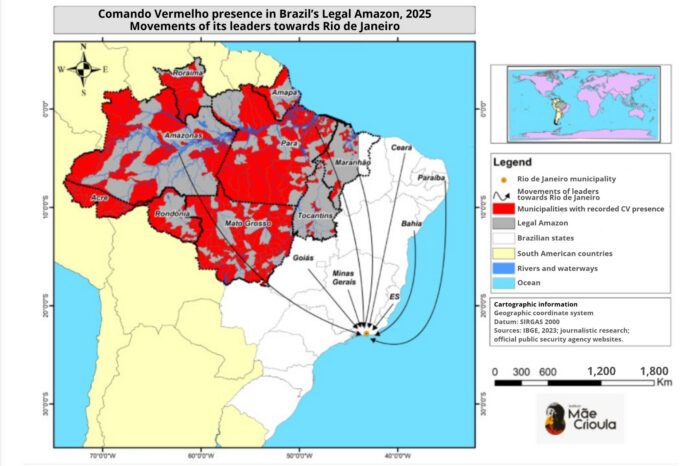
Within the forest, the organization also became more actively involved in gold garimpos, both legal and illegal. Rising gold prices on the international market and limited enforcement made the metal more attractive to traffickers.
This involvement also stems from the transformation of garimpos from artisanal mines into full-scale industrial complexes. Unlike at Serra Pelada, where miners worked with gold pans and pickaxes, many garimpos today require investments of millions of reais and rely on heavy machinery, including excavators, bulldozers, front-end loaders, and tipper trucks. Part of this transformation is explained by the difficulty of reaching remote areas in the forest’s interior, which requires aircraft, airstrips, and well-trained pilots. Some of the abundant money from drug trafficking has been invested in these operations.
In the region, a large proportion of garimpos operating outside the law depend on mercury, a substance whose trade is tightly controlled in Brazil. Despite the legal restrictions, estimates suggest that tonnes of the metal reach Amazonian garimpos every year. Mercury contamination can harm rivers, fish, and soil, as well as seriously damage people’s health, causing central nervous system damage and pulmonary and cardiovascular diseases.
A study released in 2024 by the Fundação Oswaldo Cruz (Fiocruz – Oswaldo Cruz Foundation) found mercury in hair samples from all the Yanomami participants tested across nine villages in Roraima. A February 2024 Jornal Nacional report described alarming mercury levels among Munduruku people in Pará, including at least eight people in one village. It also reported that Fiocruz researchers were closely monitoring 80 Munduruku children.
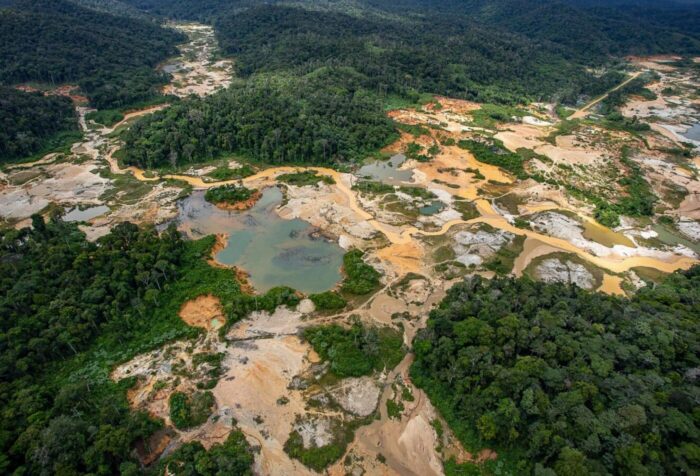
The harm caused by illegal garimpos extends beyond mercury’s damaging effects on the human body and local ecosystems. Within the Yanomami Indigenous Territory, the presence of miners caused outbreaks of malaria, pneumonia, and viral infections, as well as food shortages.
Between 2019 and 2022, 177 Yanomami people, mostly children, died of malnutrition in a humanitarian crisis completely neglected by the Bolsonaro government. Between 2023 and 2024, around 13,000 miners were removed from Yanomami Indigenous Territory.

Added to these harms is the insecurity that illegal garimpos bring to Indigenous reserves. Attacks on Indigenous Peoples have become common over the past decade. In 2021, the homes of Indigenous leader Maria Leusa Munduruku and her mother, the village chief, were set on fire after being hit by gunfire from miners. The attack followed a clash between police and miners operating inside the reserve.
In another recorded 2021 incident, miners linked to drug-trafficking organizations opened fire on a Yanomami village. A seven-year-old child died and five Indigenous people were injured.
From the Amazon to the world
Gold purchased at F.d’Gold’s buying outlets in the Amazon is flown to São Paulo, where it is refined by Marsam Metals, a company run by Sobrinho’s daughter, Sarah Frederico Westphal. For many years, hundreds of publicly listed companies in the United States and Europe identified Marsam in their reported supply chains. In 2022, the refinery lost its conformance status under an industry responsible-sourcing programme, after which some companies stopped listing it in their supply-chain reports.
The programme is run by the Responsible Minerals Initiative (RMI), a US-based industry initiative. Independent assessments examine refiners’ management systems and sourcing practices. They help companies meet responsible-sourcing requirements, including those arising from Section 1502 of the Dodd–Frank Act.
Under the US rules, companies reporting to the Securities and Exchange Commission (SEC), the US securities regulator, must investigate the origins of tin, tantalum, tungsten, and gold – collectively known as 3TG – when these minerals are necessary to products they manufacture or contract to have manufactured. The rules focus on possible sourcing from the Democratic Republic of the Congo and neighbouring countries, with the aim of preventing mineral purchases from financing armed groups and human rights abuses.
These assessments do not certify the origin of individual consignments of gold. RMI also provides a Global Risk Map, which uses governance, human rights, and conflict indicators to classify geographical areas into four risk categories: low, medium, high, and extreme. These classifications support companies’ due diligence; they do not establish the provenance of a particular consignment.
Critics cited by the Associated Press in 2022 argued that the guidelines of the Organisation for Economic Co-operation and Development (OECD) used by RMI gave insufficient attention to environmental crimes and Indigenous communities’ rights, concentrating instead on risks associated with armed conflict and criminal networks. RMI now says its Global Risk Map also includes environmental, social, and governance indicators to support due diligence beyond the risks covered by Annex II of the OECD guidance.
Subsolo’s investigation shows that the risk of armed groups being involved in gold extraction in the Amazon is higher than might be imagined.
Marsam was not named as a defendant in the public civil action brought by the MPF against F.d’Gold, although its connections with Sobrinho’s company were publicly documented. The number of companies listing the refinery in their supply-chain reports fell from more than 300 in 2022 to 185 in 2025.
An Associated Press report published in January 2022 revealed that more than a third of the gold processed by the refinery came from F.d’Gold. In the refinery’s furnaces, metal from different sources is melted down and purified, a practice that, according to forensic geochemistry studies, makes tracing gold’s origin more complex.
The Conflict Minerals Reports submitted annually to the SEC show that, despite Marsam losing its RMI conformance status, companies including Tesla, Ford, Cisco, Sony, Motorola, Starbucks, Nokia, and Embraer continued to report its presence in their supply chains in 2023, 2024, and 2025.
Amazon stopped listing Marsam after the refinery lost its RMI conformance status in 2022. The refinery reappeared in Amazon’s 2025 filing.
‘We don’t source directly from Marsam Metals and require enhanced due diligence for any smelter that loses its RMI conformance,’ Amazon told Subsolo. ‘After Marsam lost its certification in 2022, we imposed that requirement on suppliers sourcing from them.’
Amazon said none of its suppliers reported sourcing from Marsam in the next reporting cycle, explaining the refinery’s absence from its 2023 and 2024 SEC filings. ‘Marsam reappeared in our 2025 filing because suppliers resumed that relationship and disclosed it through their annual Conflict Minerals Reporting Templates.’
‘Given Marsam’s nonconformant status and alleged ties to illicit activity, including connections to F.d’Gold, we’ve again imposed enhanced due diligence on those suppliers,’ the company said.
‘We seek to enable safe, equitable, fair, and sustainable supply chains across all our businesses, and we build relationships with suppliers that align with our values and are committed to improving conditions for workers.’
Conflict Minerals Reports bring greater transparency to the raw materials used by the world’s major publicly listed companies, but they have limits of their own. A refinery’s appearance in a supplier’s disclosures does not, by itself, establish that its gold entered a particular company’s products. A supplier may purchase gold processed by Marsam and may or may not use it to manufacture a component sold to Sony, for example.
These disclosures alone therefore do not establish whether gold processed by Marsam entered a particular car, light bulb, or mobile phone manufactured by these companies, or how much was used in each product.
Marsam, Tesla, Ford, Starbucks, Cisco, Sony, Xerox, Motorola, Nokia, Embraer, and Stanley Black & Decker did not respond to Subsolo’s requests for comment.
Land grabbers and gold miners
Vando’s case demonstrates how grilagem, the illegal appropriation of land, and garimpo mining coexist as complementary ways of extracting wealth from the Amazon rainforest. The activities are distinct, but in Vando’s case they are carried out by the same person, from the same territory.
Although Brazil’s underground mineral resources belong to the federal government, there are cases in which land grabbers have seized public land containing gold reserves because control of the surface makes it easier for them to negotiate access to the minerals below with any individual or company interested in exploiting them.
This was illustrated in Chapter 3 of Subsolo’s series, which showed how land grabbers took possession of part of the Terra Nossa settlement in Pará and then sold surface access rights to Chapleau Exploração Mineral. Land containing gold deposits can also command higher prices than land with timber alone.
The rise in international gold prices since the start of the COVID-19 pandemic, together with expectations of changes to legislation governing mining in protected areas of the Amazon, has intensified this threat.
A Greenpeace report revealed that illegal mining destroyed about 4,200 hectares of forest in the Yanomami, Munduruku, Kayapó, and Sararé Indigenous territories between 2023 and 2024. According to the organization, mining activity during that period ‘did not decrease. It simply moved from one Indigenous territory to another’. The effects of this gold rush are felt by the Indigenous people living in the areas most sought after by garimpeiros.
Although Vando is serving his sentence for aggravated homicide under house arrest, his investments link him to this gold rush. Besides obtaining the PLG in Itaituba, he invested in setting up a road transport company called Soares Gold Transporte, whose partner is listed as the holder of one of the portions of the property he advertised on Facebook. Another company, Soares Gold Representações de Metais Ltda, established in March 2020, includes among its partners people named in the CAR as holders of parcels of his property.
Contacted by email and WhatsApp, Vando did not answer the questions and blocked Subsolo.
It was not possible to confirm whether Vando still has ties to Fernandinho Beira-Mar or to any other drug trafficker or criminal organization operating in Brazil. Since his recapture in 2024, his legal troubles have diminished substantially. In April 2026, the proceedings for an offence against public trust arising from his faked death became time-barred, and the drug-trafficking proceedings were suspended.
According to the prosecution service, he has ‘serious health problems’, including diabetes, gout, hypertension, acute neck pain, and lower back pain with sciatica. Because of these conditions, the prosecution service says, he needs to travel frequently to São Paulo for treatment.
While Vando serves his sentence in the gold capital, the metal concealed within our connectors, cables, chips, and circuit boards may still bear the scars of the forest’s destruction and the blood of those who watch over it.
The investigation was funded by Josh Mailman and The Mailman Foundation, Earth Island Institute, The Puffin Foundation, GRID-Arendal, and Earth Journalism Network.
Assistance: Rodolfo Gadelha, of the Center for Climate Crime Analysis (CCCA), helped filter the millions of CFEM records.