
An impassioned editorial on the website of LAB’s partner Amazônia Latitude calls for the protection of press freedom which was significantly damaged during the Presidency of Jair Bolsonaro and is gravely at risk if Flávio Bolsonaro wins the run-off election on 25 October. The appeal was co-signed by 52 organizations, among them LAB partner Sumaúma.
Brazilian society cannot take the risk and Brazilian journalism cannot falter; it is time to take a clear position in defense of democracy and against authoritarianism. This is a situation that we have seen before. In 2018, many believed in the illusion that the political status quo would end up moderating Jair Bolsonaro. Today, we can state, with certainty, that it was Bolsonarism that radicalized the status quo.
The attacks on democracy by Jair Bolsonaro’s government are well documented, with onslaughts against the credibility of the elections, hostility towards the press, the political use of the armed forces, tolerance of anti-democratic protests, contesting the hand-over of power, and open conflict with the Judiciary. The fact that the institutions have resisted does not mean that this evidence does not exist, nor lessen the severity of the attacks. It means that the containment mechanisms work.
There is no reason to believe that Bolsonaro’s son will have a better relationship with the media and with democracy. The fact that he has not been as verbal or as aggressive as his father does not make his acts any less serious. The primary promise of Flávio Bolsonaro is the release of Jair and annulation of his sentence for trying to abolish the democratic State. In addition, there is the declared threat of changes to the Constitution.
During the four Years of Bolsonaro’s government, journalism lived with the horror of repression. Verbal aggression was promoted on an almost daily basis by the president of the Republic against the reporters who covered the Planalto presidential palace. Intimidation occurred throughout the country as a result of the climate of hostility that Bolsonaro promoted against the profession.
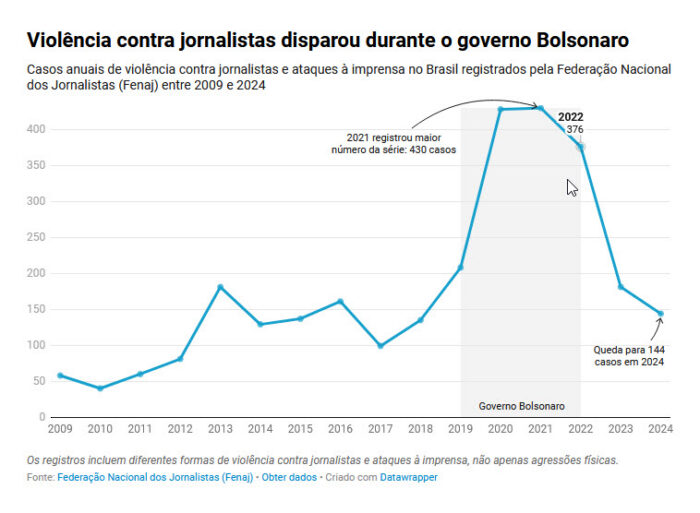
The numbers help provide a dimension to the escalation of violence. According to the Federação Nacional dos Jornalistas (National Federation of Journalists – Fenaj), 1,442 cases of violence against journalists and attacks on the press were recorded between 2019 and 2022, which is an annual average more than three times higher than that observed between 2010 and 2018. In 2022 alone, the Associação Brasileira de Jornalismo Investigativo (Brazilian Association of Investigative Journalism – Abraji) documented 557 warnings of violations to the freedom of the press, of which 41.6 per cent involved at least one member of the Bolsonaro family.
The change in the scenario from 2023 onwards is equally revealing. The incidents recorded by Abraji fell to 330 in that year and 204 in 2025, while Brazil moved up on the Reporters Without Borders World Press Freedom Index from 110th in 2022, to 52nd in 2026.
The defense of journalism, however, goes beyond the interest of a professional category; it concerns the right of the entire population to information and the very quality of the democracy we live in. This right depends on an environment of trustworthy information, where reliable, verifiable information reflecting diverse perspectives can circulate freely. Journalism plays an essential role in the construction of this environment, by investigating cases of corruption, abuses of power, and rights violations, producing evidence that helps society understand reality, holds people accountable, and grants visibility to frequently neglected populations.
As such, systematic attacks on the press do not affect only journalists and media outlets. By intimidating professionals and discrediting their investigations, they compromise the population’s access to information of public interest and weaken the capacity of society to monitor those who govern and demand accountability of those who violate the law.
What happened during Jair Bolsonaro’s government has a long history behind it. In 1999, he declared that, if he were president, he would close the National Congress and would stage a coup d’état. in 2016, he paid homage to Colonel Carlos Alberto Brilhante Ustra, who was identified by the Justice system as a torturer under the military dictatorship.
Once Bolsonaro became President, he participated, in 2020, in a demonstration that defended military intervention and the closure of the Congress and the Supremo Tribunal Federal (Supreme Court) (STF). In 2022, he gathered foreign ambassadors to level baseless accusations against the Brazilian electoral system, an episode that led eventually to his own ineligibility.
The escalation culminated in the plans to assassinate the highest authorities – namely, president elect Luiz Inácio Lula da Silva, his chosen Vice President Geraldo Alckmin, and Supreme Court Justice Alexandre de Moraes – in an attempt to impede the hand-over of power after his defeat at the ballot box, for which crime Bolsonaro was convicted by the STF in 2025.
It is against this background that we must evaluate the proposals of Flávio Bolsonaro. The senator also has his own record that deserves attention. In a book published in 2017, he denied the existence of the military coup of 1964 and praised Ustra. In July of 2026, in front of foreign diplomats, he repeated false information on the origin of Brazil’s electronic ballot boxes.
The trajectory of a political group that questioned the legitimacy of the elections, confronted the institutions responsible for holding those in power accountable, and now intends to modify some of these same institutions cannot be ignored.
The risk is not just that of a new coup d’état. It is also about the possibility of the progressive weakening of mechanisms that impede the concentration of power and ensure the accountability of those who govern.
The population depends on a free press to monitor those in power. A free press depends on institutions capable of guaranteeing rights, ensuring access to public information, protecting professionals against intimidation, and holding to account those who try to impede their work.
The experience of a Bolsonaro government demonstrated how hostility promoted by the president can have repercussions on the freedom of the press. If the mechanisms controlling power are also weakened, the conditions for journalists to independently investigate and publish information of public interest become more fragile. It is thus that attacks on journalism, institutional weakening, and the erosion of democracy can feed off each other and open the way for the advance of authoritarianism.
Therefore, this editorial is also an appeal to media outlets to reflect on their responsibility at this historic moment. It is not about defending governments, parties, or tribunals, but about recognizing that the freedom of the press, the independence of the institutions, and the right of society to information are inseparable. In the name of a viable future, Brazil needs to preserve its democracy, with all its imperfections, contradictions, and conquests. In the end, history shows us that authoritarianism comes to power through the ballot box, but its effects on rights and freedom can take decades to be reverted.
- Agência Diadorim
- Agência Envolverde
- Agência Mural
- Agência Nossa
- Agência Tatu
- Amazônia Latitude
Ambiental Media - AzMina
- Cansei de ser pop
- Carta Amazônia
#Colabora – Jornalismo Sustentável - Conexão Planeta
- Conquista Repórter
- Correio Sabiá
- De Olho nos Ruralistas
- Eco Nordeste
Eficientes - Emerge Mag
- Entre Becos
- Escotilha
- Eufêmea
- Gênero e Número
- InfoAmazonia
- Kerovi
- Jornal Espaço do Povo
- Jornalistas&Cia
- Juicy Santos
- Le Monde Diplomatique Brasil
- Mangue Jornalismo
- Marco Zero
Matinal
Meus Sertões - Mídia Caeté
- MigraMundo
- Nonada
- Nós, Mulheres da Periferia
- Notícias da TV
- Núcleo Jornalismo
- Plural
- Ponte Jornalismo
- Portal BnT Online
- Portal Catarinas
- Portal dos Jornalistas
- Portal Gerais
- Porvir
- Projeto Preserva
- Psicodelicamente
- O Joio e O Trigo
- Outras Palavras
- Revista Afirmativa
- Revista Alagoana
- Revista O Grito!
- Sul21
- Sumaúma
- The Conversation Brasil
Main image: from website of Revista Cenarium.