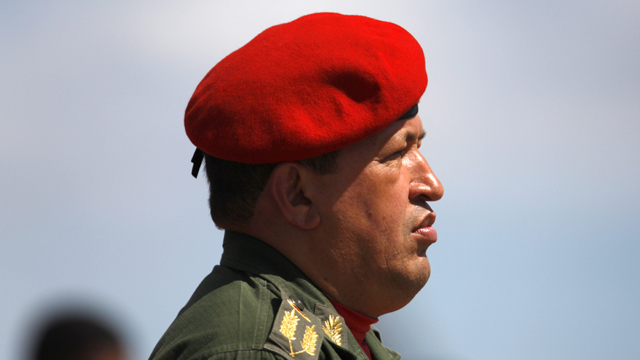
On Tuesday 5 March, at the age of 58, Venezuelan president Hugo Chávez lost his almost two-year battle with cancer and passed away. Within seconds of the news being announced, the wheels of the global media bandwagon went into overdrive, with largely unsurprising results, in both the US and British media. At the most distasteful end of the spectrum was the headline in the New York Post, the paper with the 7th highest circulation in the US, that read ‘Off Hugo! Venezuela bully Chavez is dead’.
 Other US media followed closely behind. ‘Death of a Demagogue’ ran a headline on the website of Time, the world’s biggest selling weekly news magazine. These and other US media reaction were included in a piece by the US media watchdog Fair and Accuracy in Reporting (FAIR) that also examined the distorted, often hysterical, US media coverage of Chávez during his presidency. It’s worth recalling that following the 2002 US-supported coup that briefly removed Chavez from the presidency the New York Times declared that Chavez’s “resignation” meant that “Venezuelan democracy is no longer threatened by a would-be dictator.”
Following Chávez’s death, the antipathy towards a president that had so vehemently challenged the actions and interests of the United States was also evident in the British media. Rightwing outlets displayed the usual cynical disdain that had characterised their reporting of Chávez’s presidency, although Nicolas Maduro, Chávez’s former vice-president, the current interim president and the government’s candidate for the April 14th presidential election, was also now in the firing line. In the UK’s biggest selling broadsheet, the rightwing Daily Telegraph, its chief foreign correspondent David Blair described Maduro’s role as foreign minister under Chavez in the following terms: “Mr Maduro was the obedient enforcer of his master’s highly personal foreign policy”. For Blair, Maduro, rather than responsibly representing his government’s foreign policy, was “a loyal purveyor of ‘Chavismo’ around the world”.
Other US media followed closely behind. ‘Death of a Demagogue’ ran a headline on the website of Time, the world’s biggest selling weekly news magazine. These and other US media reaction were included in a piece by the US media watchdog Fair and Accuracy in Reporting (FAIR) that also examined the distorted, often hysterical, US media coverage of Chávez during his presidency. It’s worth recalling that following the 2002 US-supported coup that briefly removed Chavez from the presidency the New York Times declared that Chavez’s “resignation” meant that “Venezuelan democracy is no longer threatened by a would-be dictator.”
Following Chávez’s death, the antipathy towards a president that had so vehemently challenged the actions and interests of the United States was also evident in the British media. Rightwing outlets displayed the usual cynical disdain that had characterised their reporting of Chávez’s presidency, although Nicolas Maduro, Chávez’s former vice-president, the current interim president and the government’s candidate for the April 14th presidential election, was also now in the firing line. In the UK’s biggest selling broadsheet, the rightwing Daily Telegraph, its chief foreign correspondent David Blair described Maduro’s role as foreign minister under Chavez in the following terms: “Mr Maduro was the obedient enforcer of his master’s highly personal foreign policy”. For Blair, Maduro, rather than responsibly representing his government’s foreign policy, was “a loyal purveyor of ‘Chavismo’ around the world”.
Other US media followed closely behind. ‘Death of a Demagogue’ ran a headline on the website of Time, the world’s biggest selling weekly news magazine. These and other US media reaction were included in a piece by the US media watchdog Fair and Accuracy in Reporting (FAIR) that also examined the distorted, often hysterical, US media coverage of Chávez during his presidency. It’s worth recalling that following the 2002 US-supported coup that briefly removed Chavez from the presidency the New York Times declared that Chavez’s “resignation” meant that “Venezuelan democracy is no longer threatened by a would-be dictator.”
Following Chávez’s death, the antipathy towards a president that had so vehemently challenged the actions and interests of the United States was also evident in the British media. Rightwing outlets displayed the usual cynical disdain that had characterised their reporting of Chávez’s presidency, although Nicolas Maduro, Chávez’s former vice-president, the current interim president and the government’s candidate for the April 14th presidential election, was also now in the firing line. In the UK’s biggest selling broadsheet, the rightwing Daily Telegraph, its chief foreign correspondent David Blair described Maduro’s role as foreign minister under Chavez in the following terms: “Mr Maduro was the obedient enforcer of his master’s highly personal foreign policy”. For Blair, Maduro, rather than responsibly representing his government’s foreign policy, was “a loyal purveyor of ‘Chavismo’ around the world”.