Beyond the glitz and glamour of the world cup, football has the power to change and rescue lives in some of Colombia’s poorest and most endangered communities — especially for women, children and young people.
For a few weeks every four years, football becomes impossible to ignore. Streets fill with shirts and flags, television schedules bend around kick-off times, and players who began their careers on local pitches become global names overnight. The World Cup is a reminder of the game’s extraordinary reach. But when the final whistle blows and the stadiums fall quiet, what happens to the children for whom football was never about a trophy, or a headline?
Across some of Colombia’s most marginalized communities, the game plays a very different role. In places where poverty, armed conflict, and social exclusion have narrowed what young people can hope for, football is not a diversion from that reality but a defence against it.
‘Football is not just a game with a ball. It teaches you to make friends and gives you lessons that stay with you for life’ ‘It has taught us to occupy spaces we once thought were not meant for us, and to understand that our voices matter’ — young girls from Tumaco.
From Chocó to communities across Colombia
Three years ago, Children Change Colombia (CCC), together with the Afro-Colombian Community Council ACADESAN, launched the Football for Peace campaign in rural Chocó, one of Colombia’s most remote regions.
Along the San Juan River, children live in the presence of groups seeking to recruit them into illegal mining and child labour. The village of San Juan lies four hours by boat from the regional capital. That isolation has left it without much public infrastructure or safe recreational space, leaving young people exposed to violence and exploitation.
Recruitment into these groups often begins exactly where the state is absent: where there is no school activity after 3pm, no youth worker, nowhere for a twelve-year-old to be that isn’t home or the street. That absence is precisely what these football projects are built to address.
Here, football is not simply a sport. It is being used as a tool of prevention: to build resilience and protect children’s rights.
Through its partnership with ACADESAN, CCC brought structured sport and socio-emotional learning to rural communities along the San Juan River, creating safe spaces for children and young people and aiming to reduce their exposure to violence and recruitment.
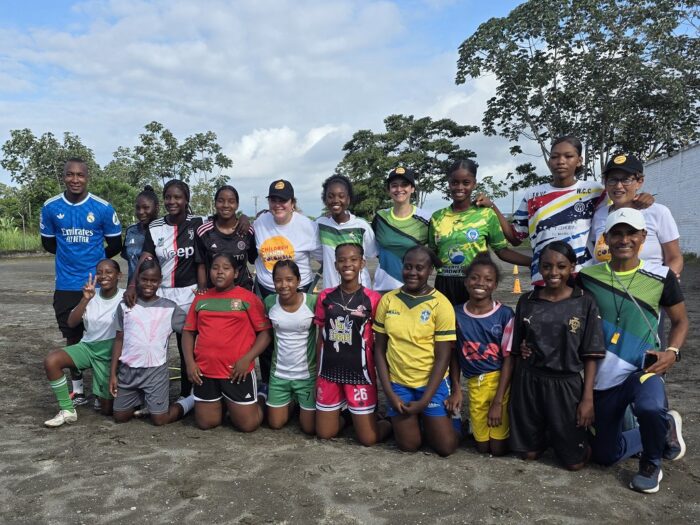
The project reached 402 children across 18 communities, more than double its original target. Two football fields were rehabilitated, benefiting 96 families.
The numbers tell part of the story. What matters more is what happens behind them.
For a child growing up somewhere armed groups are a visible presence, having anywhere safe to play is not a small thing. A football field can become a place where children spend time with peers rather than being exposed to pressure from armed groups: where cooperation is rewarded instead of violence; and where young people are encouraged to see themselves as participants in their own communities, rather than recruits in someone else’s conflict.
But the work did not stop there.
Over the past three years, the approach has evolved and expanded, moving through Valle del Cauca and Tumaco on Colombia’s Pacific coast. Today, CCC is building on those lessons in new communities in Magdalena and Córdoba through Cancha por la Paz, broadening the focus from football to sport more generally.
The locations and activities may change, but the principle remains the same: sport can create safe spaces, strengthen relationships and give children and young people the skills and confidence to navigate difficult circumstances.
Principles in practice
At the centre of this approach is a methodology known as Sports with Principles (Deporte con Principios, or DcP). Developed to move sport beyond competition, it uses football and other physical activities to teach five principles: trust, respect and tolerance, empathy, fair play and justice, and discipline.
These principles sound simple. Teaching them is anything but.
During training in the San Juan River basin, CCC Programs Director Liliana Rodríguez joined teachers and community leaders to learn how the methodology can be built into activities for children and young people. Supported by GIZ’s Sport for Development programme, the training focused on giving local leaders tools they could continue using long after the sessions ended.
The workshops show how sport becomes a form of education. On the pitch, activities such as ultimate frisbee gave a practical way into fair play and justice. The point was never only who scored, but how players communicated, resolved disagreements, made decisions and treated one another.
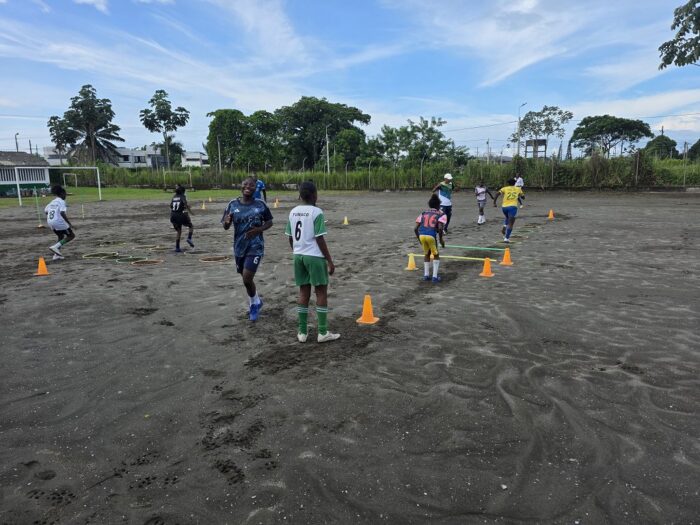
Teamwork, leadership, communication, emotional management and conflict resolution all develop through participation. The methodology asks children to reflect on their actions and understand how those choices affect those around them.
‘Football is not just a game with a ball. It teaches you to make friends and gives you lessons that stay with you for life,’ one 11-year-old girl said.
This is what separates Football for Peace from simply handing children a ball. The aim is not only to prevent recruitment, but to strengthen the social and emotional ground young people stand on, so they can navigate difficult circumstances with more confidence and agency.
By training teachers and community leaders too, the project also aims to ensure these principles stay embedded in communities long after individual football sessions have ended.
Empowering girls in Tumaco
The challenges facing young people in Colombia’s Pacific region are not shared equally. For girls, the barriers compound: gender inequality, violence, and cultural expectations that keep them out of spaces still treated as male territory. These challenges are particularly acute in Tumaco, on Colombia’s Pacific coast.
Deeply affected by armed conflict, poverty and exclusion, Tumaco is home to communities facing displacement and limited access to education, alongside the continued presence of armed groups. For girls and young women, these risks carry an additional weight: gender-based violence and gender stereotypes.
For many of them, the football pitch has traditionally belonged to boys and men.
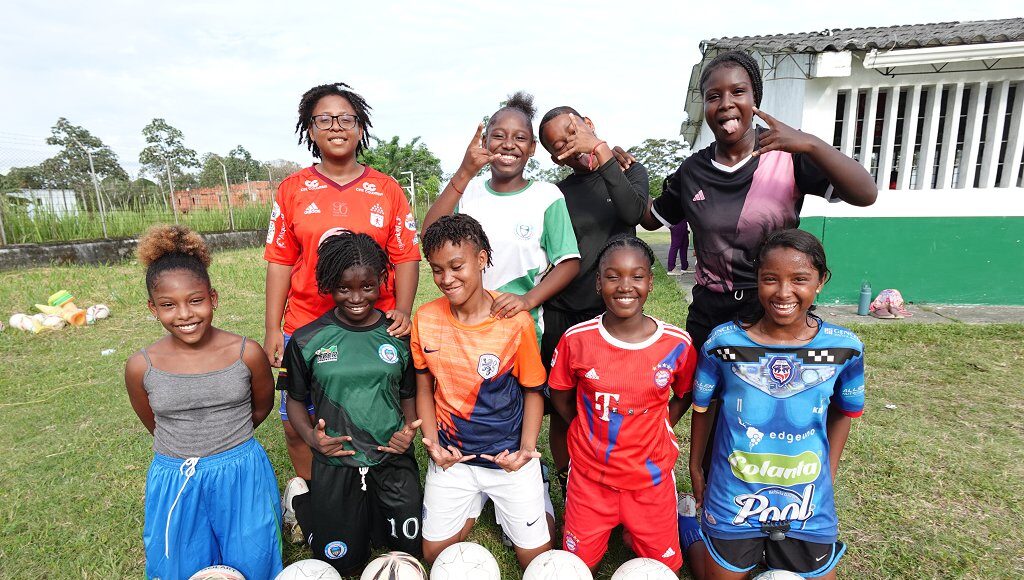
The Tumaco branch of Football for Peace project is trying to change that. In partnership with Fundación Fútbol Pazífico, CCC gives girls and young women access to professional football training alongside psychosocial and social education.
Three weekly sessions build coordination, endurance, strength, teamwork, and technical and tactical skills. Participants are equipped with boots and kit and supported to compete in local tournaments.
But, once again, football is only half of it.
Alongside training, participants take part in workshops on gender stereotypes, inequality, and the history of Afro-Colombian women. They receive education on sexual and reproductive health, while sessions on emotional wellbeing and self-esteem create space to say things that might otherwise stay unspoken. Art, storytelling, participatory mapping, and cinema forums give the girls other languages to describe the world they’re growing up in.
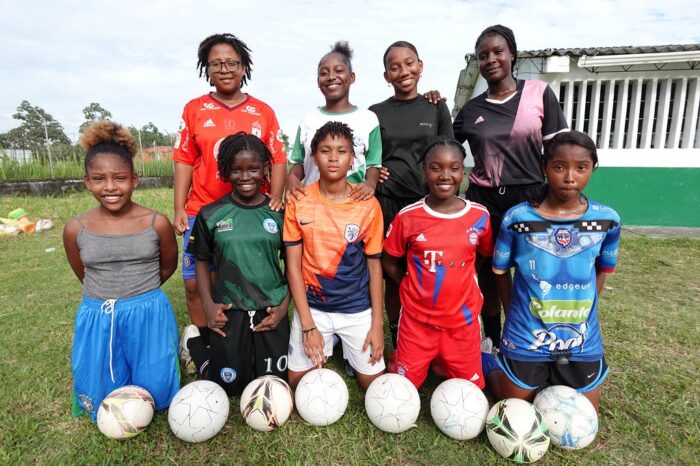
The goal was never simply better players. It is more room: physical, social and public for girls to occupy.
‘It has taught us to occupy spaces we once thought were not meant for us, and to understand that our voices matter,’ one 11 year old girl said.
There is something quietly radical in this. In a community where girls can face pressure to stay within traditional roles, taking ownership of a football pitch becomes a small, deliberate rejection of the idea that certain spaces or certain ambitions belong only to boys.
After the final whistle
The World Cup offers football at its most spectacular: packed stadiums, extraordinary goals, players celebrated by millions. For a few weeks, the game becomes a shared global language.
But football’s power was never confined to the world’s biggest stadiums, and it does not end when the tournament does.
In San Juan, it can mean a child having somewhere safe to spend an afternoon. In Tumaco, it can mean a girl discovering she belongs on the pitch as much as anyone else. For teachers and community leaders, it can mean learning new ways to support children living with violence, exclusion and inequality.
Football cannot dismantle armed groups. It cannot solve poverty or stand in for the public services many of these communities still desperately need. It cannot erase the trauma of conflict or gender-based violence.
What it can do is create moments in which a different future becomes imaginable.
The world’s greatest football tournament ends with one team lifting a trophy. For children growing up in Colombia’s Pacific communities, the victories that matter most are usually much smaller.
These victories rarely make the headlines.
They matter all the same.