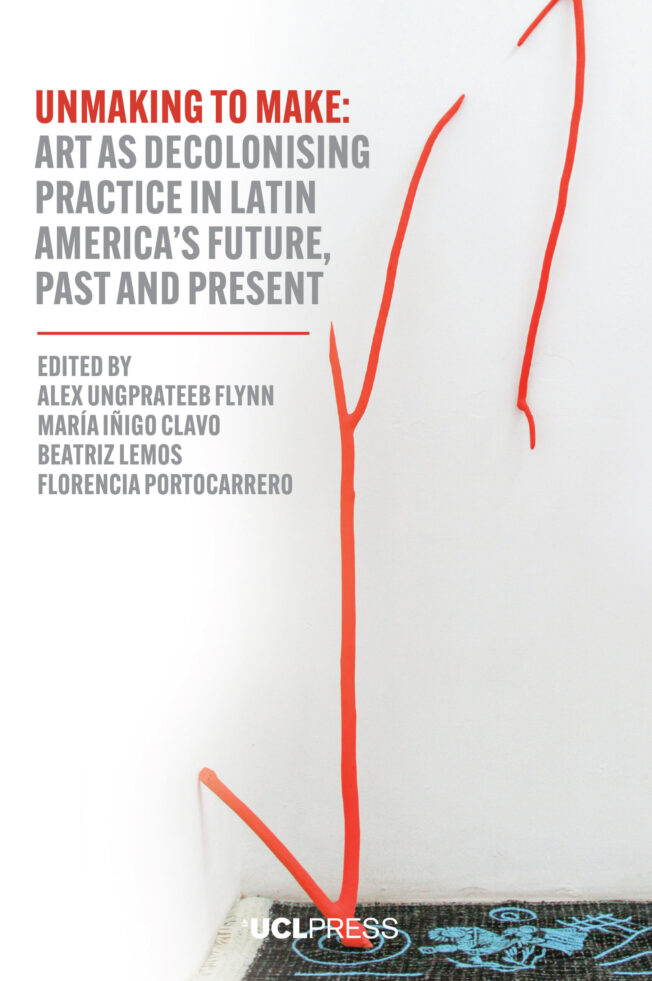
The editors hope that the collection of essays Unmaking to Make will be ‘a starting point and place of encounter’ for artistic responses to colonial legacy. Reviewer Harriet Gilbert Savage says, ‘I hope that it elicits responses of agreement and resistance that are both practical and creative. I hope that they are unique and diverse and abundant.’
A dozen Timucua people, Indigenous American people of what is now known as Florida, kneel in two rows, some leaning forward in curiosity, others back in apprehension. They look at a smaller group of European men clad in high, metal helmets, their faces obscured. These men carry tall spears and sharp daggers. In front of them stands a tall Timucua leader, his tattooed body draped with bone beads.
In the original work, the Timucua man’s arm rested on the shoulders of a European captain. Yet in The Celebration of the Lizard (2022), a digital intervention by Denilson Baniwa, Indigenous artist of the Baniwa nation, the captain is blanked out, overlaid with a skeleton stencilled in red. And the Timucua leader wears claws, bright yellow and green, on his hands and feet. And behind them, dominating the centre of the work, is a white line drawing of a bouncy colon and coiled intestines.
This is one of the diverse array of artworks discussed in Unmaking to make: art as decolonising practice in Latin America’s future, past and present, a 2026 collection of essays centring Afro-diasphoric and Indigenous perspectives on decolonizing art from across Latin America. In his discussion of the work, anthropologist Alex Ungprateeb Flynn reads this digestive tract as reference to antropofagia – a Brazilian modern art movement that argues the country’s tradition of cannibalising external influences is a powerful way of asserting independence over European colonial culture.
We are familiar with the contact between Indigenous American and European peoples, and the transformation that it caused. But what if this transformation were itself transformed by the process of antropofagia? How might the future that followed this contact look? ‘Simply put,’ Ungprateeb Flynn states, ‘a future that doesn’t lead to genocide’.
In this chapter, Ungprateeb Flynn captures the alternative temporality that this collection seeks to illustrate. Contemporary Indigenous artists are not simply reimagining the past but imagining multiple pasts, inflected by present trends and issues. These conceptualizations include futures that coexist with the past and present, alongside ones that are liberated from the sequentiality of European time linearity. This suggestion runs throughout the book, as reflected in the title’s non-chronological listing of future, past and present.
Unmaking to make: art as decolonising practice in Latin America’s future, past and present acknowledges the expansion of academic research into anticolonial/decolonial/postcolonial practice in recent years, from Paul Preciado’s 2014 symposium entitled ‘Decolonising the Museum’, Dan Hicks’ Brutish Museums (2020), as well as the explosion in public activism at the beginning of this decade across Europe and North America.
Following such a volume of voices, the editors Alex Ungprateeb Flynn, María Iñigo Clavo, Beatriz Lemos and Florencia Portocarrero are wary of the ‘easy adoption of decolonizing discourse by educational advocacy and scholarship’ in place of meaningful change, as warned by Eve Tuck and K. Wayne Yang in their seminal essay ‘Decolonisation is not a metaphor’. Yet the essays presented here demonstrate the importance of contributing to this decolonizing discourse by centring Afro-diasphoric and Indigenous perspectives from Latin America, owing to the region’s long history of independent decolonial theorisation and practice.
Indeed, the intention of this collection is not to challenge or champion varying decolonial theories that came before it, but to bring these voices together and encourage additional contributions, too. Essays, curatorial reflections and conversations with social anthropologists, historians, artists and activists studying, living, and working in Latin America are collated into four sections: counter-genealogies; museums and cultural institutions; the decolonisation and language; and plural temporalities.
Unmaking to make’s proximity to contemporary practice is its greatest strength. In ‘Welcome to the future’: spatio-temporal reconfiguration on stage and the (im)possible prefiguration of the anticolonial’, historian Claudio Alvarado Lincopi, social anthropologist Olivia Casagrande and Mapuche actor, director and playwright, Roberto Cayuqueo Martínez discuss their collaboration on Santiago Waria – a site-specific theatrical performance staged in the Chilean capital between December 2018 and January 2019.
Written in collaboration with 15 young Mapuche artists, the work leverages the city’s geography, landmarks and transport to enact ‘temporal short-circuits’ to consider how time-travelling may open up space to reimagine the past and realise an anticolonial future. This might sound like an ambitious undertaking, but through maps and images, extracts of dialogue from the performance and simple terminology, the trio explores their ambitions and reflections on the piece in an accessible way.
This chapter, along with the conversation between Maria Berrios and Pablo Lafuente on the evolving role of cultural institutions in ‘Museums under construction’, and Elvira Espejo Ayca and Florencia Portocarrero’s exploration of indigenizing museums in Peru act almost as practical guides, equipping readers with understanding of decolonial practices in art disciplines and institutions, as well as inviting contribution, collaboration and community.
However, not all the essays are so accessible. To refer to the editor’s founding objective to ‘address, often in a poetic sense, how artists theorise and model responses to the ongoing colonial legacy’, it seems as if some contributors sacrifice the clarity of their address for the poetry of their writing. While such an approach may amplify the impact of their pieces in academic circles, the unyielding prose and abstract concepts feel overcomplicated and reaffirm the sometimes elitist tone of decolonial discourse.
A line from a chapter entitled ‘this we can do, this is not impossible’ synthesizes the paradox that decolonization taking place solely within scholarship is simply not decolonization. Referring to Maria Beatriz Nascimento’s term, Denise Ferreira da Silva says: ‘Aquilombamento is this: you do it inside the university, but you also do it outside, using these resources to create breathing spaces for those who don’t have them, to create some inroads for moving around’. Unmaking to make gathers such glimmers of clarity and indeed creates some inroads for those existing outside of the university. But it needs to create more.
Ultimately, the editors express their desire for this book to be ‘a starting point and place of encounter’ for artistic responses to colonial legacy. I hope that it is. I hope that it elicits responses of agreement and resistance that are both practical and creative. I hope that they are unique and diverse and abundant.
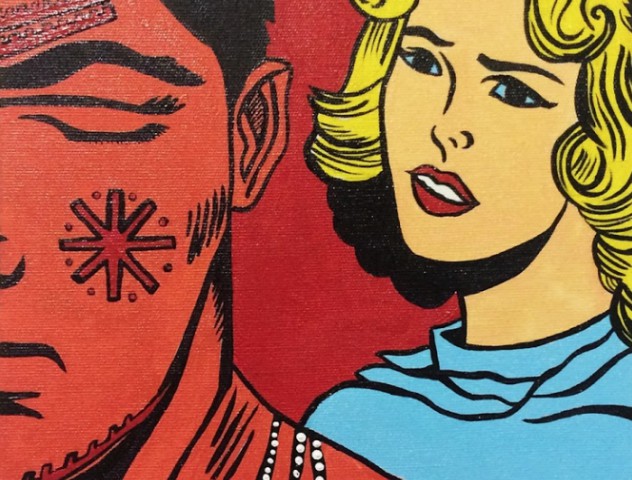
Main image: ‘Forget Me Please!’ detail from 2017 painting by Denilson Baniwa, acrylic on canvas. Photo: PipaPrize, Brazil