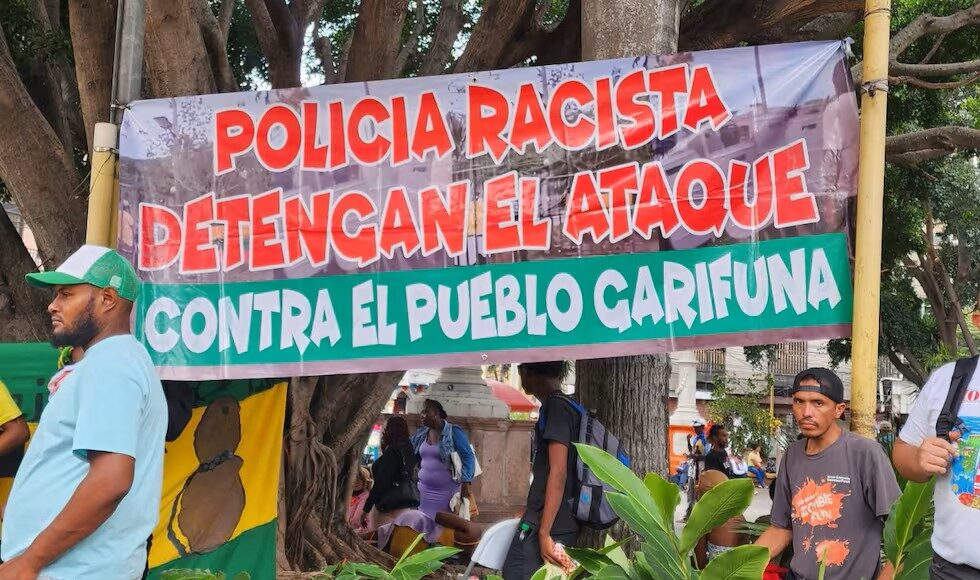
A new law of June 2026, known as the AgroIndustrial Decree, threatens Indigenous people, especially the Garifuna. Tourism, extractive industries and various forms of intensive agriculture will be given special protection, while the rights of local communities and Indigenous peoples can be ignored or set aside. Garifuna communities in San Andres and at Cayos Cochinos are already feeling the effects and are determined to defend their rights and their land. This is the second of two linked articles by Anna Ortiz on indigenous communities in Honduras defending their rights. You can read the first article here.
On 4 June 2026, The Honduran Congress approved Decree No. 107-2026, known as the Ley para el Fortalecimiento y Protección del Sector Agroindustrial, Proyectos de Energía, Turismo, Ganadería y Pequeños Productores Agrícolas de Honduras (Law for the Strengthening and Protection of the Agroindustrial Sector, Energy Projects, Tourism, Livestock, and Small Agricultural Producers of Honduras) or ‘the Agroindustial Decree’, which according to La Gaceta, took effect on 26 June.
The Agroindustrial Decree is the initiative of Honduras’s governing Partido Nacional (National Party, PN), whose president, Nasry Asfura, won office in November 2025, with the backing of U.S. President Donald Trump. Asfura campaigned on a pro-business platform emphasizing private investment.
The decree’s prioritization of designated economic activities raises questions about whether the new government will balance investment protections with the territorial rights of Indigenous and tribal communities. This controversial decree aims to prioritize and protect ‘agroindustry activity, energy and tourism projects, livestock, and agricultural activity [as a matter of] public order, national interest, and national priority’, with energy projects and tourist initiatives ‘declared immediately and mandatorily protected’, while also directing the public prosecutor’s office and national police to ‘act on reports of occupations, usurpations and blockades’ of the lands or territories in question (Articles 1, 2, and 6).
The dispute over San Juan
Though Article 1 of the decree does contain a safeguard for recognized Indigenous and tribal territories which are protected under Honduras’ constitution and ILO Convention 169, it remains unclear how this law applies to Indigenous lands and territories which are currently disputed.
San Juan, Tela, in the department of Atlandita, is one such historically disputed area. For centuries having been the home to Honduras’ Black and Indigenous Garifuna community, who call much of the northeastern Honduran coastline home, San Juan holds a place of ancestral significance to their community. The San Juan land has been disputed by the Garifuna and state of Honduras for decades, long before the passing of the Agroindustrial decree.
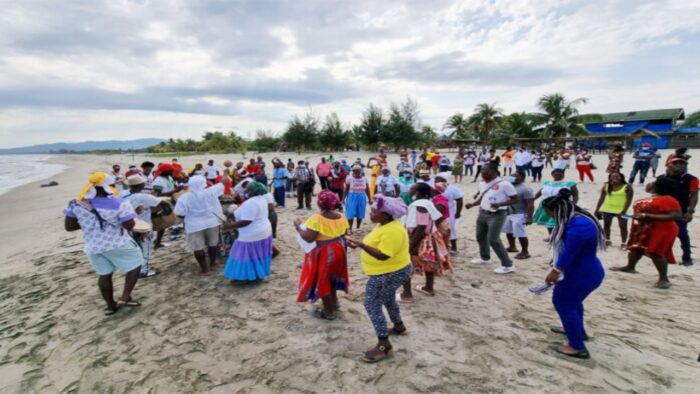
However, on 29 August 2023, The Inter-American Court of Human Rights issued a judgement in favour of the Garifuna community, finding Honduras internationally responsible for violating the their collective property and other rights, and for failure to investigate threats of violence against community members and ancestral territories.
Despite this judgement, on 6 July 2026, ten days after the Agroindustrial Decree took effect, the Centro de Estudio para la Democracia CESPAD (Center for the Study of Democracy) reported approximately two hundred police officers were deployed to carry out the eviction of San Juan. This led to the arrest of five land defenders, with the Honduran Ministry of Security stating that the land was ‘private property belonging to Promotions and Tourism’, ignoring the Garifuna people, community land defenders, and human rights organizations for whom San Juan is an ancestral Garifuna territory.
Protest camp set up
In response to these arrests, OFRANEH, La Organización Fraternal Negra Hondureña (The Black Fraternal Organization of Honduras) set up a camp, the Campamento Viva Berta Cáceres, outside the Honduran Supreme Court on 10 August. The camp was named after Berta Caceres, a Lenca Indigenous rights activist who was assassinated in 2016, and who was a close friend of OFRANEH president, Miriam Miranda.
On 15 August, Criterio.hn reported that the camp would continue indefinitely as Garifuna leaders demanded compliance with previous Inter-American Court judgments and the closure of criminal proceedings against the five San Juan land defenders. OFRANEH called for the repeal of the Agroindustrial Decree, calling for national and international communities to join the mobilization, and stand in solidarity with them. As of 16 October, Honduran news outlet, El Libertador reported that the camp has remained active for over two months.
Conflict In Cayos Cochinos
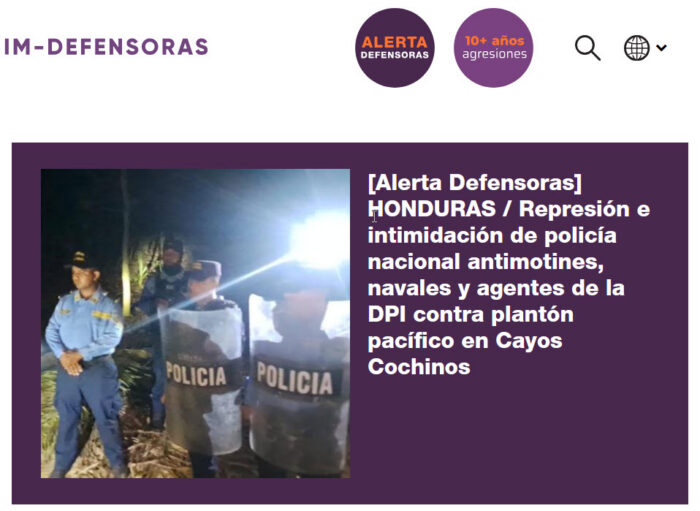
Approximately 70 miles from San Juan, Tela, lies the Cayos Cochinos archipelago, territory also held and inhabited by the Garifuna since the 1700s. Known for its picturesque beaches, and turquoise waters, the archipelago has long been the site of the Spanish reality TV show Survivor, its presence contested for many years by the Garifuna.
On 14 September, Honduran feminist defense group, IM-Defensoras described Garifuna community members protesting the filming of the most recent season of Survivor on ancestral territory, without their consent. By 17 September, OFRANEH issued a public statement warning of a threatened eviction in Cayos Cochinos, and demanding recognition of the Garifuna’s territorial rights. OFRANEH also posted videos the same day showing military police arriving at Cayos Cochinos on boats with riot shields and batons, and apparently trying to evict the Garifuna residents that inhabit the islands.
In an interview on 8 October, Garifuna member Ale Miranda described the conflict as part of a broader pattern in which tourism development goes ahead without the participation or consent of the local people. ‘Certain groups have an interest in these lands. They call it “tourism development” without involving those of us who live in these territories,’ she said.
The confrontation followed a 20 November 2025 judgment by the Inter-American Court of Human Rights in favor of the Garifuna community of Cayos Cochinos, which was notified to the Honduran government on 4 March 2026. The Court found Honduras internationally responsible for violations of the community’s rights to collective property, participation, access to information, and cultural identity, among other matters. Ale Miranda stated that ‘In Cayos Cochinos, the Inter-American Court ruled in favor of the community, which the government still does not recognize. So there is a ruling in favor of the community. Yet there are other legal actions [derived from the Agroindustrial decree] being pursued, doing everything possible to prevent recognition of the ruling in favor of the community.’
By 23 September, Criterio.hn reported that Honduran authorities had instructed police and prosecutors to prioritize ‘property-usurpation’ cases under the Agroindustrial Decree, and authorize evictions in both San Juan and Cayos Cochinos.
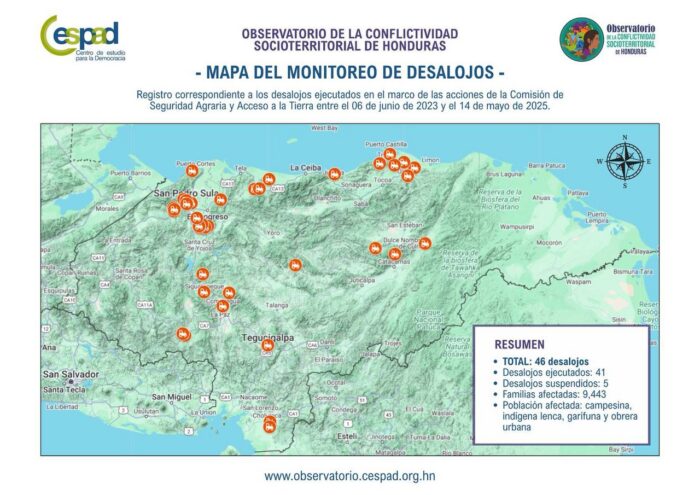
Was Decree 107-2026 used in the Cayos Cochinos eviction proceedings, where Garifuna community members were protesting the filming of Survivor on their ancestral territory without their consent? If so, its application would raise questions about how the decree’s protections for tourism-related activities are being reconciled with Garifuna territorial rights and the state’s obligation to ensure prior, free, and informed consultation. As Miranda puts it, ‘We are part of that nation. The Honduran state includes Indigenous peoples and a commitment to our peoples.’
Main image: Garifuna protest against arrests. Photo: Pueblos y Barrios
Anna Ortiz is a PhD Student and Instructor in Literary and Cultural Studies, Postcolonial and Ecofeminist Studies at the University of Arizona