In the second of three articles, Eva Newton explains how impunity is still operating for those responsible for the illegal kidnap, torture and disappearance of political opponents of Uruguay’s military regime in the 1970s. You can see the other two articles here.
This article was published previously as a single article in NACLA.
In May 2026, I took a ferry from Buenos Aires to Montevideo. Standing on the sunny deck, I sent Stella a photo of the view. Stella escaped Uruguay’s dictatorship and subsequently campaigned for those disappeared by it, as described in the first article of this series. In Montevideo, I would now be visiting the headquarters of the organization that Stella sometimes collaborated with, Familiares (Mothers and Families of the Detained-Disappeared).
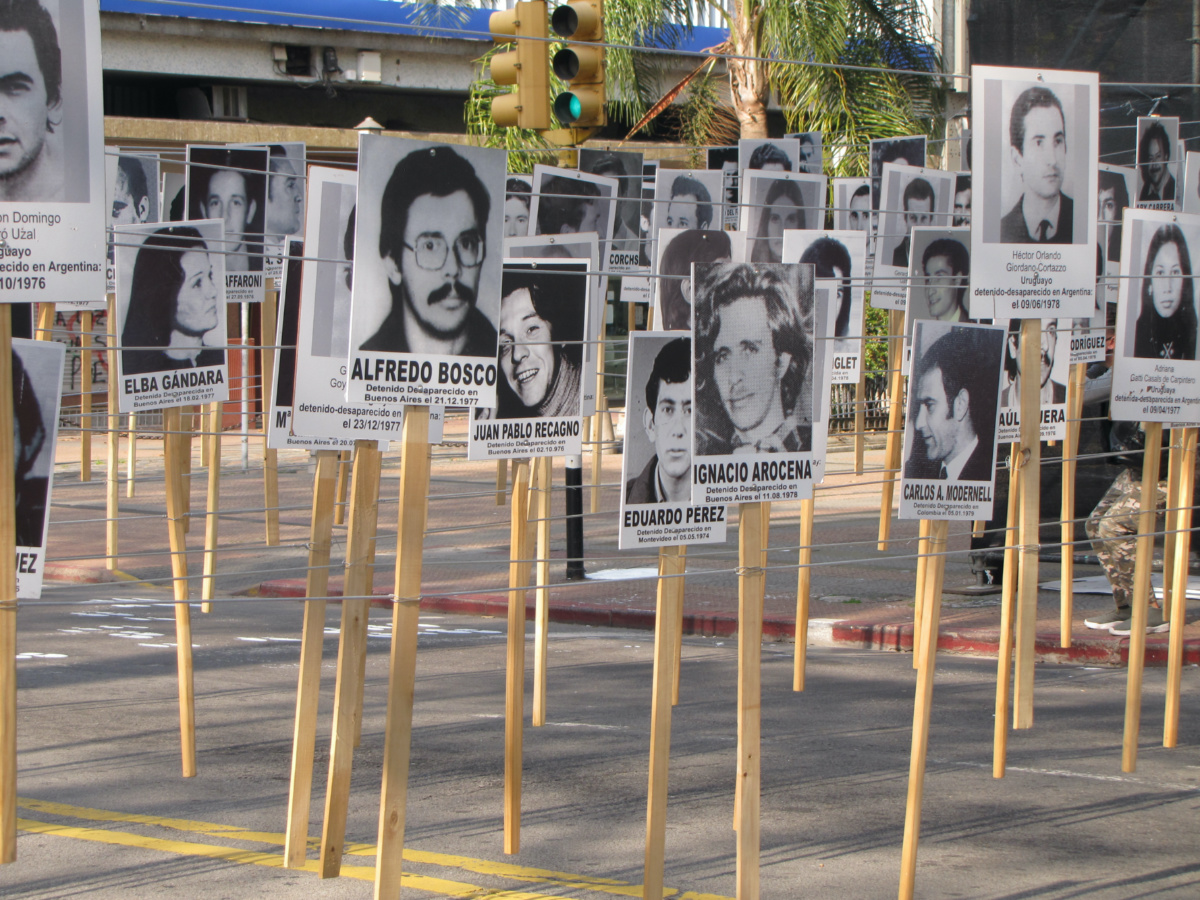
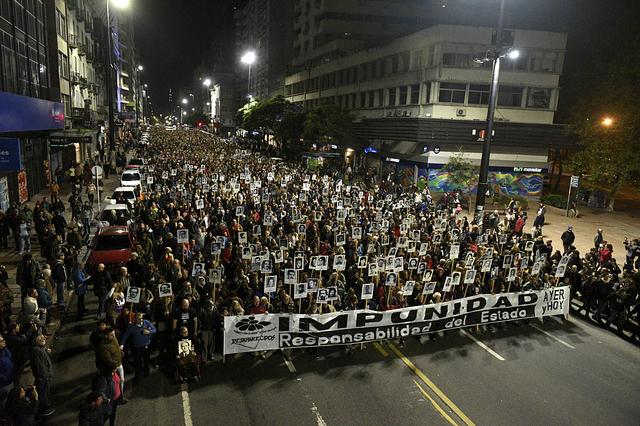
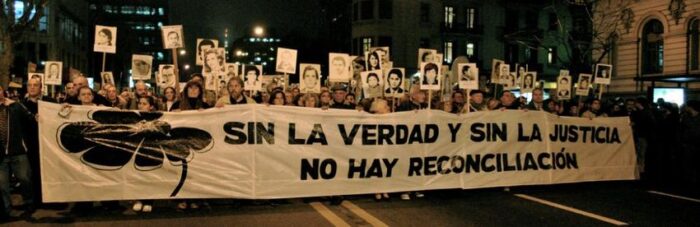
At their office, merchandise and papers were piled high. It was only two weeks until the annual Marcha del Silencio organized by Familiares, demanding justice for the dictatorship’s desaparecidos. This year was both 30th anniversary of the march, and the 50th anniversary of the five abductions the march specifically honours.
In 2025, Graciela Montes de Oca from Familiares had described the Uruguayan military’s ‘pact of silence’ regarding dictatorship crimes as the main obstacle in the search for the desaparecidos. At their headquarters, Graciela and Patricia López Melo, another representative of Familiares, explained to me that this is because when the military are summoned by criminal or civil courts to give information, ‘they always say they know nothing. However, we know that among themselves, they do hide the information’. When it is requested by military courts, however, they provide it.
One example of this evasion is the limited effect of the 2019 Law 19.822 which granted the INDDHH, the Institución Nacional de Derechos Humanos y Defensoría del Pueblo, access to military records. The law did not specify how the military should comply. So INDDHH were not allowed to search the archives themselves, nor given an inventory. Further, if they didn’t know the file title under which requested information was stored, they might not receive it.
As of December 2025, following an order from Sandra Lazo, the Minister of Defence, the INDDHH are now able search through the archives themselves. In the five months after that, eight new desaparecidos were added to the official list. The military’s vast records are clearly designed to conceal illicit actions, although ‘within that framework, they are registered.’ The December order still does not require the military to provide an inventory of the files. Consequently, Mariana Mota, head of the INDDHH, comments that it’s as if the military simply ‘open a door and you find a massive archive stretching for kilometres’. Through either genuine or deliberate incompetence, the military are not going beyond what is legally required of them to assist Mota and her colleagues.
As of 22 June 2026, the University of the Republic (UDELAR) has been formally joined to the INDDHH investigation. This will allow the INDDHH to harness UDELAR’s technology to synthesize the disparate data of the military archives.
Yet Familiares still demand that Uruguay’s President order the military to share all the information they possess about desaparecidos. They emphasize this is ‘very different’ from mere access to archives. Supporting this, Mota commented in January 2026 that she hopes that following Lazo’s December order ‘those archives will remain where they are, that they have not been modified since this access was reported’. In 2019, it was found that there was ‘permanent harassment’ in areas where the search for the desaparecidos is conducted – including the placing of one explosive device. In 2024, one relative of a desaparecido found a message on his car: ‘I know where they are, and you could end up the same’. Many believe military members are responsible for these threats. Providing all information about the dictatorship, given this past tampering with evidence, would symbolize the military acquiescing to government authority.
Familiares assert that the state needs to put more pressure on the military if this is ever to happen. However, progress in the search for the desaparecidos search could compel the state to address irts own role in the dictatorship, and in the subsequent obstruction of justice. Patricia emphasises that state policies have been designed to appease groups such as Familiares whilst enabling the state to evade full recognition for their crimes.
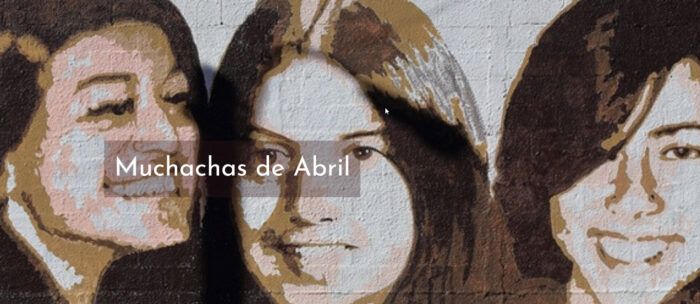
In 2021, the IACtHR ordered the Uruguayan government to carry out a ‘ceremony of recognition’ of their role in the ‘April Girls’ 1974 case, concerning three women murdered by the military. Yet the president did not attend, and the ceremony was not broadcast. Although Familiares screened the event in the square outside, ‘a reparatory act has to be known by the entire population for it to be reparatory’ – half measures do not suffice.

In some cases, the state plays a more active role in sustaining systemic impunity in Uruguay. Before Mota became head of the INDDHH, she was a judge for Uruguay’s Supreme Court of Justice (SCJ). But in 2013, she was removed, without explanation, from her criminal jurisdiction, and made judge of a civil tribunal. Al Jazeera noted that this occurred ‘only months after the Expiry Law was finally overturned’. Before her removal, Mota had been investigating 55 cases of abuse by the dictatorship; without the Expiration Law to block military prosecution, she could have sentenced multiple members of the military.
The culture of impunity in Uruguay prevents Familiares building ‘historical memory – necessary so that state terrorism never happens again in this country’. Graciela and Patricia allege that the military resist this memory because they ‘continue to be trained […] under the Doctrine of National Security’ which instils the belief that military authority stands above civilian authority. Yet this doctrine was repudiated when the dictatorship was abolished.
It is not immediately apparent that the National Security Doctrine remains incorporated into Uruguayan military education. Both courses at Uruguay’s main military academy include modules on ‘International Human Rights and Human Rights’, but Patricia observes that the ‘totally top-down discipline’ of military education ‘doesn’t allow for a closer look’. However, it is ‘what’s taught outside the books’ that concerns Familiares the most. Familiares believe that because of National Doctrine propaganda, it is difficult to initiate dialogue with officers about the desaparecidos.
Some of retired military have built their own historical memory of the dictatorship in line with the National Security Doctrine. In 2019, the far-right political party, Cabildo Abierto (CA), was founded by Manini Ríos, ex-Commander-in-Chief of the Uruguayan Army. He was dismissed for accusing the courts of misusing law to sentence military officials for dictatorship crimes. Since both Tupamaros and the military were granted amnesty post-dictatorship, some argue a double standard exists as there have been no state investigations into Tupamaros crimes. Yet some 4,500 people accused of being members of the Tupamaros and others of their supporters were imprisoned during the dictatorship. CA extends this argument to deny that institutionalized state repression took place at all; several prominent members of CA worked for the military authorities during this period. CA also demanded that active military members be allowed to hold public office, which suggests that at least some of the active military share their beliefs.
When I left Familares’ office, Patricia gave me one of the March of Silence themed calendars from a stack on the table. The pages were adorned with illustrations of daisies, each missing one petal, representing the desaparecidos’ glaring absence from their families.
This absence does not erase them from the narrative. Stella sent me a photo of herself, Patricia and Graciela with her arpillera. Thousands attended the march, which Patricia considers Familiares’ key annual opportunity to build historical memory.
Since then, however, several state manoeurvres by the government have taken the campaign by surprise. This is covered in the next article in this series.
Main image: Marcha del Silencio, Montevideo 2017
Eva Newton is an aspiring investigative journalist interested in movements challenging capitalist and neo-colonial exploitation, particularly in Latin America. She is currently based in London, and has previously volunteered with the United Voices of the World Union, the Socialist Party and the Latin American Bureau.
This article was published previously as a single article in NACLA.