In the last of three articles, Eva Newton explains how impunity is still operating for those responsible for the illegal kidnap, torture and disappearance of political opponents of Uruguay’s military regime in the 1970s. You can see the other two articles here.
This article was published previously as part of a single article in NACLA.
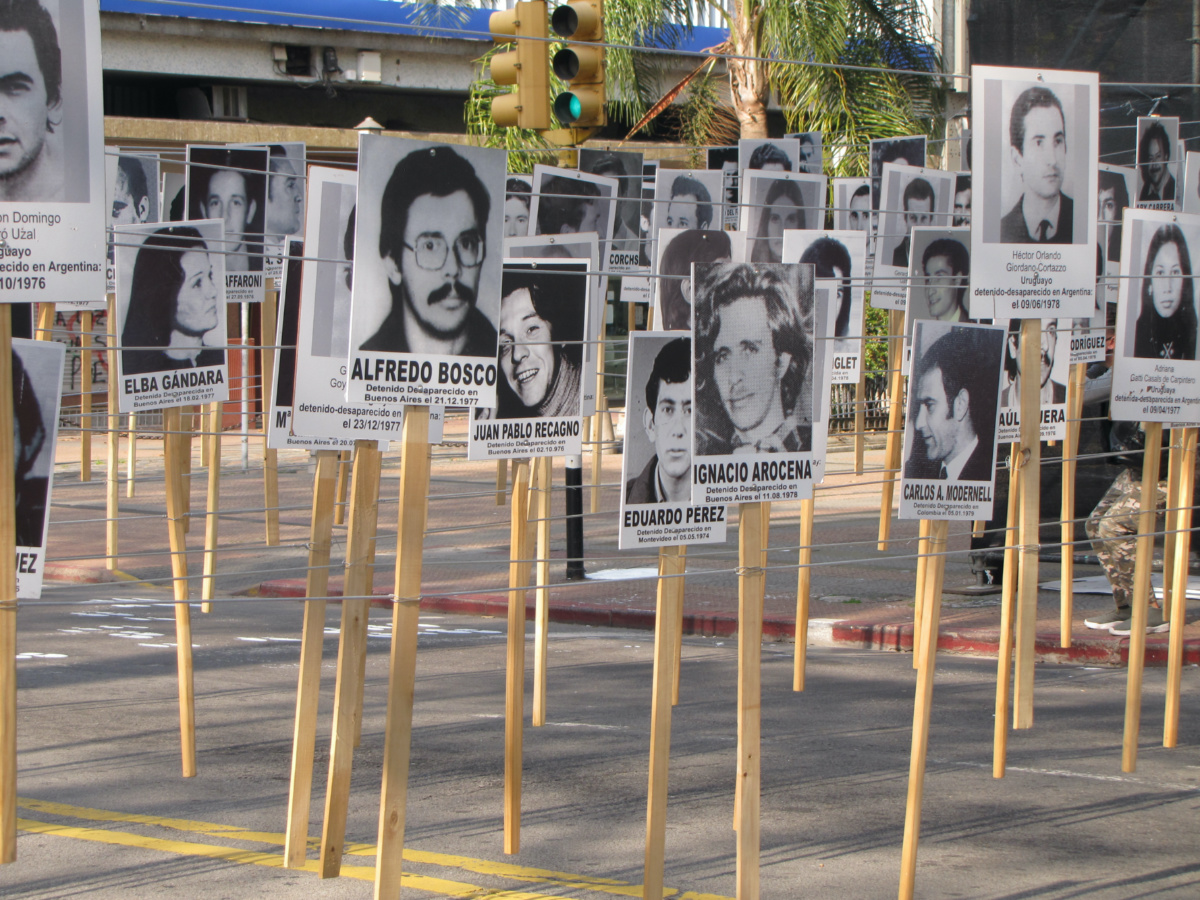
As the Uruguayan public gain more historical memory of the state’s crimes against humanity through the investigations of the INDDHH (Institución Nacional de Derechos Humanos y Defensoría del Pueblo), advocates for the desaparecidos, the disappeared, hope that widespread demand for prosecution will grow, too.
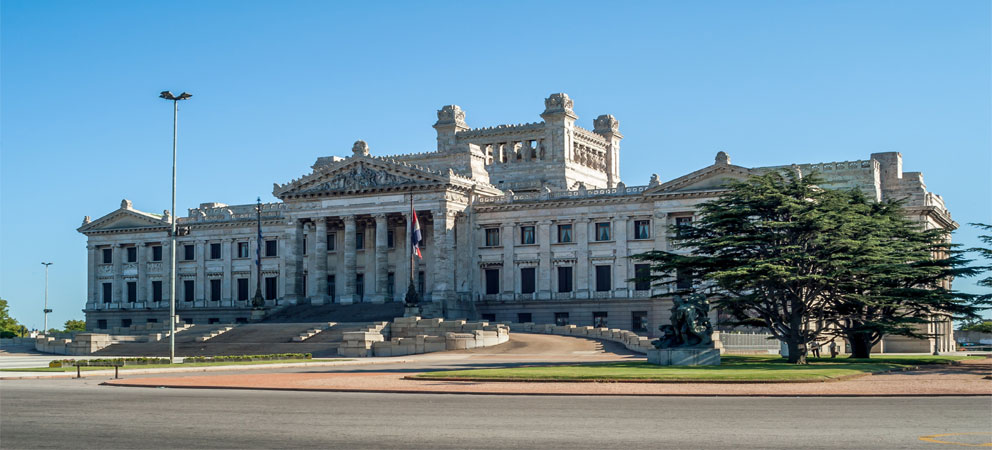
Given Uruguay’s long history of impunity, those demands can feel unattainable, the gulf between the demands and the means to address them too wide. Montevideo’s Palacio Legislativo conveys this perfectly: located in the middle of a ring road that effectively serves as a moat for pedestrians, you must navigate a maze of crossings just to reach the square. In this formidable palace, on the 7 July 2026, a new bill was presented to the Senate which could be a significant tool in uncovering historical memory; equally, however, it is feared that it could derail plans for the prosecution of military perpetrators.
Truth Trials
This bill was proposed by the government’s ruling broad-left coalition party, Frente Amplio. It aims to establish judicial ‘truth trials’ to ‘clarify human rights violations’, including those committed by state agents during the dictatorship. Senator Eduardo Brenta, the bill’s promoter, explained that since truth trials would not constitute prosecution, they could take place in cases where regular trials are not possible – for example, when the accused has fled the country, or is deceased.
According to the head of the Special Prosecutor’s Office for Crimes Against Humanity, Ricardo Perciballe, state actors ‘most responsible [for the dictatorship] have passed away unprosecuted’. As Brenta argues, uncovering their crimes would help to preserve ‘collective memory’ and provide ‘state recognition of the harm suffered’.
Perciballe also pointed out that the wording of the truth trials bill places the burden of proof on the accused party, and does not require a state investigation, for instance via a prosecutor or a judge.
Further, although the evidence truth trials uncover could be used in regular criminal trials, some fear that focusing on truth trials might delay regular trials which could prosecute military members who are still living – perhaps leading to more military passing away without facing justice.
Nevertheless, Perciballe has indicated that the scope of the truth trials is ‘slim’, suggesting they will not divert many resources away from prosecution of the military. Familiares, the Mothers and Families of the Detained-Disappeared, are not opposed to the truth trials, though ‘when the government’s political will is focused on ending enforced disappearances, this would not be the most appropriate time’: they do not want any distractions from that political commitment.
Diluting responsibilities
Familiares are more worried by the Frente Amplio’s 9 July announcement that Uruguay’s Secretariat of the Human Rights of the Recent Past (SHRRP), tasked with investigating dictatorship crimes since 2003, is being subsumed into the Secretariat of Human Rights to ‘strengthen internal coordination’. The government declared that this ‘does not imply any changes to responsibilities’ – they apparently believe that since delegating the search for the desaparecidos to the INDDHH in 2019, the SHRRP has had a reduced, supporting role.
However, Familiares and Crysol (Association of Former Political Prisoners of Uruguay) declared that ‘we do not believe these decisions are accidental, neutral’, especially since the desaparecidos, their families, and associated organizations were not consulted beforehand. They ‘will not tolerate a thematic purge that fragments, reduces or dilutes’ the responsibilities that have been assumed by the state. Familiares met with the Secretariat of Human Rights and the Deputy Secretary of the Presidency on 5 August to discuss their concern ‘about the political signal sent by this reorganization’. Subsequently, the authorities asked for some more time to reorganize.
Frente Amplio have historically declared their alignment with Familiares’ campaigns, and on 7 July they also proposed a law suspending pensions for military fugitives from justice. However, impunity has reared its head during this government before, for instance when through former Supreme Court justice Mariana Mota’s transfer from a criminal judge position, covered in the second article in this series. Also, in the proposed March 2026 reform of Uruguay’s criminal code, which would have enabled individuals convicted of human rights violations to petition for early release. Could the restructuring be yet another tool of absolution?

In May, Patricia from Familiares argued that the state is still not fully complying with the rulings of the IACtHR, the Inter-American Court of Human Rights, that Uruguay must search for the desaparecidos and prosecute the perpetrators, and yet Uruguay is not facing any institutional repercussions internationally for this. Patricia adds that international law has failed other countries besides Uruguay: ‘we’re seeing now in the war [between the US, Israel and Iran] the [limited] power the United Nations has … ’. Militaries around the world continue to violate human rights with only lukewarm pushback from international establishments. For this reason, Stella, who I interviewed for this article series, campaigns for Palestine alongside Uruguay.
I bumped into her at a London march for Palestine last winter, where she was marching with a banner for the group ‘Latin Americans Stand with Palestine’. Precisely because human rights violations persist around the world, it is key that the Uruguayan junta eventually face justice. Patricia emphasizes that strength lies in the people to bring this about: ‘the greatest force that can be exerted in the case of Uruguay toward the government, the greatest pressure the government feels, is the people taking to the streets to demonstrate every 20 May; it’s the people when they come together and say, “May is the month of remembrance”.’
This faith in the power of the public makes sense given that the military dictatorship was brought to its knees largely through relentless pushback from the general populace. Firecrackers, sit-ins, a breakaway general, synchronized beatings of pots and pans, banned flyers from National Party politicians, hunger strikes by clerics, protest votes and parades were just some of the contributions.
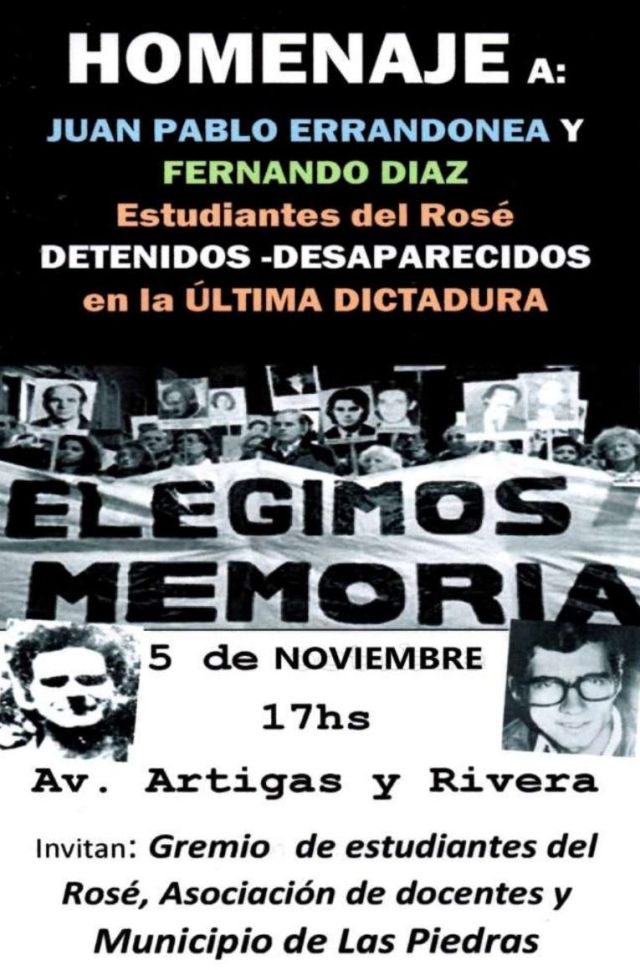
Familiares pointed out on 5 August, following their meeting about the restructuring of SHRRP, the IACtHR ordered ‘more work with the people’ to provide dictatorship reparations. This perhaps has been avoided because, as Patricia argues, Uruguay’s government feels pressure from the public more acutely than orders from international bodies. Likewise, for this reason Stella has remained resolute in her activism for those victimized by the dictatorship: ‘I have to be the force of representation’.
Stella asserts that we all have different roles in defeating the dictatorship – from her work while abroad in the UK, to ex-judge Mota leading the INDDHH, to the kiosk employee who saved Stella from walking into the army’s clutches. And of course, Patricia and Graciela, who challenge the government relentlessly. The public need to dismantle the last bulwark of the old regime – the suppression of Uruguay’s historical memory. As more time passes, it’s less likely that what happened to the desaparecidos will be uncovered in the lifetimes of their loved ones. Despite that, as a past INDDHH head put it, ‘if the perpetrators would talk, in a month we’d finish this matter’.
It’s now more important than ever that the INDDHH are able to process the military archives of the period. However, it’s also crucial to go further and expedite the Familiares’ demand that all information relating to dictatorship crimes, archival or otherwise, be requested from the military. And that the armed forces and the state are subsequently held accountable for their actions – through prosecution where at all possible. Through the collective drive to defeat impunity, people like Stella and Patricia move this needle forward.
Eva Newton is an aspiring investigative journalist interested in movements challenging capitalist and neo-colonial exploitation, particularly in Latin America. She is currently based in London, and has previously volunteered with the United Voices of the World Union, the Socialist Party and the Latin American Bureau.
This article was published previously as part of a single article in NACLA.