
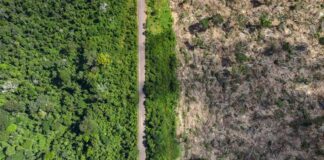
3. Growth is promised, whatever the cost
In her third blog in the Amazon on the Brink series, LAB author and editor Sue Branford looks at the sharpening political divisions which...

COP30 confirmed what we already knew: Only poor countries want to,...
‘Indigenous Peoples, poor countries – those who contributed least to the crisis are the ones who show real ability to confront it,’ writes Jelson Oliveira, professor of philosophy at Pontifícia Universidade Católica do Paraná (PUCPR) and founding-director of the Hans Jonas Professorship.

The Amazon is a rear-view mirror for the world
The Amazon is a mirror reflecting the deep contradictions in our approach: development which is a monoculture of thought, authoritarianism disguised as progress, the extractive zeal that devours everything, including the future. The mirrors brought by the Xapiri to Yanomami shamans could help us to see, to listen, and to learn. Will the leaders who are gathering for COP30 in Belém be capable of looking into these mirrors?
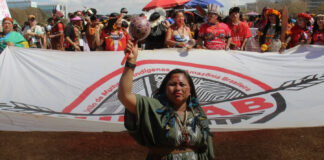
COP30: Amazon women demand to be heard
Not all the peoples of the Amazon will be represented at the COP, especially the women for whom climate change is no longer a threat, but a daily reality, and from which they are the first to suffer. Indigenous, quilombola and black women from the city periphery all confront obstacles to participate, with no guarantees that they will be heard. Agência Pública’s Cecilia Amorim has spoken to women from each of the three groups
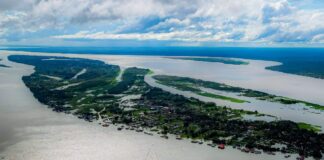
COP30: Climate summit or Amazon carnival?
The COP30 climate summit, to be held this year in Belém, the ‘capital’ city of the Brazilian Amazon, comes at a critical moment, providing an opportunity to depart from the path of climate colonialism, end fossil fuel expansion, confront agribusiness and mining, and see the Amazon as a warning, a teacher and a mirror. But it risks becoming a spectacle of exclusion, greenwashing and government ‘performance’.

Will COP 30 fiddle while the Amazon burns?
The new destructive and retrograde PL2159 Law being debated in Brazil's Congress, if it is approved before COP 30, will make a mockery of Brazil’s ambition to be a leader in environmental questions. By accelerating the destruction of the world’s largest and most biodiverse tropical forest, it will contribute to the climate crisis, not only in Brazil but on the planet.

Lula never pressured me to endorse oil exploration
As the 20th anniversary of the Amazon defender Sister Dorothy Strang, approached, LAB partner Agência Pública spoke to Brazil’s Minister of Environment and Climate Change, Marina Silva. We asked the Minister about the row sparked by Petrobras’ ambition to explore for oil at the mouth of the Amazon. The issue resurfaced this week after President Lula signalled, in private and in public, that the licence will be granted soon.

Carbon credits build a shopping ‘mall’
Indigenous people in Guyana have received some payments from a government scheme, selling carbon credits to US oil company Hess. But they were not consulted and were forced to reach a decision in haste. They feel that this was a scheme designed by the government for its own purposes, and in which they had no real say.

Panama: 300 Indigenous Guna families relocated amid rising sea levels
A community of Indigenous Guna people were relocated from their island of Gardí Sugdub in the Caribbean Sea to a new mainland settlement. They are the first island community to be recognized by the government as victims of forced displacement driven by climate change.

Indigenous community sues Colombian government
Twuliá Wayuu community sues Colombian government for climate change-induced coastal erosion causing devastating effects on their livelihood and culture in the northern La Guajira peninsula.