
This article was first published on 25 February 2026 by LAB partner Agência Pública and translated for LAB by Theodora Bradford. You can read the original, in Portuguese, here.
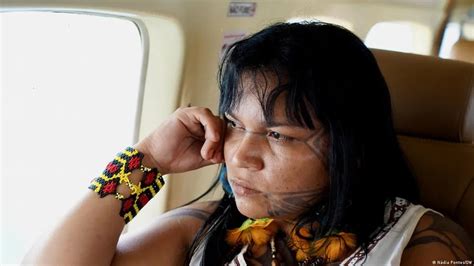
Indigenous leader Auricélia Arapiun describes the occupation of the Cargill terminal, in Pará, which forced the government to concede after 33 days, repealing the controversial decree 12.600, which provided concessions to developers hoping to turn the Tapajós, Madeira and Tocantins tributaries of the Amazon into waterways for the export of soya and the other fruits of extraction.
Gathered in a large circle, dozens of people were participating in a preparatory ritual in the late afternoon of Monday, 23 February. With enormous soya bean and maize silos in the background and the clock ticking towards the deadline given by the judiciary for them to vacate the vicinity of a Cargill port terminal, they were preparing for a possible confrontation with police forces. From the crowd, someone shouted for them to check WhatsApp. In a matter of seconds, all the tension dissipated – and transformed into a giant celebration, captured in a video clip published by Agência Pública.
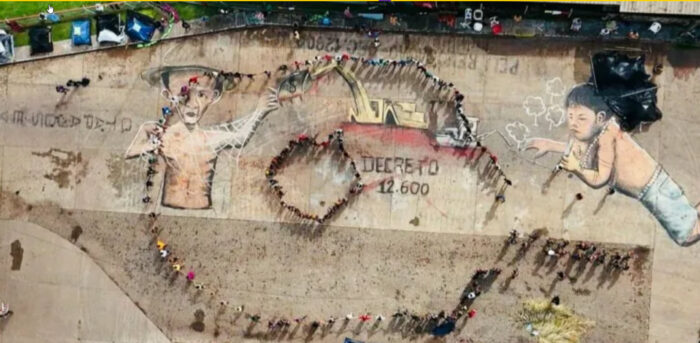
After 33 days of a mobilization by various Indigenous peoples of the Tapajós region who occupied the premises of the US agricultural multinational, obstructed roads and intercepted a grain vessel on the Tapajós River, they achieved what they wanted: the revocation by the federal government of Decree 12.600, which paved the way for the concession of waterways in three Amazonian rivers – the Tapajós, Madeira and Tocantins – to private entities.
‘It’s a lesson for all of society: only popular struggle, only our resistance and our confrontation can change reality,’ Auricélia Fonseca Arapiun, one of the main leaders of the movement of Indigenous peoples of the Lower Tapajós, told Agência Pública in an interview.
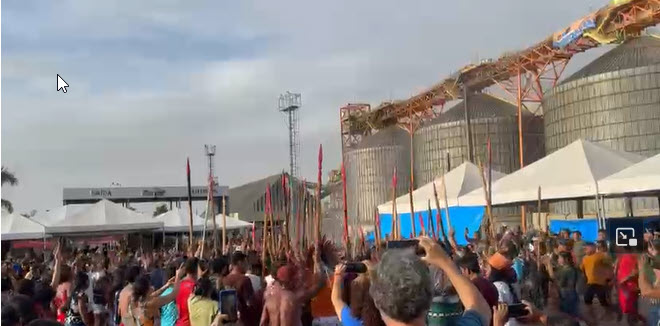
Photo: Indigenous peoples celebrate the revocation of Decree 12.600.
Auricélia was among the approximately 60 individuals of the 14 peoples of the Lower Tapajós who, on 22 January, occupied the Cargill terminal, on the banks of the Tapajós River, in Santarém (Pará). They were protesting the decree of the Lula Government and a public notice, published weeks earlier, which announced a tender to carry out maintenance dredging on the riverbed, to facilitate the navigation of large vessels.
‘It wasn’t an easy feat. There were even many relatives – the term used by Indigenous people to refer to each other – who thought it was madness to occupy the agribusiness giant,’ Auricélia told Agência Pública in the interview (read in full below).
‘Cargill itself didn’t attempt to evict us in the beginning, because they didn’t think we’d last long,’ she said.
But they did. By the tenth day, there were 700 demonstrators, working together to establish a kitchen, erect bathrooms and tents, hold discussions and spread their message.
On Friday, 20 February, tension mounted with an eviction order issued by the judiciary which gave them a deadline of 48 hours to vacate the area. The decision was made after the Association of Port Terminals and Cargo Transshipment Stations of the Amazon Basin (AMPORT) took legal action, claiming, like Cargill, that the blockade had caused them financial losses due to the paralysis of grain transport.
The morning of the following day, the protesters decided to apply more pressure and occupied an area inside Cargill’s offices. ‘Our decision was neither impulsive nor violent. It was the result of a collective process, based on the wisdom of elders, legal and political analyses and our indignation at Decree 12.600. We are here because we are defending our right to exist,’ said an open letter published by the Indigenous Council of Tapajós-Arapiuns (CITA), which represents the peoples of the Lower Tapajós. In press releases, Cargill affirmed that its operations had been suspended and that there was ‘strong evidence of vandalism’ – an accusation denied by the occupation’s organizers.
The pressure had its intended effect, and two days later, Auricélia and other leaders travelled to Brasília to meet the Minister of the General Secretariat of the Presidency, Guilherme Boulos, and Minister of Indigenous Peoples, Sonia Guajajara.
On Monday, 23 February, when Boulos announced President Lula’s decision to revoke the decree, some 1,500 people were participating in the protest, according to local leaders. As well as the peoples of the Lower Tapajós, others such as the Munduruku, Kayapó and Paraná joined the mobilization.
‘We are moved by the river, by the forest, by faith and courage. We may seem a small people, but we are giants when we confront our enemy,’ Alessandra Korap, one of the main leaders of the Munduruku people, said through tears in a video recorded shortly before the revocation was announced, published by Tapajós de Fato.
Privatization of the Tapajos is revoked. Video: BrasilDeFato, February 2026
Auricélia says the peoples of the region will not rest and feel reinvigorated to face the threats still hanging over them, such as the Ferrogrão project, a railway intended to connect Mato Grosso and Pará to transport grain production. On 23 February, a technical report published by Brazil’s Federal Court of Accounts (TCU) recommended suspending development of the railway until public hearings are carried out, according to information gathered by O Globo.
Another challenge will be the election. In October, Brazilians are going to the polls to elect not only the president of the Republic, but also governors, federal and state deputies and to renew two thirds of the Federal Senate.
Auricélia told A Pública that, currently, she is a pre-candidate for state deputy, but she hasn’t decided whether she will go ahead with her candidacy. ‘My biggest fear is that this space [of power] will change me,’ she said.
Full interview
Agência Pública: It took over a month of occupation and mobilization for the government to revoke this decree. What does this victory mean to you?
Auricélia: I don’t even have the words to say how much this means. I think it’s a lesson for all of society and for the whole population: only the people, only popular struggle, only our resistance and our confrontation can change the reality we are experiencing today in our country. There are many threats. I think that we, the Indigenous peoples of the Tapajós region, are showing society that our rights are non-negotiable, our territory is non-negotiable. It’s a historic victory, not only for Indigenous peoples. And it’s a victory for the government itself.
In what sense?
Firstly, because I don’t think they recognize they did anything wrong: they only revoked the decree under extreme pressure. But [it was a victory] for the wing of the government that we believe in, that we vote for, that was our hope to dismantle the authoritarianism of power. It was also important for the government to go back to its roots and understand the grave errors it’s made with regard to our territories and rights. And to show the government that, regardless of whatever government it is, we’re not going to keep quiet.
You said it’s a victory for all of society. With regard to the Tapajós River, what are the current impacts of boat traffic and how might they be exacerbated with the concession of the waterway to private entities?
The Tapajós River is already facing many threats. The waterway would further pave the road towards the total death of the river. The government said it was going to carry out maintenance dredging to facilitate boat traffic, but we’ve never requested nor had the need to dredge the river to navigate. The only objective is to cater to agribusiness, our greatest enemy, whose death projects have produced multiple fatalities. It’s the same with Ferrogrão, which continues to threaten Indigenous peoples. Our response to the government is that it can’t negotiate our lives, nor our rights. Our rivers, our territories are not for sale. The damage would be irreversible and irreparable. This decree was a tragedy foretold for the Amazon.
You were already demanding the revocation of this decree at COP30 (the 2025 United Nations Climate Change Conference). It was a months-long struggle. How do you interpret the government’s delayed response?
Exactly, it was more than just 30 days. We’ve been fighting to protect the Tapajós River for a long time. Even before any decree, we fought, for example, for the suspension of the São Luiz do Tapajós Dam, which was a victory of the Indigenous movement. Since August, when the government signed this decree, we’ve resisted it. We went to the COP with this as our main agenda. How can we have a COP in the Amazon when the government is proposing the privatization of rivers, mining, various projects that impact us? This struggle is political, but it’s also spiritual. During the COP, the ancestors told us to return to our territory, that our strength was in our territory. Now what they told us makes a lot of sense. This ancestral spirit has guided us all along. False promises were made at the COP. The government wanted to give society solutions; it wasn’t just for us. But we weren’t convinced by this narrative. By law, consultation [of Indigenous peoples] isn’t retrospective. It’s prior. We said from the start that we wouldn’t accept consultation without the revocation of the decree.
Speaking of ancestry. You’ve said this space of Cargill’s is sacred. Why? What’s the history of this place?
Santarém is the Amazon’s oldest city, [it was] one of the most populous. And a city in the sense that we think of them today. There were so many of us. Many more than there are today; many peoples were decimated. The site Cargill occupies is a cemetery of our ancestors. Indeed, Cargill should have paid for damages to our heritage. It was a very significant place for us to remember and preserve the memory of our ancestors, and I think they’re very proud of this. They even told us what we were doing wasn’t an occupation; we were merely taking our territory back. Cargill was the occupier, not us. There used to be a beach there too, a beautiful beach. I still remember when I was a child and went to the city for any reason, seeing that beach full of people. Now the water’s unsafe to swim in.
And how did this occupation and organizing strategy, which involved many people – women, children, youths, elders – come into being? Can you tell us?
It wasn’t an easy feat. There were even many relatives who thought it was madness to occupy the agribusiness giant, all the more because it’s a US multinational. It wasn’t easy for those of us who were on the frontline. We didn’t have any resources, only courage.
There were about 60 of us when we carried out the occupation on 22 January, without food, without water. We called our relatives and social movements, held meetings, organized, engaged society, raised awareness about why we were there, and all kinds of people began to join the struggle. In the first few weeks, the local population didn’t know the Tapajós River was being privatized; they didn’t know the extent of what was happening until we told them. And the support we received was very important, because, by the end of it, we had to feed 1,500 people per day. There were people saying it was NGOs who were behind everything, always underestimating our organizational capacity. Cargill itself didn’t attempt to evict us in the beginning, because they didn’t think we’d last long.
But we organized, we built a kitchen, we installed bathrooms, dormitories, a space for the children, for wellbeing. And then when they saw we weren’t going anywhere, they took legal action.
All the help we received, not only from the population of Santarém, from the peoples of the Madeira and Tocantins [rivers], but also from society and the convergence of social movements, was what led to this decree being revoked.
You’ve said how you engaged society. From a distance, I myself was able to follow much of the occupation via social media. The pages of the movement, but also several others, produced videos, explainers, posts. To what extent was communication important in achieving this outcome?
Our youth are brilliant, I have to say. They are very politically aware, as we’ve taught them to be. Our meetings and assemblies are educational spaces.
In my opinion, the most important part of this occupation was the children. I’m sure we’re creating a very strong foundation for the Indigenous movement with our youth and children. They made us cry every day. The letter they wrote to President Lula, on their own, with their own hands, was very meaningful. Whenever they came to meetings (and we held meetings every day), they always surprised us, the leaders of the frontline.
How did they surprise you?
With their awareness, how important the river is in their lives. The way they spoke. They wrote poems, music, war cries. All of this was very powerful. Returning to our territory with this awareness gives us strength to believe in the struggle at a time when the national Indigenous movement has been in decline. In Tapajós, we put ourselves in danger with this mobilization, [but] we came out stronger.
And we won’t rest, because we won’t have time to. They revoked the decree, but it wasn’t easy to achieve this. And we don’t know what deals were made with agribusiness for this to happen. The battle isn’t, and won’t be, easy. But we’re ready for the challenges ahead.
Speaking of challenges ahead. During the occupation, a councillor drove his car into protesters. This is an election year, and we are well aware of the size of the anti-Indigenous rural caucus in Congress. How will the peoples of Tapajós prepare for the election?
There were many people who said the occupation was a political campaign. Even the government was saying this. And so what if it was? Why would that be a problem? But yes, we need to prepare to face the elections, primarily in this Congress, which is an enemy of the people, of Indigenous peoples. We need to prepare our people to represent us in order to expand the Indigenous caucus that’s in Congress today. It’s a very challenging election. But we didn’t mention this [during the occupation]. Some deputies [who took part in the occupation] spoke about this, about how we should prepare ourselves. However, as a movement, we avoided speaking about elections because of how that might be interpreted, so it didn’t come across as a partisan issue.
Our communication is well prepared, everyone volunteered their time, every contribution was very important. We organized our village there – infrastructure, food, stewards – everything was very well organized, but we know the campaigns will be a challenge.
Have you thought about running? Or not yet?
My background is strongly rooted in the Indigenous movement. I’ve been part of the movement since I was a teenager; I’ve always fought for the Tapajós. Lately I’ve been involved in several spaces of the national Indigenous movement. In the last elections, I was a pre-candidate for councillor of Santarém, but I decided not to go ahead with it, because I didn’t think it was my moment. Also because I was scared and because I think things happen in their own time.
However, in that moment, it was very clear I had support from relatives, from non-Indigenous peoples, from sympathisers: ‘I think you’ve got to come, you’ve got to come.’ Now we’re in the process of organizing my pre-candidature. At the moment, I’m pre-candidate for state deputy. I’m still not sure if this is what I want, from a leadership perspective. Spirituality is very important to me and everything I do is guided by it. My spirituality will be what decides in the end.
You’re already a politically exposed person, despite not being a politician. Are you concerned for your safety?
I’ve never been worried, despite the fact I’ve been threatened. I have trauma, I’ve had to leave my house on several occasions, but I’ve never entered a protection programme because I think they’re flawed and don’t meet my needs. It’s one of the most difficult missions I will ever face, because of the exposure, the threats, the enemies, who really are sworn enemies. There will be a lot of persecution. But I’m not afraid.
If I were to [stand as a candidate], my only fear is that the space will change me and make me a different person, that I won’t meet expectations – mine and my relatives’. My fear is that the space could eventually transform me. I’m very unsure about this. But I’ve asked my spirit guides to show me the right path. And if they want me to run and be elected, I mustn’t lose my essence, because I often see this happen when people enter spaces of power.
And, finally, I wanted to hear you speak to demarcation, because various Indigenous Lands of the Lower Tapajós still need to be demarcated. How are these processes going and what do you hope will come of them?
We’re going to have a meeting today [Wednesday, 25 February] with FUNAI (the National Indian Foundation) to hear about some claims we presented last week. There was a hearing for one of them – the Munduruku and Apiaká of the Planalto Santareno – last week, [in Santarém], which was rather tense. Two Indigenous Lands are in the process of physical demarcation, the step before homologation [the final stage]. I hope they finish the job and that we receive homologation during Lula’s presidency. Others have been stalled and more are waiting for their RCIDs (Circumstantiated Reports on Identification and Delimitation). Demarcation is always our agenda.
Images and video courtesy of Agência Pública and BrasilDeFato