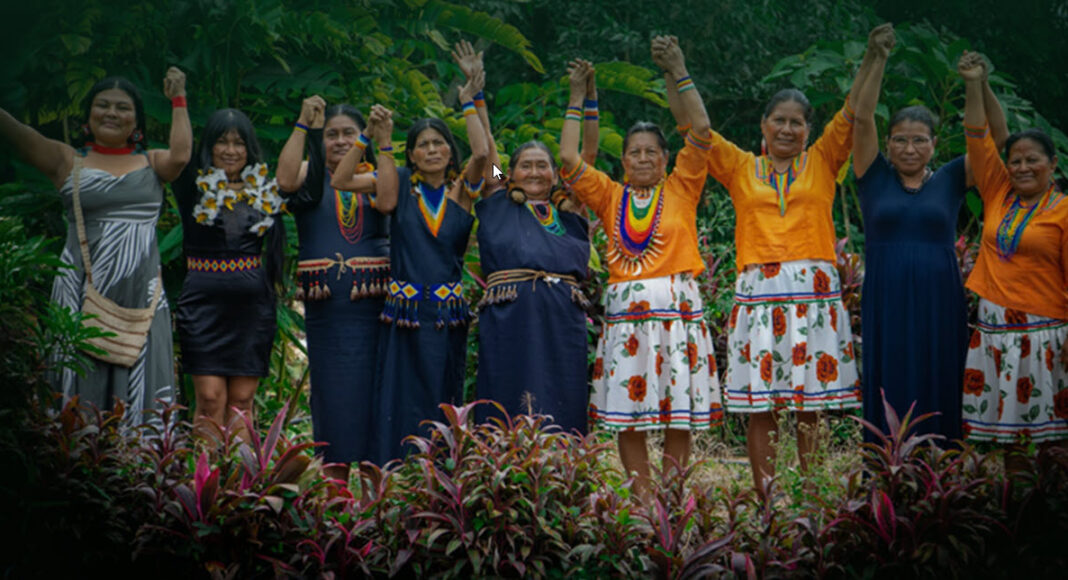
At London Climate Action Week, Indigenous women, especially from Latin America, featured prominently as leaders of their communities and territories
Fany Kuiru, a Colombian lawyer, leads COICA, the multinational Coordinadora de Organizaciones Indígenas de la Cuenca Amazónica. Founded in 1984, COICA provides courses, technical support and help in accessing funding, while emphasizing both the transmission of Indigenous knowledge and the bringing of women leaders onto the international stage.
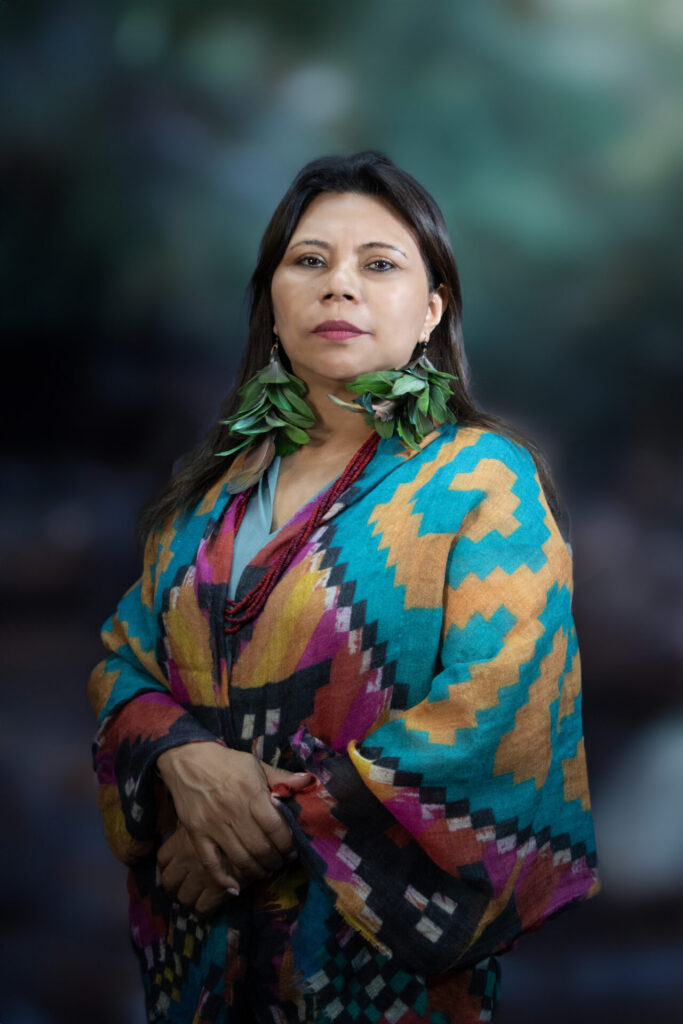
Fany was speaking on 26 June, at London Climate Action Week (LCAW), founded in 2019 by the then mayor of London, Sadiq Khan, which has become a pivotal event in the global climate calendar. Comprising over 1,000 events, some of them cultural, and attracting more than 75,000 people, it takes place each year in the second half of June. This year’s venues ranged from the offices of merchant banks to the environmentally managed premises of Greenpeace, where waste is minimized and as much as possible is recycled. What was striking at this event was the prominence of Indigenous women, notably those from Latin America.
Alongside the familiar challenges experienced by women in countless rural and urban settings, Fany Kuiru explained, there are the additional problems faced by Indigenous women, especially the floods and droughts increasingly driven by climate change. For example, they can lose the animals which supply the milk they need for their children, and represent savings set aside for emergencies.
Women are also the bearers, and no doubt developers, of traditional knowledge especially herbal medicine. In Brazil, Fany told us, there are more than 200 women Indigenous leaders, including Watatakalu Yawalapiti who, apart from Portuguese, speaks five indigenous languages and was representing the Articulação Nacional das Mulheres Indígenas (ANMIGA).
Representation at this year’s LCAW ranged from bond investors to Indigenous women leaders from the Amazon. With events spanning art exhibitions, performances, cultural gatherings and more, it provides a vital chance for activists to be heard by those with influence, whether through power or money.
Yet, despite the irony of its coinciding with a heatwave of unprecedented intensity, the event seems to have left Londoners — or at least the journalists among them — cold. It was barely mentioned in the mainstream press.
The leading role of Indigenous women
When Indigenous men, and then Indigenous women, first began to appear on the international stage some years ago, we might have thought the women’s appearances were performative or token, but within only a few years we have seen Indigenous women emerging, not as women leaders, but as the main leaders of their communities, their people, campaigning to get their territories recognized.
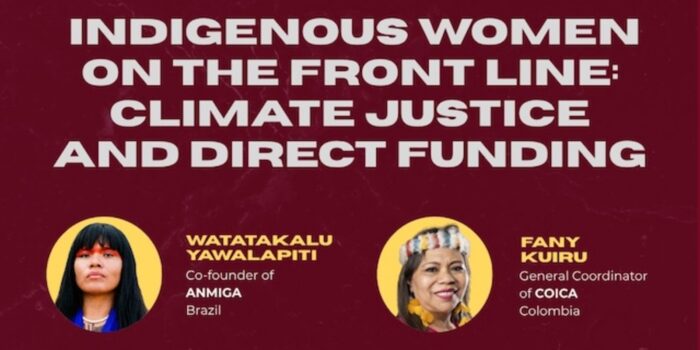
The key goal of the London visit by the Indigenous was to obtain direct funding – the aspiration to overcome dependence on international NGOs and agencies as intermediaries. It may sound technical, but it would be a big step towards empowerment and, in a sense, adult status: graduation from regimes of oversight and towards an accountability directed at them rather than international donors.
But that is some way off: donors are constantly looking over their shoulders for ill-intentioned media in search of material for a shocking headline. Although Indigenous autonomy has gone much further in Latin America than anywhere else except Canada, national states by their very nature place limits on territorial autonomy.
Claiming the territory
One of the main causes for the Indigenous is defence of territory – hence the name of a third organization Alianza Global de Territorios, represented by Sara Omi from Panama who also works with the Alianza Mesoamericana de Pueblos y Bosques. The word ‘territory’, rather than ‘community’ or ‘people’ (pueblo), is quite new in this world of indigenous representation and signals an implied claim to territorial autonomy and thus a certain degree of political independence.
Territory is a more sensitive subject nowadays than two or three generations ago because of the headlong expansion of land-hungry extractivism or quasi-extractivism: cattle-raising and the soyabean monoculture which goes mostly to feed China’s 450 million pigs.
China’s soyabean imports have increased eightfold since 2000 and it has been calculated that about 20-24 million hectares of land in Latin America are today dedicated exclusively to producing soya for them.
Pressure on the land of Indigenous peoples is often spearheaded by violent gangs. The inability or unwillingness of the machinery of state to rein them in explains why Indigenous peoples’ representatives want to be more self-reliant in providing their security. This means they are seeking recognition as institutions of governance in their own right.

Argentine campaigner Natalia Gavazzo, an active social scientist works with Alianza Global por los Cuidados, which currently is focused on the intersection between providing care and campaigning for climate justice. She spent six days non-stop at meetings whose attendees ranged from multinational CEOs to local London activist groups, and which she said sometimes felt ‘more like a shark tank than a think tank’.
She also attended more academic meetings where high-level scientists made their presentations and universities pitched their Masters courses. In the end she came away unshaken in her view that capitalism is both feeding the climate crisis and also feeding off it, as illustrated by the lithium crunch.
Lithium is produced in environmentally sensitive high-altitude areas of the Argentine, Chilean and Bolivian Andes (the lithium triangle). The process requires enormous quantities of water which are being obtained at the expense of indigenous communities. Governments do little to protect them and so they find the basis of their livelihoods threatened.
Yet lithium is also an essential ingredient in the manufacture of batteries for electric cars which are heralded as part of the solution to the climate crisis. Once again China is the new patron of Latin America’s addiction to the primary export development ‘model’. (I myself have heard stories of copper being stolen from houses on the outskirts of Rio de Janeiro and then exported clandestinely to China, for the production of car batteries).

Stitching resilience

London Climate Action Week put on many art and music shows, including an exhibition of photographs by the late Anna Mariani showing the infinite stretches of Brazil’s hinterland, or sertão, at a venue near Baker Street known as The Bomb Factory. The show was titled Caatinga: Stitching Resilience. Caatinga is the word for an arid, thorny scrubland biome where many plants are adapted to long dry seasons. It looks more barren than it is, for the thistly, umbrella-shaped trees account for a substantial share of Brazil’s carbon capture.

Nevertheless, the region is afflicted by periodic droughts, and the human frustration these engender is all too evident. Mariani’s work highlights both the region’s characteristic vernacular architecture, with its strong crenelated façades, painted in natural colours, common to the intimate small towns of these regions (stretching from Bahia and the northeast of the country across much of the Mato Grosso), and the people’s skill in growing cotton, rearing cattle and producing handicraft out of these meagre resources.
In the fashion section of the exhibition, I saw how, in the words of the curators, ‘drought-resistant species and archaeological materials’ can be used to transform ‘raw discarded elements into works of striking beauty’. These works prove, they say, that through fashion people can work with even this hostile environment to produce sophisticated items, as evidenced by the highly original designs of shoes, handbags and clothes for men and women made out of unusual materials and discarded rubber and cotton. Unexpectedly, we also see women rubber tappers and we hear a remarkable woman, Luênia who runs a cooperative of waste-pickers (catadores). These featured in a documentary film, ‘The Land we Share’, 2026.
Another hour-long documentary film by French Canadian director Jeremie Battaglia: ‘Far from the spotlight’ was devoted to Anna Mariani’s work.
It is not by accident that all the people mentioned here are women. Whether the topic in question is the climate crisis, the defence of Indigenous territories, or the search for a way out of the dead end of sertão life, these events, exhibitions and conversations keep returning to the creativity and initiative of women in mobilizing the energies of their families, their neighbourhoods and their territories.
This revolution has been germinating for decades and in recent years has exploded as women become leaders at local, national and regional levels in conflicts ranging from territorial claims, human rights and the environment to combatting organized crime and human trafficking.