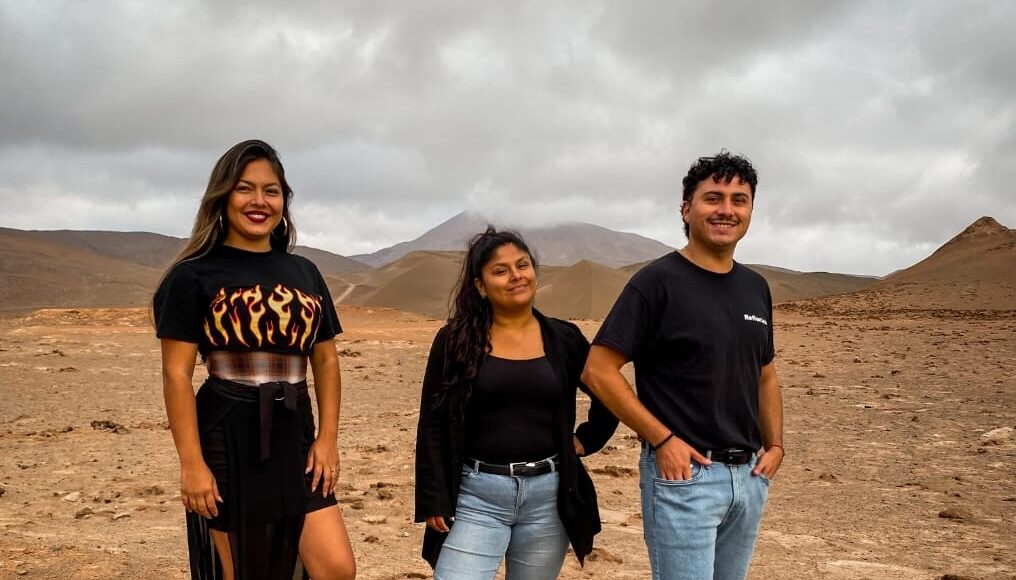
In northern Chile’s Atacama Desert, Alto Hospicio has become a dumping ground for the world’s fast fashion waste. Mountains of unsold clothes from Europe, Asia, and North America pile up, creating toxic conditions. A local youth collective, Desierto Vestido, is fighting to expose the crisis, demand accountability, and develop circular solutions.
Situated on the coastal mountain range overlooking the port of Iquique, on the edge of the Atacama desert, Alto Hospicio is one of the poorest cities in Chile. This sprawling desert city of 143,000 has historically been associated with high levels of poverty, unemployment, and lack of access to drinking water and basic municipal services. In recent years, Alto Hospicio has become a symbol of the wider dynamics of global waste disposal and the destructive over-production of the global fast fashion industry.
Every year, more than 66,000 tons of textiles arrive in the tax-free port of Iquique – from Asia, Europe, and North America. At least 85 percent of these shipments consist of brand new clothes from unsold lines, many of them produced by designer labels. Some of these clothes are sold locally or re-exported to other Latin American countries. But what cannot be sold or recycled is dumped in Alto Hospicio. Until 2022, much of Iquique’s unwanted textiles were piled up in a giant landfill just outside the city called El Paso de la Mula, creating a toxic textile mountain that was visible by satellite.
Until 2022, much of Iquique’s unwanted textiles were piled up in a giant landfill just outside the city called El Paso de la Mula, creating a toxic textile mountain that was visible by satellite.

That year, a fire of unknown origin destroyed the ‘clothing cemetery’ at La Mula, and today, there are hundreds of ‘micro-dumps’ where the detritus of the global fashion industry continues to pile up each year. Alto Hospicio’s transformation into a fast fashion sacrifice zone has attracted international attention and condemnation, including from the United Nations, and much of this is due to the pioneering activism of Desierto Vestido (Dress Desert/ Dressed Up Desert) – an NGO formed by a group of intrepid and creative young campaigners from the city.
Desierto Vestido has done more than any single organization to raise national and international awareness about the environmental emergency in Alto Hospicio, and to pressure the local authorities and the Chilean government to take action. In 2022 one of its members appeared as a witness in a case brought by a local lawyer at the First Environmental Court in Antofagasta, which sued the municipality and the Chilean government for enabling textile dumping in Alto Hospicio. Last year, Desierto Vestido staged an ‘Atacama Fashion Show’ in collaboration with the Brazilian NGO Artplan, using clothes from La Mula and the tip in a ‘catwalk’.
Alto Hospicio’s transformation into a fast fashion sacrifice zone has attracted international attention and condemnation, including from the United Nations, and much of this is due to the pioneering activism of Desierto Vestido.

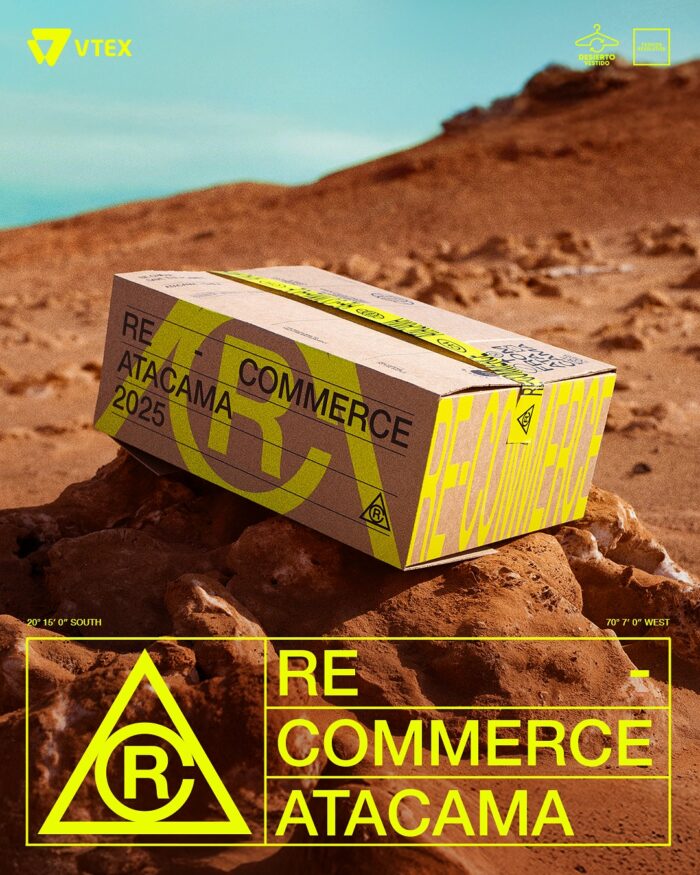
This year, Desierto Vestido and Fashion Revolution Brazil launched the website Re-commerce Atacama, where consumers pay only shipping costs for items of clothing from the city’s waste dumps. All this is no mean achievement for a group of young people from a city that has often been marginalized, ignored, and stigmatized. Jean Karla Zembrana, one of the group’s founders, took me to a micro-dump in the Santa Rosa sector of Alto Hospicio. Santa Rosa is one of the city’s ‘zonas de quema’ (burning zones), where clothing is dumped and set on fire, creating another toxic hazard for people living close by.
All around us, the ground was covered with jeans, some of which had been burned, and here and there we could see the shelters of homeless people, with articles of clothing hanging from ‘flags’ to mark their ownership.
Beyond the dump, new blocks of flats and informal squatter settlements were sprouting out of the desert, and there were also residential areas close by. ‘Recently, the way that these dumps are managed has changed,’ Karla said. ‘Now they aren’t simply thrown away, they’re thrown away and burned. And in the sectors closest to the city, they’re buried, to conceal the bad practices of some importers, who throw away textiles that are of no use to them.’
These efforts are partly a tribute to the effectiveness of Desierto Vestido’s campaigning. Its founders met in 2020, during an online course for training young leaders organized by the University of Chile and the environmental NGO CEUS. The course focused on the subject of ‘territory and the circular economy’, and attendees were asked to propose solutions to problems caused by the linear economy in their own locality.

‘Among the many problems in the territory, there wasn’t much attention being paid to what was happening to textiles, despite the magnitude of the problem,’ Karla recalled. ‘So we decided this would be the topic of our final project at school. When we finished the course, we realized that this issue was just going to remain invisible. So we told ourselves that if we had been accepted onto this leadership course, then we had to be leaders in our own territory, and continue protesting what was happening near our homes.’
The name Desierto Vestido was an allusion to the phenomenon in the southern part of the Atacama Desert known as the ‘desierto florido’ (blooming desert), when occasional showers of rain produce spectacularly colourful ‘lakes’ of flowers. ‘The northern sector doesn’t have this natural marvel,’ Karla explained. ‘We are covered with colours that in fact come from the textiles.’
Initially, Desierto Vestido’s aims were three-fold: to make local people aware of what was happening in Alto Hospicio, to pressure the local authorities into acknowledging the scale of the problem, and to create a network of activists to gather and disseminate information on the environmental problem in the city. Its members approached textile factories, people and organizations working in upcycling and climate activism, as well as the foreign press.
These efforts were not always well-received locally. Following the national and international condemnation of the textile mountain at La Mula, importers have been keen to avoid attracting more negative media attention. In some cases, Desierto Vestido has photographed dumped clothes that were subsequently burned, and importers have suggested that these photos were faked or were in fact pictures of older dumps. Now, Karla says, these micro-dumps are livestreamed on Instagram before they can be buried or burned.
Recently, Desierto Vestido stopped campaigning, after its members received anonymous threats. Some of this hostility may have come from importers or individuals working in waste disposal, but there are also local people who fear the organization is trying to do them out of a living. Iquique’s annual clothing shipments provide business for local shops, street stalls, and traders in open-air markets such as Alto Hospicio’s giant clothes market in La Quebradilla.

How did Desierto Vestido respond to this tension between environmentalism and economic survival? ‘There is a large chain of workers who depend on this industry,’ Karla said, ‘even though we accept that this work benefits the community, we are aware that there are clothes that can’t be sold, like bags of odd socks. How can people sell these things? There is no economic way out. So the same people who sell clothes in the clothes markets are also affected, because they get bags of clothes to re-sell and many of these clothes can’t be sold, so they end up contaminating our national territory.’
We don’t receive money for this work. We do it because we love our territory
Who did she believe was most responsible for the environmental emergency in Alto Hospicio? Karla traced the history of ‘ropa americana’ (the generic name for secondhand clothing in Chile) from the Pinochet era in the 1980s, when clothing was received as a response to ‘scarcity at the national level’ due to the economic crisis. However this reached a point when the textiles began to arrive in greater volumes than Chile was able to absorb. With the emergence of an international fast fashion industry that ‘nobody wanted to take responsibility for – neither the companies that created it nor the countries it came from –’ Chile became the objective of a ‘textile neocolonialism’, in which rich countries began to export their environmental problems, instead of resolving them.
Karla is proud of Desierto Vestido’s activism, and says its work with international organizations such as the US-Ghanian OR Foundation and Lazo Rosa in Brazil has been crucial to its success. ‘One of the things that happens to anyone taking action on the climate emergency, is that at certain points you feel alone,’ she said. ‘In these moments you feel as if your efforts are that of one little ant, and you’re not really contributing anything. But we soon realized that we had created a community, and that many people were seeking the same thing and were taking action, that there were authorities interested in taking action, and this has given us the strength to continue.’

After three years, the Antofagasta Environmental Court has yet to deliver its verdict on the 2022 lawsuit regarding the responsibility of the Chilean government and the Alto Hospicio municipality for the city’s environmental emergency. But whatever it decides, the sharp and savvy young activists of Desierto Vestido are unlikely to abandon the mission that they have set themselves, and which they have pursued so effectively.
‘We don’t receive money for this work,’ said Karla. ‘We do it because we love our territory, and we hope that people will love theirs, and that they will tackle the problems in their own territory. Because we have a voice, and the authorities work for us. We have to demand that they do their work properly.’