Yuvelis Morales Blanco is part of the Alianza Colombia Libre de Fracking (Colombia Free from Fracking Alliance), a collective that has been engaged in civil resistance to the oil and gas industry for over a decade. At 24, she has been awarded the prestigious Goldman Environmental Prize for her role in protecting Colombia’s largest river and one of the most biodiverse places on Earth.
Hailing from the Afro-Colombian community of Puerto Wilches, on the banks of the Magdalena River, 24-year-old Goldman Environmental Prizewinner Yuvelis Morales Blanco describes growing up in a family of subsistence fishers: ‘we had nothing but the river – she was like a mother who took care of me.’ Now a prominent spokesperson for the rights of nature movement, she has been instrumental in the struggle to protect the Magdalena, helping to prevent the introduction of hydraulic fracturing, or fracking, to Colombia.
Colombia’s lifeblood, contaminated
The Magdalena River, stretching 1,528 kilometres from the Andes to the Caribbean, has long served as the backbone of Colombia’s economy and is a foundational element of Colombian national identity. Its basin is also a biodiversity hotspot, hosting hundreds of endemic species, including the critically endangered Magdalena River turtle (Podocnemis lewyana) and the brown spider monkey (Ateles hybridus). The central portion of the river, the Magdalena Medio, is home to subsistence fishing communities whose culture, livelihoods and wellbeing are deeply interconnected with the health of the waterway.

The region is also the heart of the country’s oil industry, which drilled its first commercial well there over a century ago. Colombia is the fourth-largest oil producer in Latin America and its principal oil company, Ecopetrol, has its headquarters in the Magdalena Medio, with a refinery that extends more than one mile along the river. While oil has driven the country’s economic development, the social and environmental impacts have been significant: in 2025, the Magdalena River was recognized as an official victim of the armed conflict, due to the targeting of oil infrastructure by guerrilla groups. Recent leaked documents also reveal that Ecopetrol has systematically under-reported its carbon emissions, concealed oil spills and monitored environmental defenders.
Yuvelis explains how, from a young age, she recognized that ‘dark spots on the river meant that we were not going to eat.’ In 2018, when she was still a teenager, a spill from the nearby Lizama oil field resulted in the forced relocation of 100 families, the deaths of thousands of animals, and massive fish die-offs. Yuvelis says the incident was a pivotal moment in her life, motivating her to pursue a degree in environmental engineering and, later, dedicate herself to activism.

Birth of a movement
As oil production in the region declined in the 2010s, Colombia began to explore the possibility of extraction with fracking, a water-intensive technique that poses a high risk of contamination. Widespread in parts of the United States, it is still relatively rare in Latin America – with the exception of Mexico and Argentina – and is banned in several European countries and US states due to environmental and safety concerns.
Yuvelis recalls that, in 2019, shortly after the Lizama oil spill, she began to see billboards promoting fracking on her way to university. She didn’t know what it was at the time but learnt from the Alianza Colombia Libre de Fracking about the risks it posed to the Magdalena River. Yuvelis joined other students to raise awareness in the community. They began knocking on doors and talking to residents, and as the movement grew, they met with local officials and organized protests attended by thousands of people. In January 2021, Yuvelis was invited to speak at a public hearing on the subject, and her testimony was shared widely, marking a turning point in the campaign.
Death threats and exile
When she first began to speak out, a resident told Yuvelis she would ‘end up getting herself killed.’ Colombia is one of the most dangerous countries in the world to be an environmental defender: in 2022, over a third of all killings took place there. As Yuvelis gained a higher profile, she became the subject of intimidation and harassment and had to temporarily relocate outside of Puerto Wilches, but she continued to support the campaign on a local and national level. However, in January 2022, after a peaceful protest she helped organize, armed men turned up at her house, forcing her to seek asylum in France.
It was there that Yuvelis discovered a ban on fracking was possible. She continued her activism in exile, meeting with President Emmanuel Macron to share her story, traveling to Mexico and Argentina to visit affected communities and joining the International Rights of Nature Tribunal. Fracking became a contentious issue in Colombia’s 2022 presidential elections, and in April 2022, the environmental permit processes for the pilot projects in Puerto Wilches were suspended. Shortly afterwards, the newly elected President Gustavo Petro declared that no fracking projects would be allowed during his administration.

The struggle continues
Yuvelis returned to Puerto Wilches and her work with the Alianza Colombia Libre de Fracking after a year in exile. As yet, thanks to their campaign, no fracking projects have been able to go ahead in Magdalena Medio or anywhere else in Colombia. What is more, in August 2024, in response to a lawsuit filed by a local organization, the Colombian Constitutional Court ruled that the pilot fracking projects in Puerto Wilches had violated the Afro-Colombian community’s right to free, prior and informed consent.
In April 2026, Colombia co-hosted the first Conference for the Just Transition Away from Fossil Fuels in the Caribbean city of Santa Marta, where over 50 delegates met to discuss the possibility of a world without oil. Nevertheless, multiple attempts to pass a national ban on fracking in Colombia’s congress have failed. While the current administration has committed to upholding a moratorium, the upcoming presidential elections, scheduled to take place on 31 May, will be decisive for the future of fracking in the country.
Yuvelis remains steadfast in her commitment. In an interview with Mongabay Latam, the activist says: ‘Hope is what keeps me going. I live on this river; it’s impressive, quite beautiful. I’m lucky enough to live in one of its most beautiful neighbourhoods, in the valley. The sun sets with the river in the background, the mountains, the sky bright orange. I see people happy in the river, swimming, looking to the future, trusting in the certainty of tomorrow.’
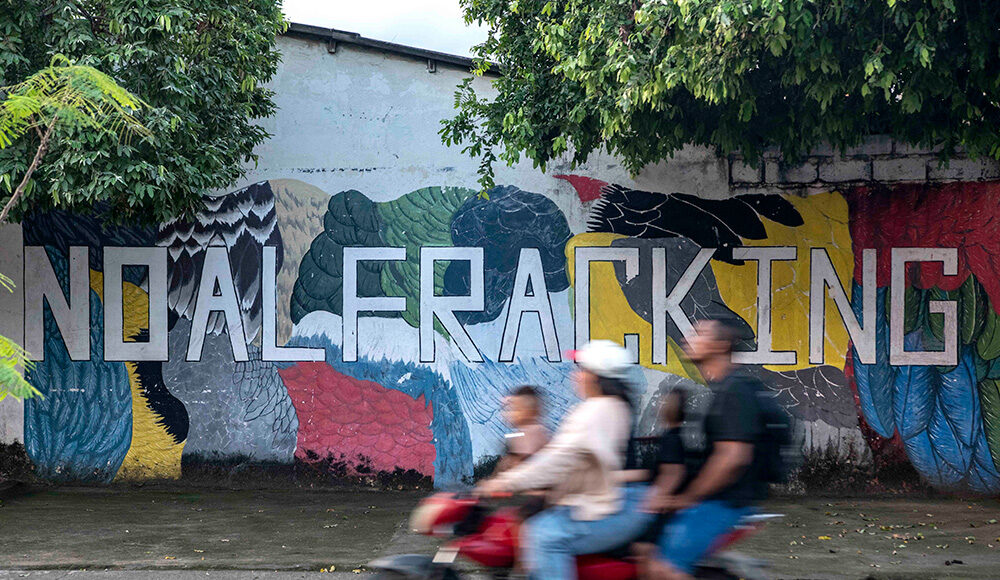
Main image: Anti-fracking mural in Puerto Wilches (Photo: Christian Escobar Mora for the Goldman Environmental Prize)