A new study of Colombian elites offers an essential framework for understanding why structural reform remains so difficult — and why Petro became trapped.
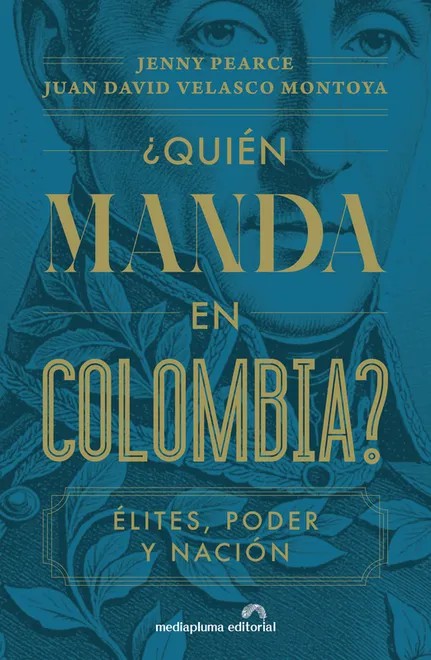
This ambitious new book, co-authored by Jenny Pearce and Juan David Velasco Montoya, offers the most comprehensive analysis of the history of Colombian elites since 1886 – the date of the Constitution that sought to end the civil wars of the 19th century. Drawing on an extensive database of Colombian elites, interviews with hard-to-access elites, and a broad review of secondary sources, this 750-page monograph presents a sophisticated theoretical framework for understanding the consolidation of a socio-economic, political, and cultural infrastructure that perpetuates inequality and violence alongside the rule of law and free-market capitalism in Colombia. In light of what they call ‘Colombia’s singularity’, the book also analyses Colombia’s progress towards change and the pitfalls of its first-ever leftist president, Gustavo Petro (2022–2026).
The lay of the land
¿Quién manda en Colombia? is really four books, and takes the reader deep into Colombia’s long history. Each of these four sections has a short introduction to guide the reader. The first section problematizes the concept of elites and explains the method of studying five constellations of Colombian elites; the second offers a historical analysis from 1886 to 1991 that seeks to explain Colombia’s singularity. The third section analyses how this singularity consolidated between the 1991 Constitution and Petro’s election in 2022. The fourth section delves into the Petro administration’s attempts at bringing about structural reforms to deal with longstanding inequality and the limitations the government encountered, trapped as it was in Colombia’s singularity.
Altogether, the book argues that any attempt to bring about structural reforms in Colombia faces an infrastructure of power imposed by these constellations of elites, which limits the possibilities for making transformations. Understanding these limits is key to any future attempts for transformation. In the authors’ view, progress cannot take place without consolidating a progressive technocracy capable of challenging the dominance of the technocratic elites which have consolidated a political system reliant on free-market consensus, prioritizing poverty alleviation over inequality elimination.
Constellations of elites
A key contribution of the book is its taxonomy of Colombian elites. Pearce and Velasco built a database of 932 individuals and 119 families, who together form the five constellations of elites which have the economic, political, and social power to determine the fate of 51 million Colombians – the oligarchic, technocratic, business (gremios), political, and judicial elites. These constellations are not homogeneous, and do not work in sync. Within and between the constellations, tensions and disputes tied to lineage, wealth, place of birth, professional background, race, and education persist.
After 1991, however, the Colombian elites mostly share the same socio-demographic background – white males from the Andean region who studied Law or Economics in a Colombian private university and with postgraduate studies in a top-ten American or British university. They also have broad consensus around two issues: (1) an orthodox economic policy dominated by following a fiscal rule that imposes low spending by the state and (2) a free market ideology that hands key responsibilities to the private sector that were traditionally in the hands of the state, such as health, education, and public services (water, roads, energy, etc.).
Principles of Domination

The taxonomy of the elites is important to understand how the oligarchs used two parallel crises in the 1990s, in the energy and economic sectors, to take control of the mining and energy sector and monopolize the banking system. In doing so, they accumulated wealth at unprecedented levels and widened the gap between the haves and have-nots. The technocrats and the business sector used their social capital to justify the privatization of key sectors of the economy, while the political elite used a transactional logic to reap the benefits of doing business with the state. The judicial elite was left to its own devices, trying to counterbalance the power of the other constellations of elites, but the principles of domination limited its capacity for action.
Another strength of the book is its identification of the principles of domination through which the constellations of elites rule. Pearce and Velasco identify five principles of domination: 1) the social and cultural supremacy of white men born in the Andean region and educated in Bogotá’s private universities (mainly Los Andes, Javeriana, Externado, and Rosario), 2) the formal attachment to the rules of electoral democracy, 3) the pre-eminence of transactional politics and clientelism, 4) the subordination of the armed forces to civilian authorities in exchange for autonomy in dealing with social unrest, and 5) the predominance of the United States in Colombia’s foreign policy.
Colombia’s singularity
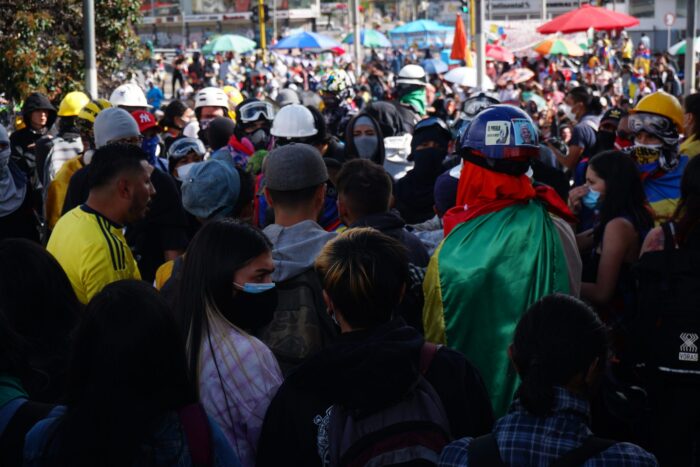
More ambitious still is the theory of Colombia’s singularity, which the authors argue explains the coexistence of democracy and violence at the core of the constellations of elites’ rule of Colombia. The principles of domination offer an ideal of stability in a context in which the elites do not share a hegemonic national project. These principles project the imaginary of a free and orderly Colombia – an imaginary which, according to the authors, constitutes an obstacle to building a truly peaceful, inclusive, and equal society.
Pearce and Velasco show that the elites perpetuate the Colombian state’s precarious control over the territory because it allows them to maintain a fluctuating balance of power. They do so through two strategies: leaving the armed forces to deal with social unrest, thereby protecting their high accumulation of wealth; and participating in clientelistic transactions with local politicians, agreeing temporary pacts which serve different factions of the elites. In this context, the reproduction of violence in the margins of Colombia goes hand-in-hand with an orthodox economic policy drafted in Bogotá which serves to protect the power of the elites.
The authors argue that the 1991 Constitution did not stop Colombia’s singularity. Instead, the constellation of the oligarchic elite and the business sector grew richer between 1991 and 2022. The technocratic elite succeeded in making orthodox economic policy part of the legal framework, while the political elite retained control of Congress, and the judicial elite consolidated Colombia’s singularity. The problem, however, is that democracy without equality creates social unrest and makes people eager for system change.
Petro’s promise for change
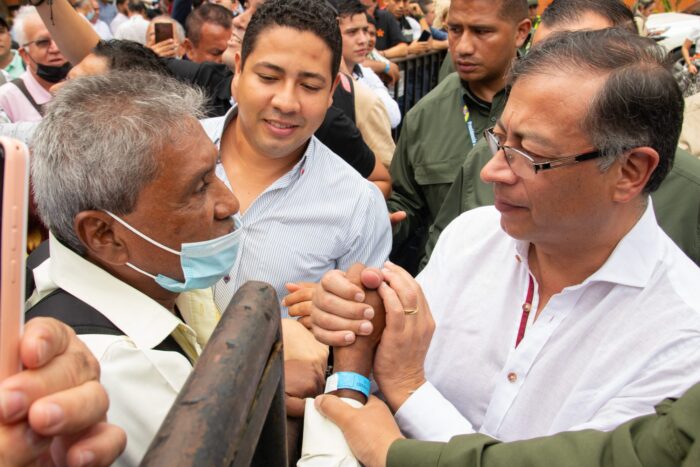
Finally, the authors deconstruct the scripts which the constellations of elites created to undermine Petro’s efforts to bring about structural reforms. This analysis begins by introducing Petro’s intellectual building blocks. The authors claim that Petro saw the idea of ‘the multitude’, drawing on Michael Hardt and Antonio Negri, as the agent for social change, rather than the older leftist ideal of ‘el pueblo’. Petro appealed to a loose network of diverse actors who do not share class consciousness, and this was a recurrent theme in his attempts to mobilize Colombian society to defend the labour, health, and pension reforms presented to Congress. These reforms were central to his attempt to transform Colombia and address the social unrest. Pearce and Velasco trace his worldview to four economists who support heterodox economic policy: Serge Latouche, Thomas Piketty, Joseph Stiglitz, and Mariana Mazzucato. Petro’s economic doctrine was that the state should focus on tackling inequality. That meant state control of key sectors of public policy, higher spending on infrastructure, land redistribution, a shift from oil and gas to agriculture and industry as the motor of growth, and intervention on behalf of the labour force.
As Petro’s credo clashed with the elites’ consensus on an orthodox economic policy, they responded with an arsenal of scripts to instil fear, anger, and distrust against him. These scripts included claims that the reforms were inconvenient for Colombia, that Congress had approved them through corruption, that they put macroeconomic stability at risk, and that Petro was mentally unstable. One effective script which dominated the 2026 elections was that his Total Peace policy (which sought to negotiate with all armed groups simultaneously) was in fact ‘total chaos’. Undermining his peace policy kept Colombia’s singularity intact – and trapped Petro within it.
The challenge of building peace
I was a peace negotiator for the Petro administration in the peace process with the Comuneros del Sur guerrilla group in the southern Nariño department of Colombia. In this peace process, the government and the guerrillas signed 12 partial agreements. As a result, the Colombian state was able to achieve several milestones: it recovered bodies of disappeared people, cleared landmines, reintegrated former child combatants into society, replaced coca crops with legal crops, destroyed a stockpile of weapons, and invested half a billion Colombian pesos in infrastructure and social programmes in Nariño. However, we did not sign an agreement for the transition of Comuneros del Sur to civilian life. Two issues got in the way: Congress’s approval of a legal process for reintegrating former combatants, and a plan of territorial security which had to be drafted by the armed forces. The pressure of the Trump administration to fight ‘narcoterrorists’ was central in preventing progress on these two issues. Moreover, transactional politics in Congress hindered Petro’s peace policy. Thus, the peace process with Comuneros del Sur fell prey to Colombia’s singularity. Pearce and Velasco are correct – whoever wants to change Colombia must understand the theory of singularity first. This book is therefore a must-read for academics and practitioners who are committed to tackling inequality in Colombia and building lasting peace.
London, 6 September 2026
Andrei Gómez-Suárez is a former peace negotiator for the Colombian government, Associate Researcher at SOAS University of London, and co-founder of the peacebuilding organization Rodeemos el Diálogo (Embrace Dialogue). He is the author of Genocide, Geopolitics and Transnational Networks: a Con-textualisation of the Destruction of the Unión Patriótica in Colombia (Routledge, 2015), El Triunfo del No: la paradoja emocional detrás del plebiscito (Ícono, 2016), and We are not made of Sugar: a childhood memoir from Colombia (Fuller Vigil, 2025).
¿Quién manda en Colombia? by Jenny Pearce and Juan David Velasco Montoya is published in Spanish by Mediapluma Editorial (Colombia, 2026), 820 pages, ISBN 9786289710380. It can be bought in the UK from Bookdelivery for £23.48.