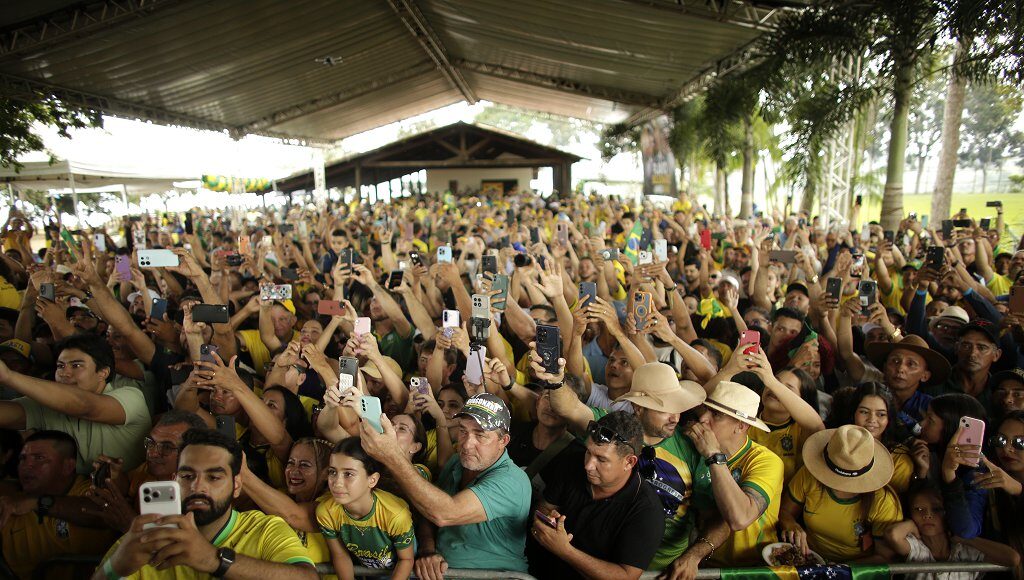
When Flávio Bolsonaro proclaims ‘The Amazon is Ours’, he threatens, if elected in Brazil’s 4 October presidential election (or the likely run-off) to condemn Brazil, The Amazon and the world to heredofascism, the continuity of an inheritance from his father Jair’s presidency, which threatens the forest, the country and the planet.
In 2018, before Jair Bolsonaro became president, I wrote that environmental fascism was about to haunt the Amazon. I was wrong: it did not simply haunt the Amazon; it governed Brazil, and the whole country lived under its shadow.
Jair Bolsonaro will not be on the ballot on 4 October. He is in prison, serving 27 years for his role in the attempted coup of 8 January 2023, the day his followers invaded the Palácio do Planalto, Congress, and the Supreme Court while he sat conveniently in Florida. He is ineligible and cannot run.
So he sent his son instead.
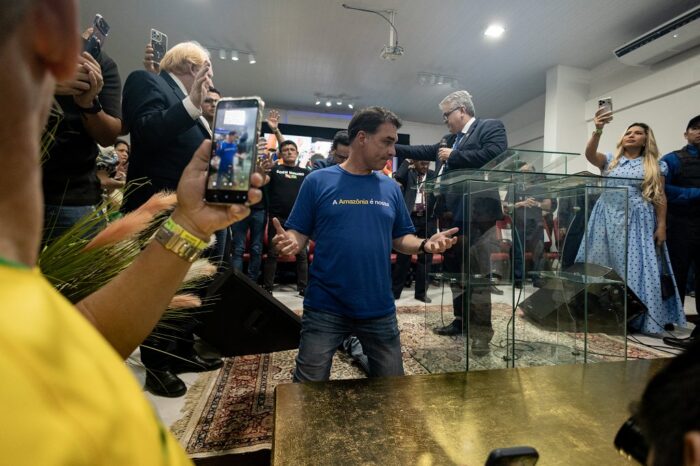
Flávio Bolsonaro landed in the city of Altamira, in northern Brazil, wearing a shirt emblazoned with the words, A Amazônia é nossa (The Amazon is Ours) – as he arrived in one of the most violently contested territories of the Brazilian Amazon, where some of the largest remaining continuous forests coexist with an advancing frontier of cattle and soy farming, mining, and land grabbing. Alongside the agribusiness interests stand the neo-pentecostal churches – the other driving force of his campaign, as they were of his father’s.
‘The Amazon is ours’. The sentence deserves to be read slowly. It is not a commitment to protect the Amazon; it is a property claim, the grammar of extraction dressed as nationalism. And the first question it raises is one the election will not answer: who, exactly, is contained in that pronoun ‘ours’?
As of 30 September, the polls offer no clear separation between Flávio Bolsonaro and Lula. AtlasIntel/Bloomberg places Flávio on 47.7 per cent and Lula on 47.6 per cent in a second-round run-off, while other recent surveys give Lula a narrow numerical advantage. The differences remain within the margins of error. They are, for all practical purposes, tied. And what is at stake in this election is not simply a candidate, but an inheritance. What that inheritance contains is one of the most consequential questions facing not only Brazil, but Latin America and, indeed, the world.
The Jair inheritance
Under Jair Bolsonaro’s four years of government, more than two billion trees were destroyed in the Amazon. In the Médio Xingu alone, approximately 684,000 hectares of forest were lost between 2019 and 2022, the highest concentration of forest destruction in that region since 2008. During those four years, 570 Yanomami children under five died from preventable causes, a 29 per cent increase. Health workers had warned the Bolsonaro government as early as 2020 about illegal mining invading Yanomami communities, spreading violence, malaria, alcohol, and drugs. Nevertheless, 795 Indigenous people were violently killed between 2019 and 2022, 54 per cent more than during the preceding four years. And nearly 800,000 Brazilians died of COVID-19 while the president mocked the virus, promoted unproven treatments, and systematically dismantled the public health infrastructure that could have saved them.

I tried to document that period in The Amazon in Times of War. The title was not intended to be metaphorical. The Amazon had become a territory where political decisions in Brasília translated into tragic consequences for forests, rivers, and human bodies.
Now another Bolsonaro is on the ballot. But I do not think the term environmental fascism is sufficient to describe this moment – or the tragedy that will ensue should he succeed. Something has changed, but not for the better.
I call it heredofascism: from the Latin word hereditas, meaning a legacy, something that is passed onward. Heredofascism refers to the inheritance not simply of a surname but of an authoritarian political ecosystem, a whole infrastructure, including the voters, the churches, the influencers, the agribusiness constituencies, the networks of communication, the symbols, the martyrs, the enemies, the memories, the electoral vocabulary, and the bellicose and lethal predisposition that Bolsonarismo spent four years building inside Brazilian institutions.
The Flávio continuity
Flávio Bolsonaro does not need to become a replica of his father for that infrastructure to govern. In fact, replication may be unnecessary.
This is the most important distinction between 2018 and 2026. Jair Bolsonaro presented himself as rupture while Flávio can present himself as continuity. And continuity is potentially less spectacular – which is precisely why it deserves attention. What shocks a democracy the first time around can become recognizable the second time, and what was once considered politically unacceptable enters ordinary vocabulary and insinuates itself into public life dressed as custom, habit, and vigilance against resistance. The radical becomes routine. Heredofascism, in this sense, is not the return of authoritarianism; it is authoritarianism inheriting a home.
The distinction between inheritance and repetition is not the destination, as both arrive at the same destructive end-point, but concerns what makes the second time more dangerous than the first. Repetition must overcome resistance and shock the system once again, but inheritance meets no such friction: the institutions are already weakened; the vocabulary is already normalized; and the radical has already become routine. Not being the father, the son need only govern what he received as inheritance. And governing an apparatus already built requires far less violence than building it from scratch.
The Altamira legacy
Look at what the Altamira campaign reveals.
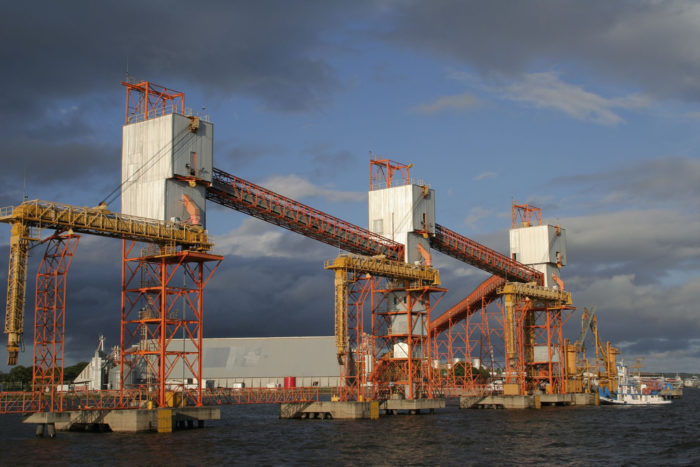
The promise to regularize irregular land acquisition is a promise to legalize land theft. The promise to free up Amazonian waterways for private concessions is a promise to convert rivers into routes, highways, waterways, and ports designed to transport commodities from the interior of the Amazon to global markets, across territories that must be emptied for the grain to pass through.
The Cargill grain terminal in Santarém, for example, was built in 1999 on a sacred Indigenous beach called Vera Paz, without an environmental licence. Since its establishment, soy cultivation in the surrounding region has grown by 34,442 per cent, while pesticide contamination cases have increased 545 per cent in five years. Deaths from nervous system diseases in the municipality of Belterra rose 667 per cent between 2011 and 2020. In early 2026, a teacher who denounced the poisoning of schoolchildren was transferred from her school without warning. ‘The Amazon is Ours’, Flávio Bolsonaro’s t-shirt proclaims. It has been theirs for twenty-five years, and the results are already measurable in bodies.
That is why 14 Indigenous people occupied Cargill’s port terminal for 33 days, demanding the annulment of the federal decree that would privatize three of the Amazon’s major rivers, the Tapajós, Tocantins, and Madeira, and when the government suspended the dredging auction but refused to revoke the decree, the protestors stayed. When Flávio promises to remove the state from the backs of those who produce, he is really promising to finish what the decree started.
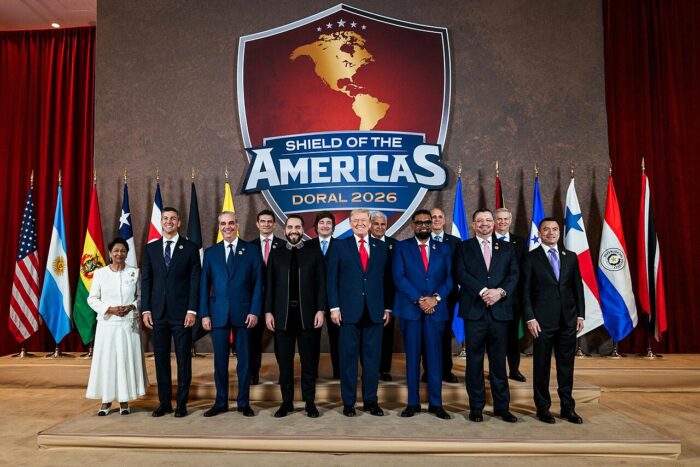
In May 2026, Flávio flew to Washington to meet with Donald Trump. He asked Trump to designate Brazil’s criminal organizations as terrorist groups, effectively inviting a foreign government to define Brazilian domestic security policy, and discussed Brazil’s potential entry into the Shield of the Americas, a US-led regional security framework. He also proposed a long-term strategic partnership involving Brazil’s rare earths and critical minerals. Brazil holds some of the world’s largest reserves of these materials – the lithium, niobium, manganese, and rare earth elements that power the energy transition and the defense supply chains of the 21st century. Flávio is offering them to Washington. The father sold the forest; the son is offering the ground beneath it.
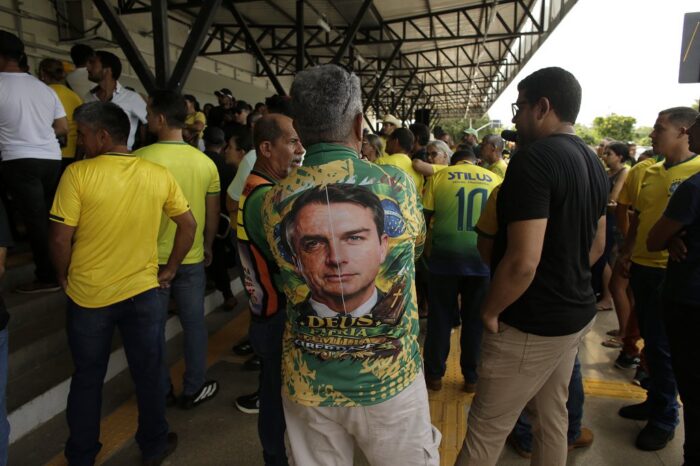
And the evangelical campaign in Belém – the pastors, the discourse of spiritual warfare, the radical punitive beliefs sold as salvation – represents the same fusion of religious authority and extractive politics that has proven, across Latin America, to be one of the most effective tools for dismantling the territorial rights of Indigenous communities and peoples of African descent. When Flávio tells evangelical leaders in Belém that politics is a spiritual war, he is not speaking metaphorically. He is describing a cosmology in which the forest and its peoples obstruct progress and must therefore be removed from the path, in the way, in his father’s words, the American cavalry once did.
Continental shift
The pattern is continental. Before Trump’s reelection I predicted what his return would mean for the Amazon and its peoples. That analysis proved accurate in almost every particular, including the abandonment of multilateral climate commitments, the green light to extractive industries, and the signal to right-wing governments throughout Latin America that environmental governance was optional and Indigenous rights were negotiable. Trump’s second term did not just affect the United States; it restructured the geopolitics of extraction across the Americas. A Flávio Bolsonaro presidency would send the same message from the south.
This is so because Brazil is the Amazon. The Amazon as legally defined covers nearly 59 per cent of Brazilian territory. Whatever president governs Brazil governs the respiratory system of the planet, and either governs with the peoples who have served as stewards of that system for ten thousand years, or governs against them. There is no neutral position. The history of the last decade has made that clear.
The most recent polling shows 46 per cent of Brazilians say they fear the return of the Bolsonaro family to power more than they fear a continuation of Lula’s government. 40 per cent say the reverse. The country going to the polls on 4 Octoberis deciding between two futures – one of which is already the recent past: a past that witnessed at least 200,000 unnecessary deaths, that gave us Manaus as the laboratory of a tragic and macabre experiment during the COVID-19 pandemic, and that carries within it the desire to restore colonial Brazil, with all its catastrophic consequences.
Heredofascism
One thing the occupation of the Tapajós made clear deserves to be said plainly. The current government, sustained by a broad alliance that includes, remarkably, former allies of the Bolsonaro administration, has not managed to dismantle the same commodity logic, the same political economy that treats rivers as highways and forests as commercial inventories. Heredofascism is only the most extreme expression of that logic. The Amazon requires us to scrutinize every political project that treats rivers as export corridors, forests as inventories, and Indigenous territories as spaces awaiting economic incorporation. This is no longer a political question. It is a question of the survival of us all.
Heredofascism does not need a father on the ballot. It only needs the name, the network, the T-shirt, and the promise that the extraction will continue, if faster this time, without the inconvenience of laws designed to slow it down.
In 2018, those who feared the effects of a Bolsonaro government were looking toward something that had not yet happened. Eight years later, prediction is less useful than memory and fact. We have satellite images, government records, investigations, testimonies, forest clearings, graves. History rarely returns wearing exactly the same clothes. That is what makes inheritance more difficult to recognize than repetition.
Repetition announces itself. Inheritance already belongs in the house.
The Amazon is not ours. It never was. It belongs to the peoples who made it, defended it, and have been burying their children in it while the world debates climate targets. If this were simply repetition, it would be easier to refuse. We have done it before. The danger of heredofascism is that it does not ask to be recognized, it only needs our acquiescence to its familiarity.
What happens to the Amazon if Flávio Bolsonaro wins on October 4th will be a recurrence, the perfecting of a catastrophe – the ‘double-tap’ second bomb dropped to kill the rescuers. The experiment has already been conducted and the results published. The only question is whether Brazil, and a watching Latin America, decides that it is worth repeating.
Presidents govern for four years. Forests live by another clock. A road driven through Indigenous territory, a river privatized for commodity export, a forest converted to pasture, a people expelled from ancestral land: these events do not obey electoral calendars.
This is not a matter of belief. They have done it once and have already said they will do it again. It is an inheritance we are obligated to reject.
But the polls confirm what the forest already knows: there are moments when the entire world holds its breath – and prays that it does not stop.
This article is based on one the author wrote in Portuguese for Amazônia Latitude. You can read the original here. The transation is by the Author.
MARCOS COLÓN is the Southwest Borderlands Initiative Assistant Professor of Media and Indigenous Communities at Arizona State University’s Walter Cronkite School of Journalism and Mass Communication. He is the director of Beyond Fordlândia (2018) and Stepping Softly on the Earth (2022), and is the author of The Amazon in Times of War (Latin America Bureau & Practical Action Publishing, 2024, published in Spanish as La Amazonía en tiempos de guerra, Planeta, 2025); and organizer of Utopias Amazônicas (Ateliê, 2025).