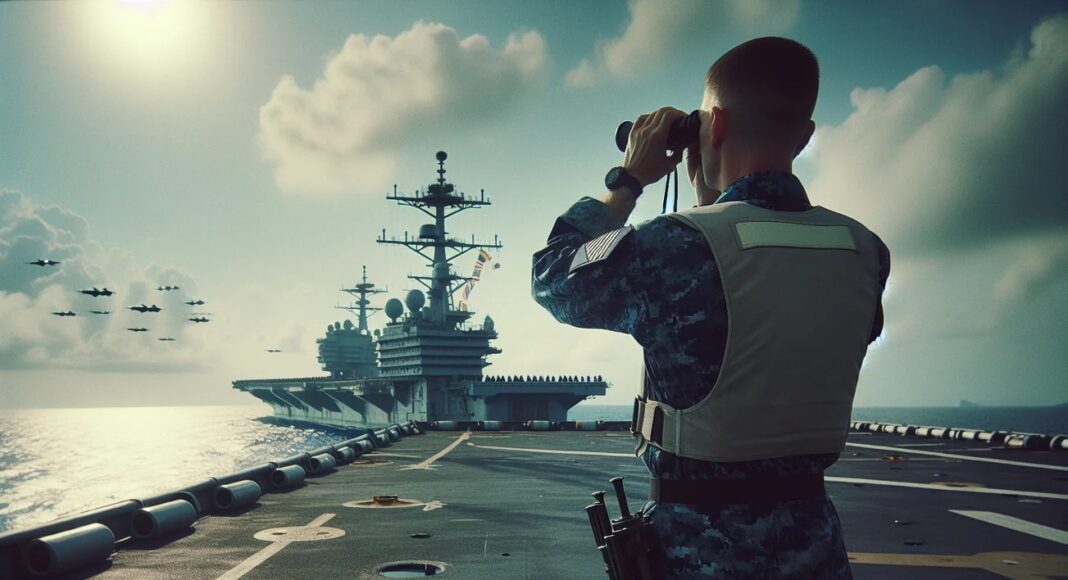
The Trump administration has sent 12 military warships to Caribbean waters near Venezuela, including the world’s largest aircraft carrier, a submarine and four amphibious vessels for landing troops. US forces have killed 83 people in extrajudicial strikes on boats since September, claiming, without evidence, that these were transporting drugs. Donald Trump has now threatened land strikes on Venezuela.
Grace Livingstone author of America’s Backyard, has spoken to Venezuelan and US experts about US military build-up.
Venezuelan economist Victor Alvarez says US actions have paradoxically strengthened the Maduro regime, quelling opposition within the country and drawing the military closer to him. Civic groups, says Alvarez, are calling for international mediation to avoid military escalation and promote a negotiated settlement between the government and opposition.
Venezuelan journalist Jessica Dos Santos believes that that the Trump administration’s aim is to destabilize or overthrow the government, either through targeted attacks, military invasion, more psychological/economic warfare or further diplomatic and economic isolation. One section of the Venezuelan population, she says, fears a possible invasion and is convinced that it’s imminent. Another is completely incredulous. They think the US is crying wolf.
Símon Rodríguez, a Venezuelan writer and co-founder of Venezuelan Voices, says there is a left-wing opposition in the country that opposes the government and US military aggression.
Roxanna Vigil of the US Council on Foreign Relations says the that Trump administration’s rhetoric on migration and drugs trafficking does not add up – it does not explain the size of the military deployment. She believes that the policy objective is regime change, but the administration has not announced this publicly because it recognizes that regime change is risky and may not succeed.
Adam Isacson of the Washington Office on Latin America says the Trump administration has no clear game plan and warns that escalating attacks could eventually lead to a Libya-like situation of warlordism and violence. He analyses the conflicting perspectives within the Trump administration and MAGA coalition on the military build-up in the Caribbean.
Read the full interviews below:
Victor Alvarez
Victor Alvarez is director of the thinktank Pedagogía Económica y Política. He is an economist and winner of Venezuela’s national science prize. He was industry minister (2005-2006). @victoralvarezr
What are the objectives of the Trump administration? Do you think they are planning an invasion or are trying to provoke an internal coup?
This unprecedented military build up in Latin America has a very strong psychological impact. One of the objectives of this type of operation is to provoke divisions and defections in the governing coalition in Venezuela. Yet there have not been defections or ruptures in the government. That’s because the United States has constructed this narrative, claiming that Venezuela’s military leaders are part of a so-called drug-trafficking cartel, the Cartel of the Suns. This has actually made military leaders feel threatened: they fear they could be imprisoned if the regime falls. So instead of causing division, US actions have had the opposite effect and Maduro’s government seems more cohesive than ever.
Those who lead the Venezuelan government, who feel they are carrying out a revolution, are mentally prepared for these kinds of attacks. Far from being intimidated, it glorifies them. They develop a narrative of heroic resistance against imperialist aggression, far from frightening them, it actually encourages them.
What is the climate in Venezuela now?
This US aggression has enabled Maduro to smother the criticism he was receiving internally from other leftist groups, trade unions, and social movements, that were heavily criticizing his economic policies, his mistakes, his missteps. Now instead of criticizing Maduro their priority is to prevent aggression against national sovereignty, and to prevent the country from sinking into a spiral of violence. So opposition to the government is weakened. Moreover any criticism of the government is interpreted as playing into the hands of the foreign invaders.
There were protests after last year’s presidential elections in July 2024, when the electoral authority announced that Maduro had won, which was a surprising and unexpected result that contrasted with what the exit polls had shown and with many of the tally sheets held by opposition observers. The demonstrations after that election were brutally suppressed. Almost 2,000 people were imprisoned and that frightened the population.
There are no street protests against Maduro at the moment, there isn’t a climate of social conflict against the government, what they call ‘heating up the streets’. What you see are demonstrations in favor of peace, marches against the US military intervention. There is also a permanent state of government-promoted mobilization: volunteer militias are training every weekend to protect strategic sites such as power plants, oil pipelines, oil fields.
You and other civil society groups are calling for the international community to mediate to promote a negotiated settlement between the opposition and the government. Would either the government or the opposition be willing to negotiate?
The problem is there are extremists on both sides. There are extremists in the government who want to annihilate the opposition, to remove it from the political ecosystem. Then there’s the section of the opposition led by Maria Corina Machado, previously led by Leopoldo López and Juan Guaidó who are saying that the only thing they’re willing to discuss with Maduro is how to transport him out of the country and into jail. They say they want to see him in a Guantanamo prison uniform. What leader would negotiate a transition if the only outcome would be a jail sentence, or ending up like the former Panamanian dictator Manuel Noriega?
But there is another, less extremist opposition, which is here in Venezuela, not based abroad. It has participated in elections but has not been able to build up its institutional strength in Venezuela because, among other reasons, in the recent elections held this year — for congressional seats, provincial governors and city mayors – the opposition faction led by Marina Corina Machado called for a boycott of the elections. This allowed the governing parties to sweep the board and now the opposition does not have governorships, mayoralties, or a significant presence in congress from which it can exert pressure, nor does the more moderate opposition have much international influence. The best-known figures in this section of the opposition are Henrique Capriles, who was a presidential candidate twice, and Manuel Rosales, who until recently was governor of the state of Zulia.
Which countries could be mediators?
Brazil, Mexico, Colombia. The Community of Latin American states.
How do you see this conflict with the US playing out?
As long as the US or extreme opposition keep insisting that Maduro surrender or he be brought before a court, it won’t be resolved. He’s not going to relinquish power like that. I mean, nobody in their right mind hands over power so they can be sentenced to life imprisonment. He’s going to resist. Well, then that runs the risk of a [US] attack against the President, but that would leave the country in ruins and that wouldn’t allow the United States to achieve its goal, which is to control the country’s reserves and resources.
Why? Because the regime is armed. As Maduro himself has said, they would move to a stage of armed resistance. The Venezuelan army doesn’t have the capacity to sustain a prolonged confrontation with the US in a regular conflict, so it would resort to guerrilla warfare. This means that acts of sabotage, such as oil pipelines and attacks on oil tankers or the sabotage of docks, all to prevent Venezuelan oil from reaching the United States.
So, this country, which was a peaceful, tranquil country would then be plunged into a spiral of violence and destruction. And while Trump and the White House may achieve their goal of bringing about regime change, they won’t be able to control the country, which will remain mired in that violence.
And if you add to that the Colombian guerrillas and other illegal armed groups on the border with Venezuela, the situation would be worse. So what would be better? A peaceful political solution.
Why do you think the US wants to intervene in Venezuela?
I am totally convinced that narrative that the United States government has constructed around the threat of migration and drug trafficking is to stigmatize and demonize Venezuelans, demonize us, and cover up the true interest of the United States. The US will use up its own oil reserves in ten years if it continues extracting at the current rate. They need a stable and secure oil supplier and right here in in the hemisphere they have a country called Venezuela, which has oil reserves of 300 billion barrels beneath its soil.
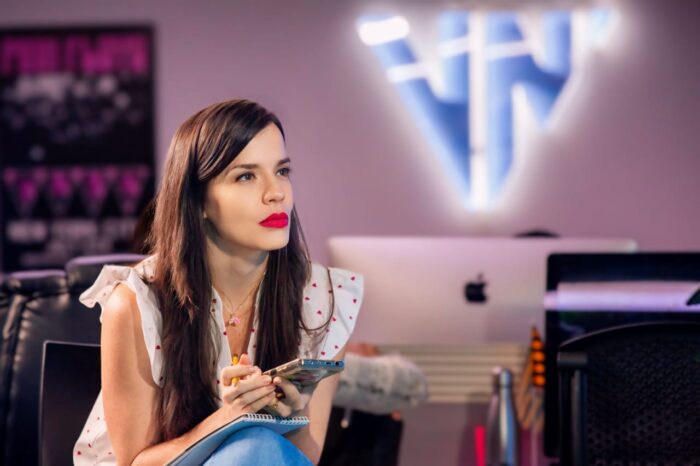
Jessica Dos Santos
Jessica Dos Santos Jardim is a Venezuelan writer, journalist, and university professor. She has worked for media outlets such as La Radio del Sur, Últimas Noticias, Épale CCS magazine, Venezuelanalysis, and Investig’Action. She is the author of the books Caracas en Alpargatas (2018), Nada es tan personal como parece’ (2023), and ‘Mujeres venezolanas en la ciencia’ (2024). She won the Aníbal Nazoa Journalism Prize in 2014 and received honorable mentions in the Simón Bolívar National Journalism Prize in 2016 and 2018. https://x.com/JessiDosSantos
What is the current feeling in Venezuela? Are people afraid of a possible invasion?
It’s not one single sentiment. One section of the population does indeed fear a possible invasion and is convinced that it’s imminent. Another is completely incredulous. They think it is the US crying wolf. This isn’t the first time a similar US military scenario has been discussed; it’s something that has been debated since Obama declared us ‘a threat to US national security’ (2015), then when Juan Guaidó established a parallel government (2019), and after Operation Gideon (2020), the failed attempt at an invasion by supporters of Guaidó. However, now it’s something much more real, enormous, tangible.
What has been the response of different sectors of Venezuelan society to the US military action: the government, the opposition, public opinion, and other important organizations?
The government has condemned US actions and has called on the international community to do the same. It has organized recruitment drives for the Bolivarian Militia, which now includes 8.2 million citizens currently participating in various military training exercises. The opposition is not monolithic. The moderate opposition, including leaders like former presidential candidate Henrique Capriles, has rejected US military actions. However, leaders like María Corina Machado, Leopoldo López, and others who are currently abroad have called for this intervention. Regarding public opinion, prestigious polling firms like Datanalisis state that 97 per cent of the population rejects foreign military intervention, while polling companies like Hinterlaces claim that 93 per cent repudiate it; either way, it represents a large majority.
What is daily life like in Venezuela now?
Daily life is absolutely normal. Days ago, amidst the escalating threats, the entire nation celebrated the canonization of José Gregorio Hernández and Carmen Rendiles. Now, families are busy preparing for Christmas, a time that usually brings Venezuelans together. In fact, the streets are already decorated, and there are Christmas markets, concerts, and other events organized by the government and/or local communities. And therein lies people’s real concern: inflation. The official exchange rate is 244 bolivars to the dollar and is rising between 1 per cent and 1.2 per cent daily, while the parallel rate, exceeds 370 bolivars—a difference of almost 50 per cent. Furthermore, at the end of July, the US Treasury Department granted a restricted license allowing Chevron to operate in Venezuela and export oil to the United States, but prohibited payments in Venezuelan currency, which has affected the flow of foreign exchange.
Why do you think the United States has developed this enormous military presence in Venezuela? Do you think they are planning an invasion or a coup?
Undoubtedly, to destabilize or overthrow the government. I don’t know if through targeted attacks, military invasion, more psychological/economic warfare, further isolation (which is what they are seeking by declaring the alleged Cartel of the Suns a terrorist organization or by getting multiple airlines to cancel flights to Venezuela after the US warning of ‘increased military activity’), etc. But, without a doubt, their excuse of ‘fighting drug trafficking’ is quite absurd, since 87 per cent of the cocaine that enters the US leaves through the Pacific, mainly from Colombia and Ecuador; only 8 per cent leaves through La Guajira in Colombia, and only 5 per cent attempts to cross through Venezuelan territory: of that 5 per cent, Venezuelan security forces seize and destroy 70 per cent. In the United Nations Office on Drugs and Crime (UNODC) Annual Drug Reports from 1999 to 2025, Venezuela does not appear as a significant country in terms of illicit drugs, narcotics, or controlled substances.
A military invasion would not only lead to a quagmire but would also set back the entire region, and neighboring governments like Brazil and Colombia, despite their differences with the Venezuelan government, know this and are condemning the US actions. But it would also have consequences for the Trump administration’s own popularity.
Would people in Venezuela support external efforts to overthrow Maduro? Or have US actions strengthened support for Maduro, in opposition to foreign aggression?
A sector wants Maduro gone, and perhaps they would support some external initiatives, pressure, or dialogues, etc., but they would not support a military invasion. In the last 20 years, [US or opposition efforts to] target the government with actions that harm the people – for example actions that generate violence, shortages, hinder oil production and therefore social investment, or affect the family economy or prevent Venezuelans from traveling, etc. – do not usually garner the support of the population; on the contrary, it ends up benefiting the government.
What are the United States’ interests in Venezuela? Do they differ from those of previous US administrations?
US interests are the same as always: control of Venezuela’s natural resources and distancing the country from allied nations like China, Russia, Turkey, etc. This is the objective of all US administrations, only some attempt it through licenses, agreements, etc., that benefit the US and its companies more than the Venezuelan government, as Biden did, while others pursue it through more direct aggression, like the two Trump administrations.
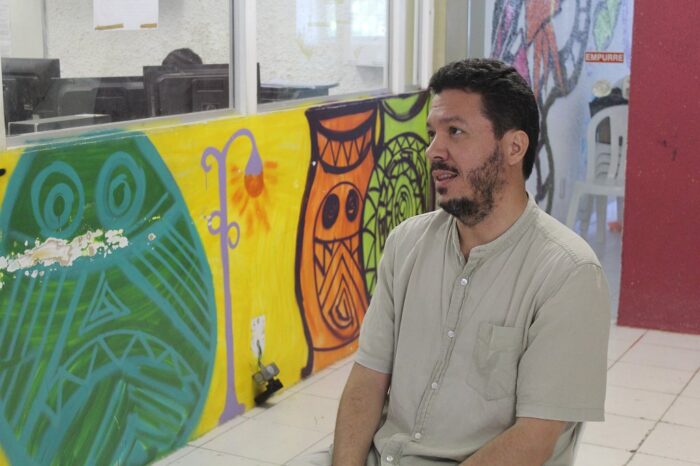
Simón Rodríguez
Simón Rodríguez is a journalist and researcher based in the Dominican Republic. He is the co-founder of Venezuelan Voices, an exile network aimed at amplifying unheard perspectives in Venezuela. https://substack.com/@simonrodriguezp
What is the mood in Venezuela now?
Well, it’s very rare for people to talk about politics openly, but the main concern is that, after a brief period when there was a slight improvement in the economy, for the past 18 months inflation is starting to increase again. During the worst period of crisis in 2017, hyperinflation reached one million percent. So that’s people’s main concern – how to survive in an economy that is deteriorating again.
[The first Trump administration (2017-2021) imposed sanctions on Venezuela. The Biden administration (2021-2025) lifted some of these measures, but re-imposed the restrictions after the July 2024 elections, which were widely considered to be fraudulent.]
What has been the response in Venezuela to the US military build-up, from the government and opposition sectors?
The government has responded by intensifying repression. They’ve revived the Venapp, a digital app for reporting crimes, so that citizens can report on each other. It’s a climate of a lot of repression. Of course, the government also boasts with exaggerated statistics about the level of military mobilization and the militias they have. The US military offensive has given the government the opportunity to construct a heroic narrative of resistance.
On the other hand, we have the traditional opposition, headed by Nobel Peace Prize laureate María Corina Machado, which directly supports this policy they call maximum pressure. She has praised the bombings in the Caribbean, which is outrageous, because they are war crimes, because it involves the bombing of civilian ships that pose no military threat to the United States.
Not only Venezuelans have been murdered, but also Colombians, Trinidadians, people of various nationalities. She is also exaggerating expectations, suggesting that thanks to this US pressure, the political transition has already begun. All her speeches are very optimistic that the government is about to fall.
Then there is a third sector, which is the left-wing opposition. Most of the left-wing organizations in Venezuela have broken with the government in the last three years. There was already a left-wing opposition before, but in the last three or four years, parties like the Communist Party of Venezuela, which is a very old, very traditional party, are now in opposition to the government.
Various organizations, including the Communist Party, the Partido Socialismo y Libertad and Marea Socialista have grouped together in a front called Encuentro Nacional en Defensa de los Derechos del Pueblo (National Meeting in Defense of the People’s Rights).
This sector has spoken out and demonstrated in Caracas against Trump’s threats and against the possibility of a military invasion. But they are also criticizing the government, arguing that it prevents effective popular mobilization through its repression and its great unpopularity.
What do you think the US is planning with this military build-up?
An invasion with troops on the ground is very unlikely because of public opinion in the United States – more than 70 per cent of people are against an invasion. The mid-term congressional elections are coming up, and Trump’s popularity is very low. I mean, it’s not that it can’t happen, but I think it’s unlikely. What does seem a little more likely are bombings, that is, without the involvement of troops on the ground, but with drones or airplanes.
What would be the impact of increased attacks in Venezuela?
I think that if there were bombings, that would have very strong negative social, political, and economic effects. It’s one thing for people to fantasize that Venezuela’s problems will magically be solved with a bombing, right? I think those people have a naive view of war.
People who support María Corina’s policies have illusions that the country’s problems can be solved by some kind of deus ex machina – a power that suddenly arrives from the outside and fixes things. We, the left-wing opposition, believe that’s completely wrong.
What do you think is motivating US actions?
The Trump administration has militarized the Caribbean using a kind of war speech against alleged drug trafficking and so-called narco-terrorism, which is a fusion of the doctrine of the war on drugs and the war on terror. They claim that the Venezuelan government is the head of a supposed ‘Cartel of Suns’, which does not exist. ‘The Cartel of Suns’ was a name that emerged years ago to talk about military corruption. It was like a meme. It was a satirical thing to talk about the corruption of military officers who take bribes from drug traffickers, not to suggest that the military actually had a structure for producing and exporting drugs.
In fact, in Venezuela is not a significant drug-producing country. It is a country of transit essentially and not one of the most important. Ecuador is a more important transit country, which is an ally of the United States. This narrative of narco-terrorism would justify a US attack on virtually any Latin American country – if the excuse is that you can attack any country where there’s drug trafficking.
Another aspect was reflected in a speech by Marcos Rubio, the secretary of state, The fundamental idea he put forward was that it was necessary for the USA to prioritize spheres of influence in the world. That implies a situation like the one we’re seeing now – the focus on restoring its historic dominance of the region of Latin America and the Caribbean. That’s why I think the scope of this militarization of the Caribbean goes far beyond Venezuela. It has Venezuela as its axis, but it is not the only target.
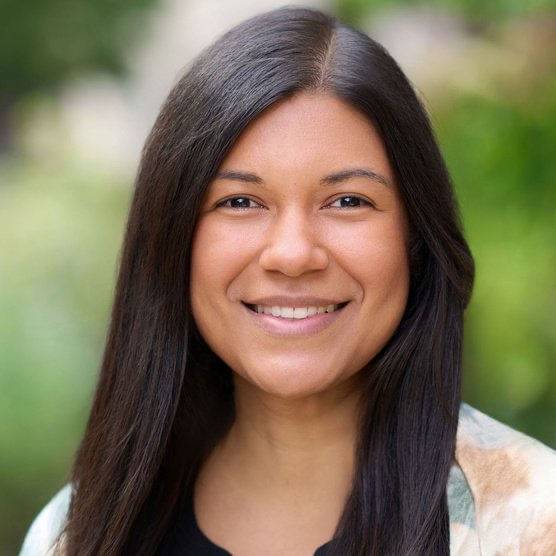
Roxanna Vigil
Roxanna Vigil is an International Affairs Fellow in National Security at the Council on Foreign Relations
What is the US government’s thinking behind this military build-up? What’s the purpose of it?
The public explanation doesn’t match what’s happening in reality. Publicly, the administration has said the military deployment is a counter-drugs mission. They also keep pointing to claims that Venezuela is emptying its prisons into the United States, and all sorts of ‘bad’ people are going into the United States from Venezuela. That’s the migration argument. But it doesn’t match up with what’s happening on the ground, with the size of the deployment. The largest aircraft carrier in the US military is now there.
And then you have the increased rhetoric related to President Nicolas Maduro specifically, including, for instance, the increase of the bounty on his head from $25 million to $50 million that the State Department announced. So, to me, that points to some other motivation which the administration hasn’t publicly expressed. I think that part of the policy objective here is regime change and because there’s a recognition that regime change is extremely risky and hard to achieve, that’s maybe why they haven’t come out right out and said that that’s the goal.
But how would they effect regime change? Is the idea to encourage an internal coup, or is it actually US deployment in Venezuela?
There’s been a long conflict between the Chavistas in power and the opposition that has tried, through many different means, to return the country to democracy. There have been times when the opposition has made a lot of gains, for example in 2015 when they won a supermajority in the National Assembly. Even though it was not a free and fair election, they nonetheless won a supermajority. That was a huge win. Then you have 2019, when you had Juan Guaidó challenging Maduro in his role as the president of that democratically elected National Assembly, and over 50 countries around the world rallied behind Guaidó. Then in 2022 and 2023, there were negotiations between the Maduro government and the opposition, in Mexico City, resulting in the Barbados Agreement in 2023 [which led to the opposition’s participation in the Venezuelan elections in 2024].
Maduro stole the election in 2024, according to all observers. The opposition candidate Edmundo Gonzalez won, and Chavismo was at a low point. And so, to me, the key factor in every single one of those milestones for the opposition was really strong international support. They got their leverage from the United States, but also from the other countries that were there to support.
So how does this play out now? What are the different scenarios? Whether, perhaps the US military decides to do land strikes for drug targets – how does that play into this bigger picture of what’s going to bring them to a negotiating table? Because I really see the only way that this ends is through negotiation.
The Trump administration has said they plan to do land strikes. They plan to move from international waters to land. We don’t know what kind of targets they will go after. If I had to find a value in that, it would be to bring the regime to the table with the opposition and to cut a deal where Maduro departs, and there is some transition phase to elections, a transition to democracy. The alternative to me is not good, because if you have US-imposed regime change, it puts the opposition in a really weak position because they’re saying they have the support of the people – but then why do they need a foreign country to go in and force that change?
The opposition could be handed a strong mandate if it happens through a negotiation where they’re also a party to those talks.
Is there any possibility that some elements of the military would depose Maduro, with sections of the opposition?
I’m sceptical of this theory of internal change through external pressure. I’m sceptical of it because that was the theory in the first Trump administration. You cripple the regime with maximum pressure sanctions and those around the leader get so frustrated that they say, this is enough. And it just didn’t happen. It didn’t work. So now, what you have with the military deployment is a foreign country threatening Venezuela, and so the Venezuelan military is very focused on that very active threat. I don’t see a situation in which they can then turn their attention to planning some internal coup. US military action has really put Venezuela’s attention on the foreign adversary and I don’t see how there’s space for that internal fracturing.
I think my biggest concern is an escalation and that it would be a mistake. The likelihood of an invasion is so low. Venezuela’s a really big country, twice the size of Iraq, 12 times the size of Panama. So it would be a huge undertaking, and my concern is if this pressure that’s there right now doesn’t bring the parties to a table, and there needs to be a further escalation, that that has really significant spill-over impact in the region. The region is in a really fragile point right now.
Venezuela has millions of people in militias and the government has been thinking about a possible US intervention since President Hugo Chavez was in power. Chavez himself was very interested in asymmetrical warfare. Presumably the US could get very bogged down if it did invade?
Anything short of a negotiated way out is going to be very messy, very complicated, not quick at all. And you have armed groups from Colombia that have set up permanent residence in Venezuela, so it’s a really complicated security situation.
As you say there are armed groups in Colombia. What impact will US moves have on Colombia?
I think there’s a lot of uncertainty right now in the US-Colombia relationship because of the rhetoric between President Gustavo Petro and Donald Trump at that really high level, even though the rhetoric from the United States side is that the United States still supports the Colombian people that and will continue cooperation with the Colombian security forces.
[In October 2025, the US imposed sanctions on President Gustavo Petro after he criticised the US strikes on boats in waters near Colombia and Venezuela. The Trump administration also imposed tariffs on Colombian goods after Petro refused to allow a US migration fight to land in Colombia in January 2025].
The United States made a huge investment in Colombia, you know, 25 years ago [with large amounts of military aid to support counter-narcotics and counter-insurgency campaigns]. And there’s an argument, I would argue it’s paid off. Colombia has returned from the brink of being a failed state to what it is today, which is one of the strongest democracies in the region, you know, more stable, more prosperous.
On top of that, so much of the US security assistance that went to Colombia, the Colombians have turned it around and had a multiplier effect by becoming a security assistance provider for the rest of the region.
Then we had a shift to the peace process. And the US government supported Colombia’s peace process with the FARC, supported the 2016 peace deal. We’ve seen how polarizing that peace deal has been in Colombia, right. The referendum, the no vote winning by the thinnest of margins. And since the deal has been on, this very thin ice ever since then, trying to survive and you have over 11,000 demobilized FARC guerrillas that are in the reintegration process.
I think the big question right now is, what does the future US-Colombia relationship look like? Will the 2016 peace deal survive whatever comes next? And how does the worsening security situation in Colombia, with the active armed groups, with the thousands of FARC dissidents that didn’t demobilize?
The military buildup in the Caribbean matters because if you have this risk of instability in Venezuela, the last thing you need is an unstable Colombia
Do they still have that strategic alliance with at least the Colombian military, even if Trump and Petro don’t get on, or has it lost that position of being the strategic partner in South America?
It’s really tough to answer, but I think the strategic relationship is still there. It’s one of the biggest missions, that the US has abroad. It’s been so hostile, the relationship at the top. The Colombian elections next year will be a big turning point. Do the elections lead to a reset for the US-Colombia relationship?
Is there a precedent for this US military action? How does it compare to the invasion of Panama in 1989 or the Dominican Republic in 1965?
This is extremely unusual. And just extraordinary. The example that you’ll see a lot is Panama. When the U.S government went after Panamanian president Manuel Noriega, the US force there was about 35,000 and it’s a very, very small country. There were some American lives lost. Venezuela is 12 times the size of Panama, has ten times the population. It’s just on a whole other scale.
And this military deployment, there’s never been a military deployment like this striking so-called drug boats. Usually the US Coast Guard would do it in a law enforcement capacity. So this is really unprecedented.
Adam Isacson
Adam Isacson is the Director for Defense Oversight at the Washington Office on Latin America.
What’s behind this US military buildup in Venezuela? What’s the US plan?
A US ground invasion with lots of troops in Venezuela still seems pretty unlikely to me. Most of Trump’s base wouldn’t even support something like that, but then if their interest really is to try to force Nicolas Maduro from power, that would leave them with just gradually escalating military pressure, short of a land invasion, which I guess would be a lot of strikes of targets, a lot of CIA sabotage operations, efforts to maybe kill Maduro by building a case that he’s the head of a terrorist group, which they’re doing now.
But I’ve heard no inkling that there’s much thinking about the next steps. If they take Maduro out on Tuesday, what they would do on Wednesday? I’m not sure they know.
This strategy that you’re talking about, gradually building up pressure, increasing strikes – what is the end game?
We don’t know. And but what we do know doesn’t make any sense. Using an Iraq analogy there are perhaps some who think they’ll be greeted as liberators. I think the US government do hear from voices in the Venezuelan opposition, many of whom are not in Venezuela, who are assuring the Trump administration that they’ve got this. I imagine that in the Pentagon and the uniformed military in Southcom some have doubts about this. As do people like Richard Grennell [who was sent by the Trump administration to negotiate with Venezuela earlier this year] and maybe Homeland Security Advisor Stephen Miller.
But Secretary of State Marco Rubio and Defence Secretary Pete Hegseth and others probably do not have these doubts. The President is certainly not inclined to carry out a big military operation.
So if you want to split the difference between those factions, they’re putting all of their hopes in a few airstrikes, Kosovo style, leading to a transition pushing out the equivalent of Milosevic, and then hoping that … that everything will fix itself afterwards. I mean, it doesn’t make any sense.
Given that presence of Venezuelan militias and Colombian illegal armed groups on the border– what do you think the consequences of US actions will be?
You could have perhaps a Libya scenario where you have armed groups everywhere, warlordism, people with a great capacity to do violent damage, carrying out attacks all over the country. Some of them might makes deals with the new regime, which may not be a democratic regime, to keep running their lucrative operations.
How could US attacks lead to a new regime? What steps would lead to regime change?
There’s many scenarios that this could take. I mean, most of them are not really plausible, in my view. But if you kill top leadership, a lot of the other leadership will exit. I mean, you’re asking me to read the minds of some very unstable people here in Washington DC.
If the US carries out increasing attacks, as you predict they might do, what could be the consequence?
If the targets are just things that they regard as important for narco-trafficking, like some airstrips or some labs, probably not very much. It could freak out the Venezuelan military. It might cause a few defections. I can’t tell you how this would work, how you get from point A to point B, because I don’t think you actually can. The most likely scenario is that Maduro still in place. The regime is resilient. They remain hanging together. The repression of civil society worsens even further. And then the Trump administration will be at a real crossroads. I mean, you can’t dislodge him through this method of attacks and you’re racking up collateral damage. And really hurting your own image. You’ve got no regional leader with you. What do you do next?
And really, the only answer is, if you pull out, then Maduro declares victory and represses civil society further. If you stay in it’s the classic military quagmire. The next step, if you’re escalating and your Tomahawk missiles aren’t doing it, then you are going to need boots on the ground. And boy, that is a nightmare scenario.
I don’t like being this hypothetical. But if you war game this to the point where you’ve started land strikes, and they’re not working, and your only choices are to escalate or pull back or strike some sort of deal. But if a Maduro doesn’t want to deal, then you’re only choice is to escalate.
Can you talk a bit more about the different positions within the Trump administration
I can still see there being a lot of reluctance because nobody really wants to create the next Cambodia or Vietnam. Stephen Miller is the deputy chief of staff of the White House and maybe the most powerful person in the government right now. He comes from the far right, and is a crusader. His big mission is stopping immigration. He would be in favour an intervention if it leads to a situation in Venezuela where they take back more migrants. He apparently has is very one of the key people supporting the boat strikes.
I’m not as clear if he’s that gung-ho about intervention in Venezuela itself. Trump’s right-wing coalition is divided between America First isolationists, people who are very sceptical of any foreign entanglements and on the other side, the old fashioned neocons like Rubio who are more in favour of direct intervention. From the first deployment of the boats in August, this has been very much Rubio’s show. I think Rubio does believe that if you take out Venezuela, then Nicaragua and Cuba are the next dominoes.
There’s certainly large parts of this administration which don’t care about whether Venezuela’s democratic or has human rights. If they do come up with a deal that weakens Maduro, which can be portrayed as a defeat for Maduro, even if he’s still there somehow and keeps the oil flowing in a bigger way and keeps the Chinese out and stops migration and allows more, migrants to be deported, they would consider that a victory.
Trump would love to make a deal, but the problem is that any deal that leaves Maduro with any shred of an ability to claim victory, is going to sit so badly in South Florida and a key part of the key part of the Republican base that I don’t know how they can sustain it.
Does the US still have a large military presence in Colombia? Does it still have the use of military bases? Colombian president, Gustavo Petro, a left-winger, has condemned the US military build-up and has tense relations with Trump, but there are presidential elections in Colombia next year, which the left could lose. Could the US use Colombia as a base from which to attack Venezuela in that scenario?
There is still a lot of US-Colombian military cooperation, mainly on counter-narcotics. They’re still delivering some military assistance for building up a police presence in ungoverned areas of Colombia. The US still have pretty free use of Colombian bases and barracks and airstrips and things like that around the country. There’s ongoing trainings happening all the time. So, yes, there is a US military presence. It’s not huge. It’s probably never more than a couple of hundred soldiers at a time.
Under the current government of Gustavo Petro, they obviously cannot launch any attack on Venezuela from Colombian soil. But you might have a very different government in August next year after the Colombian elections. And then certainly, we can’t write off the possibility of Colombia being used for that.
What are US interests in Venezuela?
Oil and migration are the top two. The Pentagon does a national defence strategy every four years, and they’re about to publish the new one. That strategy is going to define the number one priority for the US military as the defence of the homeland in the Western Hemisphere, above Middle East terrorism, above NATO. This means the main interest is reminiscent of 19th century gunboat diplomacy, it’s protecting your sphere of influence, keeping other foreign powers out.
I think they do want to cut the Chinese out of oil exploration and rare earth and all those other things that Venezuela has, but also just cut them out of the region to the extent that they, can, at least militarily.
Part of the US pulling out of Ukraine and pulling back from NATO is saying that Russia can do what it wants with its neighbours, as long we can do we want with our neighbours like Venezuela.
And, more generally in Latin America, what would you say the Trump administration’s interests are?
The interests are mostly material, getting better trade deals for the United States, more protectionism, more access to those countries’ resources.
I wouldn’t say this is Trump’s goal, but people around him aim to build a core of like-minded leaders, a sort of MAGA coalition in the Americas, which includes Javier Milei in Argentina, Nayib Bukele in El Salvador, Jose Kast in Chile and the Bolsonaro family in Brazil. A lot of these leaders have attended the Conservative Political Action Conference (CPAC) events that Steve Bannon and others have organized in Latin America. So the desire to build this new authoritarian bloc in the region is real.
Main image: Aircraft carrier USS Gerald R Ford arrives in the Caribbean. Image: Conflingo