
A million Mexican supporters gathered to cheer their national team as it progressed to the knock-out stage of the World Cup, due to play England on 5 July. The country’s 130,000 disappeared people will not be present. Yet the tide of hope aroused by football offers a way to defeat violence and despair.
England are set once again to play in the Azteca Stadium. Forty years on from arguably the most iconic match in the history of the World Cup, it’s tempting to see the 5/6 July 1)Kick-off is at 18:00 in Mexico on Sunday 5 July, 01:00 BST on Monday 6 July encounter as a moment for national redemption. Yet while England will take to the pitch hoping the ghost of Diego Maradona can finally be laid to rest, for their opponents this tournament holds a deeper meaning.
The evening before England’s victory over the Democratic Republic of Congo, over one million Mexican supporters gathered along Avenue Reforma in wild celebration of their own defeat of Ecuador, singing and dancing beneath the fireworks in the company of the large golden sculpture of Nike, the Greek goddess of victory. It was almost as if they had already secured their place in the World Cup final.
While this might be explained simply as Mexicans’ fanatical support for the game, social commentators may note that such an outpouring of passion, pride and beautiful togetherness spoke of a nation needing to find a means to express its joy amidst all the violence and disappearance.
More than a game
Football has always been more than a game. It provides occasions in which a society’s hopes, dreams, terrors and nightmares are often concentrated in the collective imagination and publicly paraded before a watchful world, impervious to the boundaries erected by official narratives and commercial interests. This tournament is an exceptional showcase of these last – few sporting organizations have done more to undermine public trust than FIFA. Decades of corruption scandals, commercial excess and political controversy have come to a head with this tournament, which, for many, is in direct contradiction with what should be the real spirit and focus of the beautiful game – its fans.
Yet despite FIFA, the game retains an extraordinary capacity to generate moments of collective identification that escape the calculations of those who seek to profit from them. That capacity is especially significant in societies living with violence.
Since former president Felipe Calderón launched the militarized ‘war on drugs’ in 2006, Mexico has experienced unprecedented levels of violence that have transformed every aspect of life. Nobody has remained untouched by this.
Public discussion often focuses on homicide figures, which number in the hundreds of thousands, as the nation has been devastated by cartel territorial battles that resemble a civil war. Equally defining, however, has been the unprecedented rise in enforced disappearances. More than 130,000 people are officially registered as disappeared or missing, since the war on drugs began, making disappearance the central political and humanitarian crisis of contemporary Mexico.
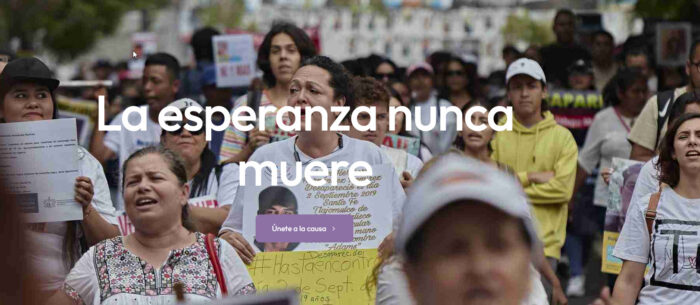
Disappearance is the most extreme form of violence. It stops the living from living and the dead from dying. If death brings grief, the act of disappearing a person prolongs that grief indefinitely. Families inhabit an endless condition of waiting, or what has been termed ambiguous loss, a purgatorial hell. In response, across Mexico, families have organized themselves into search collectives, traversing open fields and digging into the earth in search of clandestine graves. Searching for both bodies and truth, they have fulfilled the roles abdicated by failed institutions of state which are often themselves involved in the crimes.
Contemporary Mexico cannot be explained without recognizing the moral and emotional weight carried by these families, who have transformed the way the country views itself. 130,000 disappeared persons are, after all, tied to many times that number of affected families – a wounded nation that could have filled the Azteca from the opening game right through to the final whistle.
Visibility vs disappearance
For the families of the disappeared, visibility is everything. This year’s tournament has therefore brought renewed purpose, not least since one of the host cities, Guadalajara, lies in a state that has become synonymous with the worst excesses of the violence of one of the country’s most powerful criminal organisations, the Jalisco New Generation Cartel.
For international visitors, Guadalajara this year has become a city of football with streets as multicoloured as the many football jerseys on display. For local families its fields are marked by disappearance, as painfully shown last year with the discovery of what was described as an extermination camp at the Izaguirre Ranch.
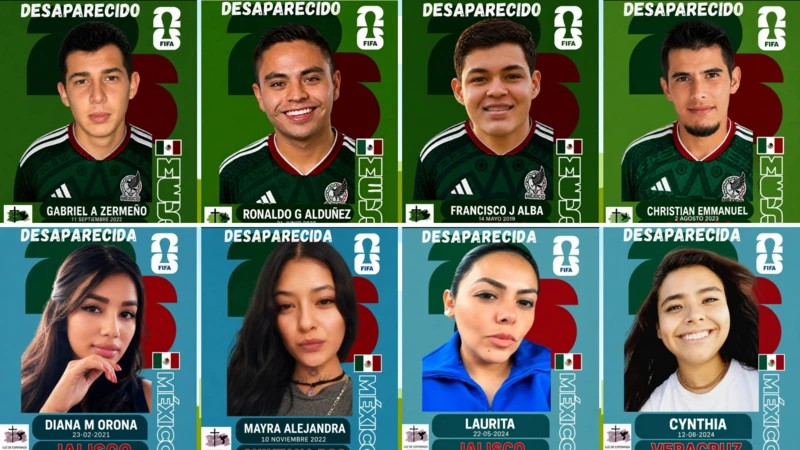
Families of the disappeared have learned to be resourceful and creative in their public interventions. A powerful example is a family-led campaign by the search collective, Luz de Esperanza, which recreated iconic stickers collected by football supporters across the world. Instead of celebrated footballers, however, the stickers carry photographs of the disappeared wearing the national shirt, featuring their names with the legend Desaparecido.
In a recent documentary titled El Mundial y los Desparaecidos (the World Cup & the Disappeared), one searching father spoke movingly of the contradiction of celebrating football while knowing that, only a short distance from the Estadio Akron, designed so that its exterior appears to emerge from the grassy fields surrounding it, investigators a uncovered mass grave known as Las Agujas containing 200 bags filled with human remains.
Gruesome echoes
Such reflections invariably recall memories from elsewhere in Latin America. Chile’s National Stadium, after the 1973 military coup led by General Augusto Pinochet, became symbolic of the regime’s brutality. As many as 40,000 people were herded at gunpoint through the turnstiles at the Estadio Nacional between 12 September and 9 November that year. Many would be tortured, subjected to abuse, and a number murdered in the changing rooms beneath the stands or in the nearby building which housed the cycle track, El Velódromo.

Argentina hosted the 1978 World Cup, which unfolded just as the military junta of Jorge Videla ramped up the systematic disappearance of thousands of its own citizens. As Will Hersey noted, ‘In earshot of the stadium drums, just a few streets away, inside the tree-lined campus of ESMA, the Navy Petty-Officers School of Mechanics, the junta’s flagship torture centre continued to operate’. The Junta took great delight in stripping away clothes, dignities, layers of flesh, pages of truth, while claiming to be preventing ‘the disappearance of the Fatherland as a state’.
A World Cup wasn’t going to stop the disappearance machine. Quite the opposite. It accelerated and intensified the military’s mission to disappear people in the name of security and order. That 1978 victory still haunts the Argentinian psyche, which makes Diego Maradona’s 1986 success at Mexico’s Azteca more than a confirmation of his then unrivalled brilliance. It became a form of internal psychic healing for a people whose anger and shame found a way to overcome the demons of the past.
While football is the true global game, how it is experienced is never universally felt, nor can it ever convey a single message. The game acquires significance through the historical circumstances in which it is played and remembered. Mexico’s current celebrations belong to this wider history in which football reflects a nation’s emotional landscape rather than simply its sporting fortunes.
Part of that story today centres upon the emergence of seventeen-year-old prodigy Gilberto Mora. Born in Chiapas in 2008, Mora belongs to the generation that has grown up during Mexico’s drug war. Chiapas itself remains inseparable from the legacy of the Zapatista movement and its demands for dignity and social justice.When Mora was six, his family moved to Tijuana, one of Mexico’s most violent border cities. His footballing success, therefore, carries a significance far beyond the sporting arena.
His emergence offers a rare public image of Mexican youth defined not by criminality or victimhood but by possibility.
Such distinctions matter.
A game of hope
Mexico is often presented internationally through the lens of cartels, corruption and insecurity. These realities cannot be ignored. But neither should they become the only stories available through which the country is understood. Nations require affirmative narratives as well as critical ones. They need public figures capable of embodying hope without denying suffering.
This is perhaps what the remarkable scenes in Mexico City have revealed. The celebrations do not indicate that violence in Mexico has been overcome or that the crisis of disappearance has receded. Rather, even as families continue their search for their disappeared loved-ones, the celebrations suggest something that is also important – collective joy possesses political significance that can outweigh the painful reality of a depressed condition.
Violence not only destroys lives but narrows the horizons through which societies imagine their future. The disappeared speak to a future that has been taken away. Moments of collective celebration offer a spontaneous refusal to be cowed that is also a form of resistance. They remind people that solidarity remains possible, that public space can once again become a place of encounter rather than anxiety, and that younger generations may still inherit futures not entirely defined by the violence of the present.
As the rain continued to fall over Mexico City following the third goal in their final group stage victory over the Czech Republic, a carnival of umbrellas was pictured bouncing in rapturous joy. Dancing in the storm, the fans were celebrating the possibility that, even in a country marked by profound loss, hope remains a shared public experience.
Football cannot bring back the disappeared. Nor can it be a substitute for justice and political reform. And Mexico’s celebrations will certainly not erase its suffering. What they do reveal, however, is that even amid violence and disappearance, a people can still refuse to let fear dictate the final score.
Main image: Football Stickers of the Disappeared, as produced by Luz de Esperanza, a campaign NGO based in Jalisco state. Image: BBC
Brad Evans is Professor of Political Violence & Aesthetics at the University of Bath. He is Assistant Editor of the American Book Review. His latest book is Disappearance: The Normalisation of the Extreme (Forthcoming, Edinburgh University Press 2027).
References
| ↑1 | Kick-off is at 18:00 in Mexico on Sunday 5 July, 01:00 BST on Monday 6 July |
|---|