Grace Livingstone, author of America’s Backyard, analyses the Chavista revolution, what went wrong, the different factions in Venezuela today and the long history of US intervention in the country. She explains why the US did not attempt immediate regime change and discusses Trump’s plans for the country.
You can read this article in Spanish here.
Mr Danger: the long history of US intervention in Venezuela
When Venezuela’s President Hugo Chávez described George W.Bush as ‘Mr Danger’ during a 2006 speech to the United Nations General Assembly, he was met with bemused faces. But it was a literary allusion to a character in one of Venezuela’s most famous novels, Doña Bárbara. Mr Danger is a fortune seeker from the United States ‘with very blue eyes, flaxen hair and a rifle on his shoulder’ who arrives in Venezuela, slings up his hammock and declares ‘I’m home’.
Prospectors struck oil off Venezuela’s Maracaibo in 1922 and a plume of black liquid shot into the air, raining down on city for nine days. By 1929, Venezuela was the world’s largest oil producer. US oil companies soon controlled 75 per cent of production. Resentment at foreign dominance grew; in 1945-48 a centre-left government came to power and began discussing nationalizing the oil industry.
This was halted by a coup in 1948 which established a military junta. Army officer Marcos Pérez Jiménez became dictator of Venezuela 1950-58, first as a member of the military junta and then as president after fraudulent elections in 1952.
Pérez Jiménez, an anti-communist who gave favourable terms to US oil companies, was awarded a Legion of Merit by Dwight Eisenhower’s government in 1955 for ‘outstanding services to the Government of the United States’. The Venezuelan dictator also featured on the cover of Time magazine and when he was overthrown in 1958, the United States offered him political asylum.
Anti-US feeling exploded in May 1958 when vice-president Richard Nixon’s motorcade was besieged by protestors in Caracas, the Venezuelan capital. Demonstrators, angry at US support for the recently-fallen dictator, rocked Nixon’s car, almost overturning it, before it managed to speed away.
The country’s oil industry was eventually nationalized in 1976. However, the former concessionaires were given priority rights to buy the oil and all the refineries to process Venezuela’s heavy oil remained on United States’ soil, so US companies continued to dominate the country’s oil trade.
As oil prices soared in the 1970s, luxury buildings shot up in Caracas, transforming the cityscape with modernist architecture. But red-brick shanty-town huts also sprawled up the hills surrounding the city because the oil revenues did not benefit all. It was the residents of these shanty towns that formed the backbone of support for Chávez, a left-winger, who was elected president in a landslide victory in 1998.
The Chávez years (1998-2013)
The new government initially envisaged an alliance with the Venezuelan business class to promote national development. But from the outset Venezuelan elites were hostile to Chávez, a former paratrooper, who believed that neoliberalism (free market economics) had hit the poor. He opposed the creeping privatization of Venezuela’s state-owned oil company and said he wanted to use the country’s oil wealth to benefit the Venezuelan people.
In 2002, he survived a botched coup attempt, as well as a stoppage by managers of the state-owned oil company, which brought the oil industry and the country’s economy to a halt. The George W.Bush administration gave millions of dollars to Chávez’s opponents and invited the key plotters to Washington in the months before the coup d’etat, including Pedro Carmona, the head of Venezuela’s business federation, who swore himself in as president while Chávez was in captivity.
María Corina Machado – today the best-known leader of the opposition – attended Carmona’s swearing-in ceremony and was one of the signatories of the decree that dissolved all Venezuela’s democratic institutions, closing congress, dismissing elected governors, mayors and the supreme court judges. Machado subsequently said she didn’t realise what she was signing.
But the coup failed: people flooded the streets to demand the return of the elected president and military officers who remained loyal to Chávez restored him to power.
Using the country’s oil revenues, Chávez launched schemes that drastically reduced poverty in the early years of his premiership – cheap food shops, literacy campaigns, medical centres in shanty towns, house-building for the poor.
But his government did not re-invest in the oil industry so gradually its infrastructure fell into disrepair. Crucially, it did not put money aside in case the oil price fell and it never diversified the economy, so Venezuela remained vulnerable to swings in the global oil price. The international price of oil began to fall in 2010 and then crashed in 2014 (after Chávez’s death), plunging Venezuela into economic crisis – supermarkets ran out of foodstuffs and people had to queue for basic necessities.
Chávez won landslide victories in three presidential elections; he held elections for a constituent assembly and several referenda. He said he wanted to deepen democracy, setting up popular councils, literacy circles, community radio projects, agricultural communes. Some of these grassroots organisations developed a degree of autonomy but most remained in a client-relationship with the government, dependent on it for funds.
The United Socialist Party of Venezuela (PSUV) established by Chávez lacked internal democracy and in an atmosphere of political polarization, Chávez used the presidency to criticise his opponents and journalists.
Maduro (2013–2026): crisis and clampdown
Nicolas Maduro, a former bus driver and trade unionist, who’d served as foreign minister, was elected president of Venezuela in 2013, after Chávez died of cancer. It was during Maduro’s premiership that the military began to take a much greater role in government and when democratic norms were most clearly violated: several opposition political parties were banned, candidates barred from standing, political opponents arrested and dates of elections arbitrarily changed. When the opposition won a majority in congressional elections in 2015, the Maduro government set up an alternative assembly. Repression of journalists intensified and state influence over the media was extended.
In presidential elections of July 2024, exit polls and polling-station tally sheets suggested that the opposition had won, but the electoral authorities declared Maduro the victor. Even long-time allies of Venezuela, such as the left-wing president of Brazil, Luiz Inácio Lula da Silva, shed doubt on the results by calling on the government to publish the voting data.
After the 2024 elections, the Maduro government cracked down on protests against suspected electoral fraud: more than 2,000 people were detained by the security forces. At least 1,000 remained in prison by early 2026. The government launched a digital app encouraging the population to report dissidents to the authorities and pro-government armed militia groups remained a threatening presence in many neighbourhoods.
A United Nations fact finding mission found in 2025 that Maduro’s government had committed crimes against humanity involving ‘imprisonment or severe deprivation of liberty and other crimes’.
An opposition of many factions
The opposition in Venezuela began as a right-wing elite opposing the reforms of a popular elected leader. But it now encompasses a broad swathe of the population – exhausted by economic crisis and an increasingly authoritarian government. The opposition includes centrist politicians such as former presidential candidate Henrique Capriles and the former governor of Zulia, Manuel Rosales.
There is also a left-wing opposition alliance, the Encuentro Nacional de la Defensa de los Derechos del Pueblo, which includes the Communist party, Marea Socialista, and the Trotskyist party, Partido del Socialismo y Libertad. Both the centrist and left-wing opposition strongly oppose foreign intervention and favour a negotiated settlement between the government and its opponents.
The best-known and most right-wing sector of the opposition, led by María Corina Machado, Leopoldo López and Juan Guaidó, have taken the most radical stance, aiming to oust the government by any means possible. Machado for example welcomed the recent US bombing of Venezuela. It is this right-wing section of the opposition that has received US funds and has had the closest, longest-running relationship with the US government.
There are also still some grassroots groups, such as members of agricultural communes, that continue to support the ideals of Chávez’s Bolivarian revolution, but which were also privately critical of the bureaucratized Maduro government. All Chavistas today, however, are focused on opposing US intervention.
US Sanctions
US governments began imposing targeted sanctions on Venezuelan individuals in 2005. These were ramped up during Obama’s presidency. However, it was during Donald Trump’s first administration (2017-2021) that the most sweeping sanctions were imposed, making it illegal for US companies to trade with Venezuela’s state-owned oil company (PDVSA) or with any foreign company that did business with PDVSA or the Venezuelan government. The sanctions had a devastating effect on the already fragile economy, stoking hyperinflation and prompting millions of Venezuelans to emigrate.
Joe Biden (2021-2025) relaxed these measures in 2023 after the opposition and government reached an agreement to hold elections. The Biden administration awarded licences to US company Chevron and a few European oil companies, including Spain’s Repsol, to export oil from Venezuela.
When Trump came to office in January 2025 he ordered these licences to be revoked. However, in May he sent a special envoy Richard Grenell to Venezuela, who hammered out a new deal. Chevron – which is involved in four oil-producing projects in Venezuela – was granted permission to continue exporting oil to the US. In return, the Maduro government agreed that it would accept flights of Venezuelan migrants deported from the United States.
US military build up 2025
The Trump administration began its military build-up around Venezuela in August 2025. It comprises 12 warships, including the world’s largest aircraft carrier, four amphibious vessels for landing troops and a submarine. The US military has killed more than 110 people in extrajudicial strikes on small boats in waters around Venezuela, Colombia and the Caribbean.
Throughout this military build-up, however, Chevron has continued exporting oil from Venezuela to the US. Since December 2025, the US has seized four oil tankers and has imposed a naval blockade on Venezuelan oil. US sanctions are unilateral: they are not backed by the United Nations security council, so the US does not have the authority under international law to enforce these sanctions in international waters or in foreign countries.
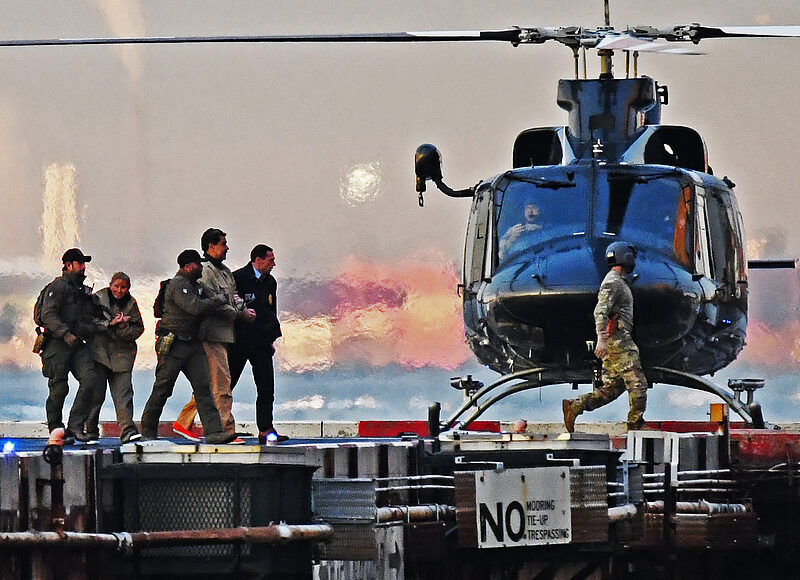
On 3 January 2026, the Trump administration bombed several sites in Caracas and other Venezuelan states, and US special forces seized Nicolas Maduro – a clear violation of the UN Charter.
Drug-trafficking: the evidence
One pretext for this action was that the Venezuelan government was involved in drug-trafficking. However, the United Nations Office on Drugs and Crime’s World Drug Report 2025 shows that shows that Venezuela does not produce cocaine or fentanyl and that most cocaine entering the United States is transported via the Pacific, not via Venezuela.
The 2025 International Narcotics Control Strategy Report – United States Department of State also shows that Venezuela is not a major transport route for drugs entering the United States.
The Trump administration repeatedly claimed that the Venezuelan government and military leaders were running a drugs trafficking cartel called ‘El Cartel de los Soles’. This had simply been an internet meme used by the opposition to refer to corruption in government, the ‘suns’ (soles) referring to the insignia on Venezuelan military uniforms.
The US indictment of Nicolas Maduro published in 2026, when Maduro appeared in a New York court, finally made clear that the ‘Cartel de Los Soles’ referred to a ‘culture of corruption’ and such a cartel did not exist.
Why did the US not attempt regime change?
After the bombing of Venezuela and the seizure of Maduro, Donald Trump declared that the US would ‘run’ Venezuela and get ‘our’ oil flowing. Oil companies would go in and rebuild Venezuela he said. When asked about elections he stated: ‘We have to fix the country first.’ With Maduro removed, all the other ministers remained in place, including defence minister General Vladimir Padrino López and interior minister Diosdado Cabello, a former military officer. Vice-president Delcy Rodríguez was sworn in as president.
The Trump administration decided against attempting regime change because the Venezuelan military stayed loyal to the incumbent regime. Military officers did not defect to the opposition because there have been several purges of the military by the Venezuelan government and the top brass fear that if the government falls they will be indicted either by their opponents in Venezuela or extradited to the United States.
Attempting to oust the regime by force, could have resulted in a protracted Vietnam-like conflict, given that Venezuela has a substantial army and large numbers of civilian militias (the government claims 5 million although 160,000 is a more realistic number for active members).
In addition, Venezuela has a 1,400 mile border with Colombia in which several armed groups are active, including 12,000 dissident left-wing guerrillas, according to the Colombian ombudsman’s figures. A CIA analysis reported in the New York Times, which assessed the security scenarios if Maduro was removed, concluded that Machado’s opposition did not have a ‘realistic’ plan to take over Venezuela, in the absence of support from the military.
US current strategy – ‘coercion’ for oil
The current US strategy is – in the words of US senate speaker Mike Johnson is to ‘coerce’ the Venezuelan government to adhere to US interests. Trump said president Rodríguez would ‘pay a very big price, probably bigger than Maduro’ if she ‘doesn’t do what’s right’. The main demands of the US are likely to be:
- open up the oil industry to US companies
- indemnification for Conoco Phillips and Exon Mobil (whose assets were seized by the Venezuelan government in 2007 after they refused to work as minority partners in joint ventures with the Venezuelan state-owned oil company)
- non-renewal of contracts with China, Russia and Iran.
Trump has said that the US will sell Venezuelan oil, the money will be put in an US-controlled account, and Venezuelans will only be able to spend the money on US goods, but there has been no public comment on this by the Venezuelan government.
On 7 January, interim president Delcy Rodríguez outlined the key objectives for her government: the return of Maduro, and ensuring ‘peace’ and ‘stability’ in Venezuela.
As well as the ongoing US threats of additional military action if the Venezuelan government does not comply, coercion takes the form of the continued naval blockade of Venezuelan oil exports – which risks bringing the economy to collapse, and is causing hyperinflation and hardship for ordinary Venezuelans.
The ‘Don-roe’ doctrine
The Trump administration’s policy is an updated version of the Monroe Doctrine expressed in its crudest terms – an assertion of US power in the region and its right to access strategic assets, including its natural resources.
In 1823, President James Monroe warned European powers to stay out of the Western Hemisphere, effectively staking it out as a US sphere of influence. In 1904 President Theodore Roosevelt added a Corollary which explicitly justified US military intervention in the region. ‘Chronic wrongdoing’ in Latin America could require the intervention of a ‘civilized nation’ he wrote. Since the Monroe Doctrine was proclaimed, the United States has intervened militarily in the Latin America over 80 times.
In 2025, the Trump administration published a new National Security Strategy which states:
‘The United States will reassert and enforce the Monroe Doctrine to restore American preeminence in the Western Hemisphere, and to protect our homeland and our access to key geographies throughout the region. We will deny non-Hemispheric competitors the ability to position forces or other threatening capabilities, or to own or control strategically vital assets, in our Hemisphere.’
The Security Strategy calls this the ‘Trump Corollary’. The president himself later described it as ‘the Don-roe Doctrine’.
Grace Livingstone also recently took part in a BBC Programme on US interventions abroad, speaking mainly about Guatemala, and a long interview with BBC Brazil, in Portuguese, about the Monroe Doctrine.
Main image: US federal agents bring Venezuelan President Nicolas Maduro and his wife Cilia Flores to lower Manhattan by helicopter to then be transported under heavy guard to NYC Federal Court in New York, United States, January 5, 2026. /VCG