ATRATO by Juan Covelli runs until 22 February 2026 at the V&A Photography Centre in South Kensington, London. Admission is free.
The rights of a river
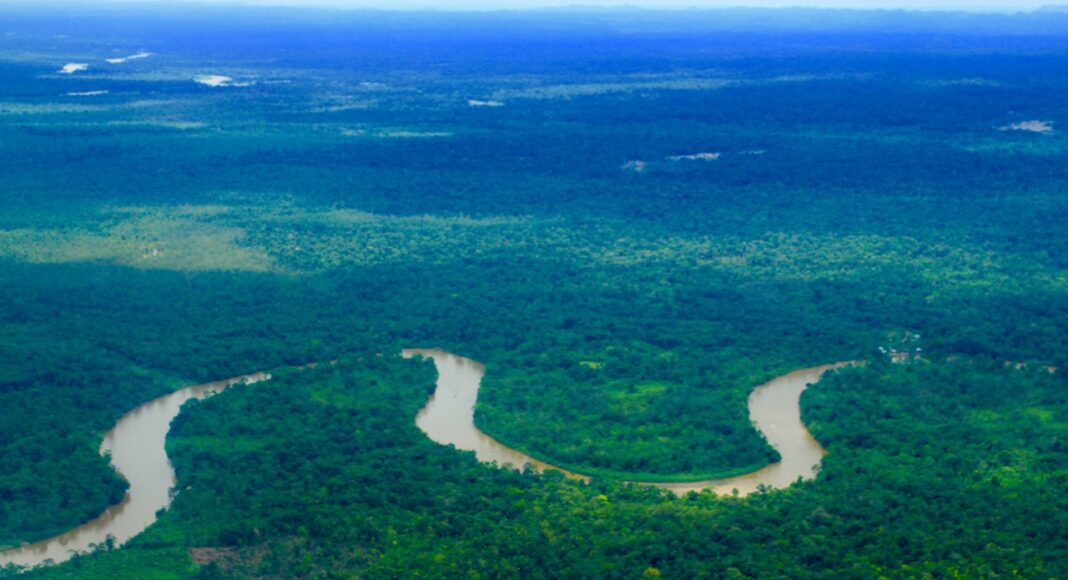
Illegal mining in the Atrato River that runs through the Chocó region in northwest Colombia is devastating biodiversity and communities. ATRATO, a multi-media installation by Colombian digital artist Juan Covelli and his team in collaboration with the V&A, positions the contemporary degradation of the Atrato River within a long history of extraction.
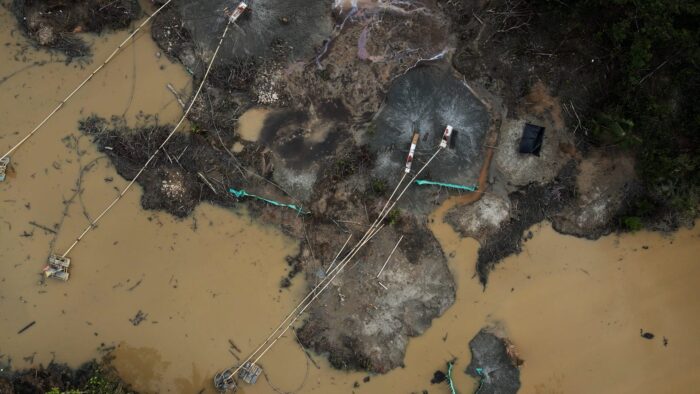
In 2016, the Constitutional Court of Colombia recognized the Atrato River as a legal entity with rights to protection and restoration. However, illegal gold miners have continued to expand their activities along the length of the river in the nine years since the declaration. The UN has now warned the Colombian government of a ‘serious […] human rights crisis’ affecting riverine communities. Illegal gold mining is poisoning water and food systems, increasing erosion that causes flooding, and driving extortion, forced labour, and people trafficking.
Extracting El Dorado
The Atrato River, which flows for 750km, is strongly emblematic of the country’s historic experiences of colonisation. Spanish colonisers landed in South America looking for gold and found it in the alluvial deposits of the Atrato. After enslavement and disease eviscerated the Indigenous population, Spanish colonisers transported thousands of enslaved African people to the region and forced them to pan the river for gold. Today, over 80% of the population of Chocó has African heritage and many Mestizo and Indigenous people live in the region.
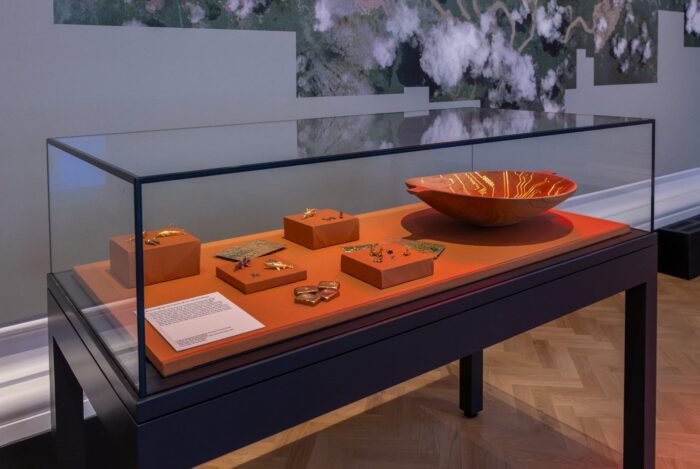
Juan Covelli’s multi-media installation is located in Room 99 of the V&A Photography Centre. Below a composite satellite image of the Atrato River that stretches across two walls, a display box holds tiny, ornate golden fish from the V&A’s own collection. These artefacts are described as having likely been looted from gravesites of Indigenous Peoples in Chocó. Alongside, Covelli has ‘faked’ his own golden creations. Using 3D printing and alternative materials, he subverts the value of the original artefacts while opening a conversation about the repatriation of the spoils of empire.
These ornate creations are reminiscent of the little gold fish Aureliano Buendia painstakingly crafts, melts down and remakes, again and again, in Gabriel García Márquez’ One Hundred Years of Solitude – a man’s slide into isolation and misery in the grip of an obsession. Covelli further emphasizes the human obsession with this precious metal by displaying live updates of the dollar rate and percentage change in the value of gold. The price of gold has almost trebled since 2015, reaching approximately three and a half thousand dollars per ounce in April 2025.
Huge profits allow illegal miners to keep expanding their operations despite the Colombian army regularly seizing and dismantling dredging boats that cost upwards of four hundred thousand dollars to build. As with other illicit economies, illegal mining is part of an international system and responds to demands arising far away from the sites of extraction. Organized criminal groups sell their gold to international markets where it ends up in consumer electronics and jewellery.
An invisible killer
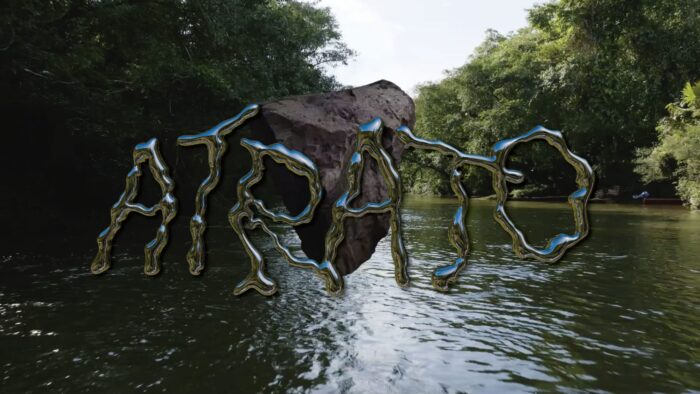
The centrepiece of Covelli’s installation is a video presented on an eight foot high screen. It begins with the river’s name, ATRATO, spelt out in spidery letters of liquid mercury. This silvery, elusive, and toxic element serves as a key motif throughout the installation.
Opposite the screen, the exquisite craft of the pre-Columbian gold artefacts is monstrously aped by two holographic projections of ghostly, cybernetic fish rotating in hallucinogenic purple and green colours. These same fish reappear in the video as menacing spirits that dwarf the devastated riverbanks and spew quicksilver. On a digital display to the left of the screen, a kaleidoscope of CGI forms – fish, wooden stilts, rubber tyres, and batea bowls traditionally used to pan for gold – amalgamate into an ever-changing cylinder down which liquid mercury cascades and sloshes.
Of the many harms associated with illegal gold mining in Chocó, mercury contamination is one of the most insidious. Miners use mercury to separate gold from its ore, before evaporating it to leave pure gold. Once in the water system, mercury accumulates as it travels up the food chain, until it becomes dangerously toxic in animal life. The larger fish traditionally eaten in Chocó have thus become a source of poison.
Many inhabitants of Chocó report being unaware that they might have mercury in their blood before becoming violently ill. The consumption of organic mercury can cause devastating health impacts, including blurred vision and blindness, tremors and cramps, increased blood pressure, lung disease, and memory loss.
The river speaks
Covelli, an artist with a BA in Political Science who has been researching the Atrato River since 2021, seeks ‘through art and story-telling, to talk about uncomfortable situations.’ His installation places the poisoning of the Atrato in the uncomfortable context of environmental degradation to service digital products. Covelli decries ‘seemingly clean technology’ that conceals ‘centuries of extraction and domination.’
Covelli describes his use of multi-media as part of a strategy ‘to break the human gaze and then try to see what other ways a non-human eye can see the river’. He uses reflections, repetition, and looping in the footage to illustrate the river’s never-ending flow and articulate the belief of local people that ‘nothing is destroyed’ but only takes new forms. Echoing this, a sober narrator recounts that people were ‘torn from their African homeland by colonial ambitions’ and their descendants now suffer from a new form of colonisation in the name of technological innovation.
One tool of domination, Covelli tells me, is art itself: ‘when you paint, when you name, you conquer. I want to break that relationship.’ Much of the video is based on drone footage of the churning brown waters beside scarred forests. The narrator muses on the habits of the river, its history through the era of Spanish colonisation to the present, always intertwined with gold. Ambient sound recordings of the river and mournful chanting compete with the narrator, so the viewer strains to hear the testimony. The river is both subject and witness, its poisoned waters reflecting centuries of extraction disguised as progress.