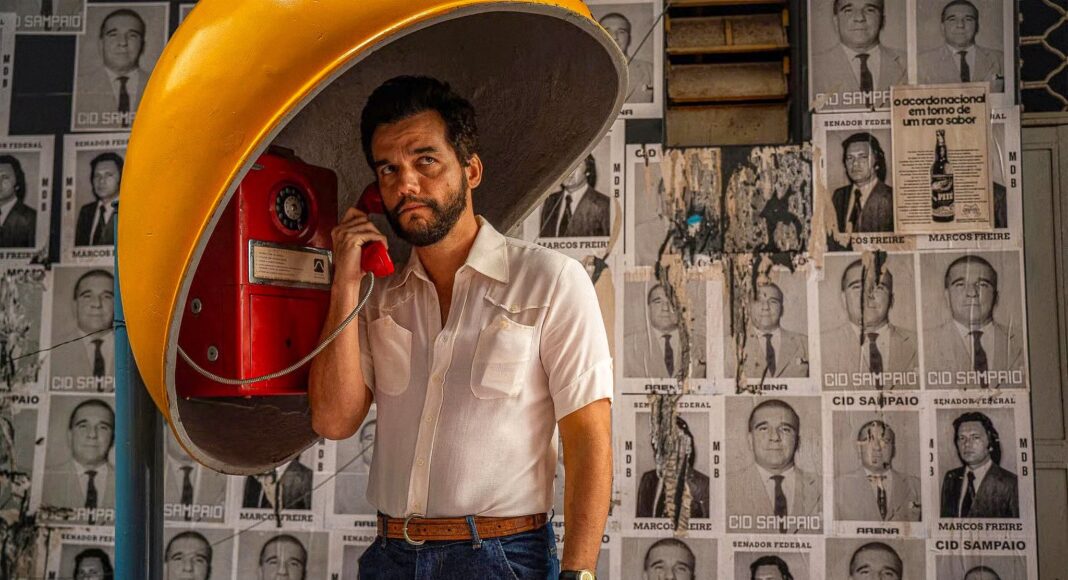
Marcos Colón reflects on the Cannes and Golden Globe award-winning Brazilian film The Secret Agent, directed by Kleber Mendonça Filho, starring Wagner Moura. The film engages questions of state censorship, political repression, and surveillance not by following a reporter chasing a story, but, this time, by following a man hunted by a system terrified of memory.
I last crossed paths with Wagner Moura in the spring of 2023, in a moment that now feels strangely prophetic. I was heading to the Princeton Environmental Film Festival to present my own documentary and he was in Philadelphia filming the HBO series Dope Thief. We met briefly in Rittenhouse Square, exchanged a few words, took a photo, and moved on. At the time, the world was already fraying, but the language of authoritarianism had not yet fully settled into everyday public discourse.
The following year, in Alex Garland’s Civil War (2024), Moura would portray a journalist navigating a collapsing United States. The film unsettled audiences by placing journalism at the center of a dystopian national breakdown, in which reporters are brave, committed, and deeply compromised, chasing truth while feeding an economy of spectacle and adrenaline. Objectivity is not neutrality; it is a flirtation with danger. Survival is not ethical clarity; it is negotiation.
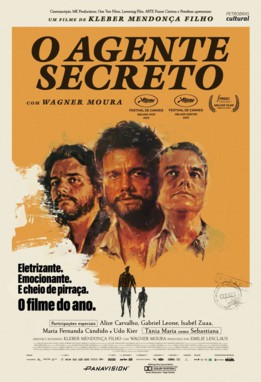
Now, with The Secret Agent (2025), which received major honors at the Cannes Film Festival, including Best Director for Kleber Mendonça Filho and Best Actor for Wagner Moura, and went on to win Best Motion Picture, Non-English Language and Best Actor in a Motion Picture, Drama at the 2026 Golden Globe Awards, the Brazilian actor returns to themes central to journalism from a different vantage point. The film engages questions of state censorship, political repression, and surveillance not through a reporter chasing a story, but this time by following a man hunted by a system terrified of memory. It is worth recalling that Wagner Moura and Kleber Mendonça Filho are both trained journalists, a fact that quietly informs the film’s acute understanding of how repressive power fears documentation.
Set during Brazil’s 1977 Carnival, during the military dictatorship, the film is saturated with journalism even when no reporter is visible on screen. From its opening images to its final silences, The Secret Agent makes it clear that authoritarian power is not only sustained through violence, but through control of information, control of the narrative, and enforced amnesia.
The opening scene sets the tone: a body lies decomposing on the ground near a gas station while Marcelo, a professor returning home to his family, is harassed by a corrupt police officer demanding a bribe. Played by Wagner Moura, Marcelo’s persecution begins not with a crime, but with his mere presence, signaling how authoritarian power turns ordinary life into grounds for surveillance and threat.
As the scene unfolds, the local police ignore the body, which remains on the ground for at least three days during Carnival. A gas station worker eventually steps closer, waving off a pack of hungry dogs circling the stench, and looks at the sheet of cardboard covering the corpse.
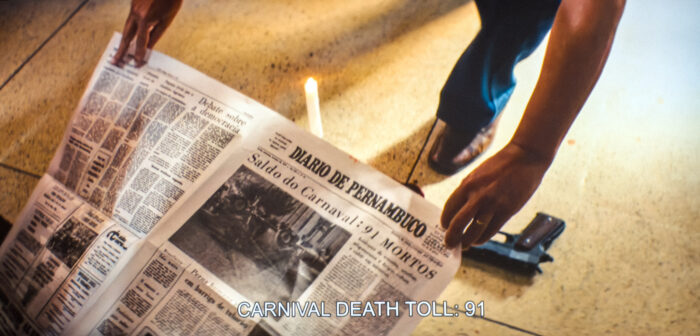
The gesture is quiet, almost compassionate, but devastating in what it reveals: violence is not only tolerated: it is managed, covered, and folded into tomorrow’s headline, ’Carnival Death Toll: 91’, as if death were just another statistic in the season’s noise. In this displacement, journalism becomes both shroud and witness: it hides the body from view while insisting, in plain ink, that it existed.
In a later sequence, when a shark is found with a human leg inside it, the first question asked by authorities is not about the victim, whom the police already know by name, or the reason for his disappearance, but whether journalists are present at the scene. In the film’s world, it is visibility that threatens the authoritarian regime, not the victims of its crimes.
As the film unfolds, we see how communities in Recife consume information through local papers already contaminated by the regime’s agenda. In Dona Sebastiana’s house ‘Edifices Ofir’, the group of refugees in hiding reads the daily news with suspicion and dark humor, not trust. The headlines sit alongside the film’s flashes of magical realism, such as the severed leg that appears to lunge at passersby in the public square, and everyone in the room understands what it signals: the news is planted as a distraction.
Kleber Mendonça Filho skillfully draws on his hometown’s folklore by invoking Perna Cabeluda (Hairy Leg), a popular Recife urban legend, to satirize the dictatorship’s tactics of misdirection and its efforts to conceal state violence and crime. Silence is manufactured. Truth becomes rumor, and rumor becomes danger. This is not the spectacular repression often associated with dictatorship, but its quieter, more effective cousin: soft censorship, narrative engineering, fear disguised as normalcy.
I am no stranger to such repression, having spent much of my career reporting from the Amazon. Journalism in the forest reveals a truth often obscured elsewhere: objectivity is not a shield, and survival is never neutral. It is the fragile space where journalism decides whether truth can endure at all. Here, authoritarianism rarely announces itself with tanks or decrees. Instead, it arrives through administrative choke points and quiet erasures: permits denied, access revoked, information requests stalled, stories discouraged or quietly dropped, and the slow criminalization of those who speak. Violence, inevitably, follows. Journalists disappear.

The disappearance and murders of my friends Bruno Pereira and Dom Phillips are stark reminders of the risks of reporting in territories where truth itself is under siege. I had been in that same territory months earlier filming my documentary Stepping Softly on the Earth, where their bodies were later killed, dismembered, burned, and made to disappear. In my case I received a local warning to leave the area as a gesture of protection.
We are in a war for truth. Sources are exposed and at risk. Communities are misrepresented or erased altogether, from both the narrative and the archive. The Secret Agent understands this terrain intimately. Its tension does not come from action, from the knowledge that speaking freely, even carefully, carries consequences.
Assembling the truth in fragments
One of the film’s most revealing figures is a historical researcher, Flávia (Laura Lufési), who patiently pieces together fragments of erased lives, tracing the shifting identities of Marcelo, also known as Armando, while uncovering the fate of his son Fernando, also portrayed by Wagner Moura, further deepening the actor’s multifaceted performance. Through her work, the film shows how truth survives when direct accounts disappear, reconstructed through archives, testimony, and the careful reading of what power tries to erase.
It is through her findings that we ultimately learn his fate, revealed quietly, almost brutally, in a newspaper headline. Kleber Mendonça Filho’s precise decision to offer no further explanation leaves interpretation in the hands of the audience, ultimately refusing closure and mirroring the violence of historical erasure itself. Flávia’s work reflects what journalism is often forced to become under repression: archival, forensic, indirect. When direct reporting is impossible, truth survives through fragments, testimony, memory, and a stubborn ethic of care, as we can see in the character of Dona Sebastiana (Tânia Maria), a non-institutional archivist, a guardian of those who held the truth.
The Secret Agent also speaks to broader questions about the fragility of truth and journalism in contemporary democracies. Even in the absence of formal authoritarian rule, conditions can emerge that restrict journalistic practice and public knowledge: hostility towards the press, pressure on academic and cultural institutions, and struggles over historical interpretation. In the post-truth society, censorship is rarely singular or explicit – it is distributed across legal, economic, technological, and cultural systems.
The truth of the street
One aspect- The Secret Agent understands with rare precision is that under dictatorship, journalism does not operate only through newspapers or reporters, but also through cities, bodies, and everyday gestures that become unofficial archives of power and resistance. So, the city of Recife (which could be any city in Brazil or in the world) is not a backdrop, but a character where the past, present, and future interact in an exchange of messages.
This is crucial for journalism under repression. When institutions collapse or are co-opted, truth migrates to the streets, the kitchens, the whispered networks, and the marginal figures like Dona Sebastiana, whose home provides a haven for circulation, and transmission.
Journalism, in this sense, is displaced from the newsroom and reconstituted as relational practice, listening, sheltering, remembering, guiding people through danger. The film suggests that the most enduring form of reporting under authoritarianism may not be publication, but preservation: holding fragments together long enough for the future to read them.
Cultivating memory
As such, The Secret Agent proposes a radical lesson for our present moment. When the state monopolizes the narrative, journalism survives not through sensational headlines, but by cultivating memory across time and space, so that what is meant to be erased remains legible later.
The Secret Agent forces us to confront questions that journalism often avoids. When the truth becomes a liability, protecting sources is no longer a technical matter of anonymity or encryption; it becomes an ethical practice of subterfuge. The film shows how survival can depend on fragmentation, on letting stories circulate partially, indirectly, or through trusted intermediaries rather than complete exposure. In such conditions, neutrality is not the absence of position, but a choice shaped by power; a counterpoint to the silence, delay, or restraint that serve authority as efficiently as propaganda. The film reminds us that claims of objectivity under repression often mask unequal risks, where those closest to the truth pay the highest price.
Finally, The Secret Agent makes it clear that historical erasure does not happen in one fell swoop, but through small acts of omission, files lost, names altered, details withheld, stories left unfinished. Like Moura’s character who is trying to find any existing record of his mother. This reminds us that journalism’s task, then and now, is not only to report events as they unfold, but to resist enforced amnesia by preserving fragments, sustaining memory across time, and ensuring that what power seeks to dissolve remains available for future reckoning.
Most urgently, The Secret Agent asks whether journalism can still function as a tool for freedom, or whether it risks becoming, once again, an instrument of repression if it fails to recognize the moment it is in.
The Secret Agent does not seek to explain dictatorship, but it makes you feel how authoritarianism can seep into daily life, how it rearranges relationships, and how it turns memory into contraband. In this sense, cinema can offer something journalism often cannot. It grasps a moment in time. It allows silence to speak. It makes absence visible. Where journalism must race against deadlines and algorithms, film can linger, insist, and haunt.
Act before democracy dies
Yet cinema cannot replace journalism. What it can do, what this film does so powerfully, is remind journalists of what is at stake before systemic collapse, not after. It insists that defending democracy is not a retrospective exercise. It is a daily practice, rooted in courage, protection of sources, refusal to normalize repression, and an ethical commitment to communities whose lives are made precarious by exposure.
The question now is whether journalism is willing to recognize the early signs of authoritarianism, not as abstract threats, but in the conditions shaping who can speak, who is heard, and who pays the price for telling the truth.
Taken together, Civil War and The Secret Agent are not films about journalism after democracy has fallen, but about journalism when the failure or survival of democracy still matters. One shows a future where reporters document the wreckage of a nation already lost; the other reminds us that the work of truth often begins earlier, in fragments, whispers, and acts of memory that resist erasure before collapse becomes irreversible.
If these films offer a warning, it is that journalism does not save democracy after it dies. It matters most in the fragile, contested space before everything breaks. The Secret Agent reminds us that when memory is erased, repression does not need to raise its voice. Silence will do its work.
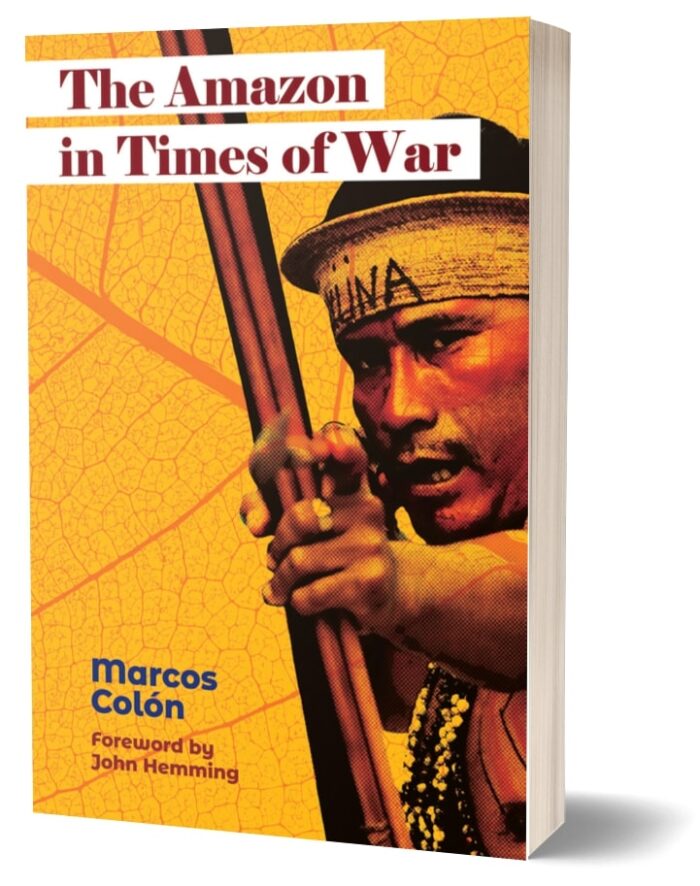
MARCOS COLÓN is the Southwest Borderlands Initiative Professor of Media and Indigenous Communities at Arizona State University’s Walter Cronkite School of Journalism and Mass Communication. He is a writer, director, and producer of Beyond Fordlândia: An Environmental Account of Henry Ford’s Adventure in the Amazon (2018) and Stepping Softly on the Earth (2022), and the author of The Amazon in Times of War (LAB, 2024). He is also the organizer of Utopias Amazônicas (2025).