
This article was originally published by Instituto Humanitas Unisinos on 25/11/2025. You can read the original here. It was translated from Portuguese for LAB by Ben Kara.
‘Indigenous Peoples, poor countries – those who contributed least to the crisis are the ones who show real ability to confront it,’ writes Jelson Oliveira, professor of philosophy at Pontifícia Universidade Católica do Paraná (PUCPR) and founding-director of the Hans Jonas Professorship.
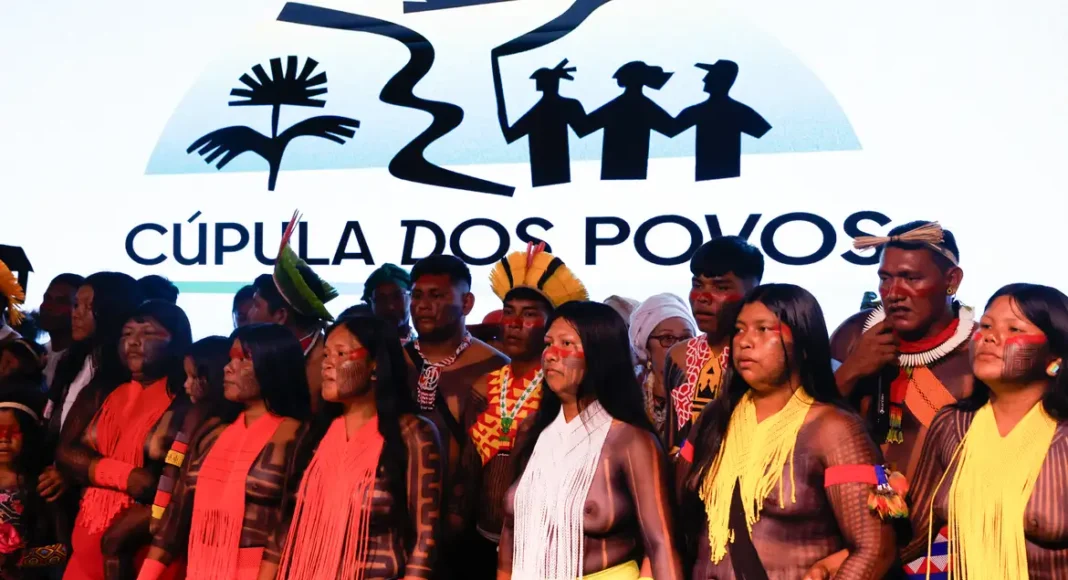
I do not say this out of any kind of naive romanticism or something of that sort, but because its these groups that still stay closely connected to the land, water, the rhythm of life and intergenerational responsibility. But above all, because they are the primary victims, the most vulnerable, and those that possess the wisdom, understanding, feelings, and methods capable of changing where things are headed. These people who travelled here from further up river, dancing with chocalhos [shakers] in hand, wearing headdresses and singing sambas, brought with them cause for hope.
Jelson Oliveira
Amongst the more than five thousand Indigenous people who participated in COP30 and joined the Marcha dos Povos (People’s March), which gathered 70 thousand people in the streets of Belém on the morning of 15 November 2025, circulated a phrase that sounded more like a prophecy: ‘We are the solution.’ Now that the conference is over, we can conclude that this statement articulates a great truth: an event which began with such great expectations ended in disappointment for the organisations and people who fight every day to defend the planet. The two issues deemed most urgent (greater investment from wealthy countries in climate finance and an agreement to put an end to fossil fuels) were not even mentioned in the final document. Meanwhile, the more limited alternative, as its name suggests (Mapa do caminho [Roadmap]), put forward by the Brazilian government amounted to little more than a mere voluntary commitment on the part of a few countries led by Colombia.
What we know for certain is that the fossil fuels and agribusiness lobbies impeded real progress on these issues, condemning future generations to live in a hotter, ecologically poorer and socially more unequal world. At COP30, the wealthy countries – prisoners to their own productive surpluses, bound to uphold a system that exploits nature to its limits – showed their inability, their unwillingness even, to resolve the climate question. Never before has Mark Fisher’s notion of ‘capitalist realism’ been so evident: for the rich ‘it’s easier to imagine the end of the world than the end of capitalism.’
Therefore, those who went to Belém did not leave surprised. The wealthy of the world have long made their intentions clear. And we have known this for a long time. It was not by chance that on the eve of ECO92, Hans Jonas expressed such scepticism towards this type of event, arguing that ‘those who do not find themselves directly threatened will not fight to truly reimagine their way of life.’ This is exactly the problem: the wealthy countries of the Global North feel the effects of the climate emergency less and have more resources to confront them. Meanwhile, the poor countries of the Global South suffer a ‘triple injustice’. Despite being among the least responsible for creating the crisis (since they were historically excluded from the supposed benefits of the progress that brought it about), they are the first to feel its impacts, and in its most devastating forms. Moreover, without the means to implement adequate climate recovery and adaptation processes, they are witnessing these inequalities become more structurally entrenched. And yet, we are faced with the question of climate justice, which demands (precisely for reasons of justice) that rich countries be ready to make sacrifices – and not just for the sake of poorer countries, but for the whole planet, and even for themselves. Jonas is also emphatic on this point: ‘if we are not ready to make sacrifices, there can be little hope.’ And without a willingness to make sacrifices, debates like those that took place in Belém are no more than ‘dubious discussions’ and ‘conversations among the privileged.’
COP30 was one of those moments in which we see the illusion of progress acquire renewed vigour and expression, like a kind of fetishism. But it was also in Belém that we saw all manner of interests, causes, and people come together to reveal their contradictions and inefficiencies. Be it the presence of those who have been excluded from the current development model. Or, because the urban infrastructure built specifically for the event did not reach the peripheral populations, who live next to sewers and open dumps, travel in packed and suffocating buses, and suffer due to the lack of healthcare and quality education. Belém was the proof that the rich men of the North do not want to renounce the model of the world that they have historically fabricated and that, fundamentally, their gains make them blind to the victims of global warming, who will always be here, in the peripheries of the world, dying in their thousands. Belém (and all the poor cities of the world) shows us, every day, that climate justice cannot be achieved ‘within the current economic system and its structures of governance.’
This inescapable tension – characteristic of the capitalist system founded on extractivism, fossil fuel exploration, deforestation, and the exploitation of natural resources – can only be resolved by changing the socioeconomic regime. As Jonas has already pointed out, now is the hardest moment, because a fear of restraint, moderation, and abnegation has arrived precisely at the point that we have attained more power and things look more promising. If poor countries are still to achieve decent levels of wellbeing for their people, one would expect wealthy countries to show a greater capacity to rein in their developmentalist zeal. Hans Jonas reminds us that, ‘we have more room for manoeuvre on questions of moderation and abnegation in Western industrialised countries. Even a substantial slowing of growth would leave us fairly well off.’
Yet, the problem is that wealthy economies are founded on a logic of natural resource exploitation that they refuse to put aside, and which consequently traps all of us in a suicidal game, the effects of which are the daily catastrophes unequally impacting populations around the world. As we all know, the current model for growth always requires more destruction and natural resource exploitation. Therefore, only the stabilisation of the economy and the imposition of economic limits on rich countries could save us from a perverse end. Insofar as COP30 was made to fail to deliver on its most urgent objectives, this economic model is pushing us into the abyss. Jonas echoes Fischer on this subject, asking himself: ‘Why is it not possible to stabilise the economy? Why must national productivity always grow without interruption?’ It would require imposing on corporations and governments ‘demands contrary to their own existential mechanisms: expansion, the maximisation of profit and benefits,’ states Jonas in another interview. Of course, it would require the rich to accept a decrease in production and consumption to slow the exploitation of nature: ‘Our appetite for consumption must not grow constantly, as has happened up to now. We must adopt a more moderate way of life. If we are not ready to make sacrifices, there can be little hope.’ As we recall from Jonas’ previous work, his position articulates a critique of ‘the desire for unlimited power’ and the necessary recognition of the limits of available natural resources to fuel the limitless expansion of economic growth. He says: ‘the question to ask here is not how much man can still achieve – on this point one can be optimistic about Promethean potential – but how much nature can take.’ And this incontrovertible point is an obligation to rich countries, since ‘one cannot go to the hungry and those who need the earth, with whatever exaggerated pretence and preach abnegation.’
Indigenous Peoples, poor countries – those who contributed least to the crisis are the ones who show real ability to confront it. For this reason, it was not by chance that COP30’s most impactful thread came from social and ecclesiastic movements, NGOs, and primarily, Indigenous populations. They demonstrated what we already knew: faced with impending climate collapse, only the poor (Indigenous Peoples, peripheral communities, and historically exploited countries) seem truly willing and able to save the world. I do not say this out of any kind of naive romanticism or something of that sort, but because its these groups that still stay closely connected to the land, water, the rhythm of life and intergenerational responsibility. But above all, because they are the primary victims, the most vulnerable, and those that possess the wisdom, understanding, feelings, and methods capable of changing where things are headed. These people who travelled here from further up river, dancing with chocalhos [shakers] in hand, wearing headdresses and singing sambas, brought with them cause for hope.
It did not go unnoticed that this hope was born in the heart of the Amazon, where all of these Peoples can be found. The climate in Belém during the fortnight of the conference – the dense heat, evening showers, and diverse mixture of Peoples – helped recall the deep meaning of this territory. The forest displayed itself to the world and, in a sense, to Brazil itself – which understands little of the real Amazon – its colours, faces, feathers, leaves, and narratives that reveal strength and vulnerability. Each rainy evening pierced through by almost unbearable heat, it became more clear that global climate stability depends directly on the ability of humanity to protect this ecosystem and learn from those who have lived in it for thousands of years.
One of the greatest lessons from the event has been that adaptation is not a concession offered by states, but a fundamental human right: whole populations have the right to the minimum conditions to combat the storms, droughts, floods, and displacements already happening. And yet, there was palpable frustration because the approved measures, although important, were inadequate for such an emergency. While before the consensus was a maximum global temperature increase of 1.5°C, the event ended conceding to at least 2°C by the end of this century – which will be catastrophic for different natural habitats. Ultimately, the ones who decide did not hear the voices of the victims who, despite having sat at the negotiating table in greater number than before, do not command the power to decide. So-called ‘multilateralism’ continues to be partial, ensnared by economic interests that prevail over life. That is why it is imperative to fundamentally reform the international decision-making system, to go beyond the logic of states and abandon the paralysing requirement for consensus. The time of infinite negotiations must end! It is not fair to wait another 10 or 15 years for governments to ‘decide how to decide,’ while lives that cannot wait are sacrificed.
This does not mean that COP30 has been a total failure. Events like it, though slow, have helped decelerate the process of destruction, forcing governments and businesses to heed the science, make commitments, create mechanisms for transparency, and recognise the urgency of the climate situation. But they also make clear that there is no real way forward as long as we insist on adhering to the same model of civilisation responsible for such inequality and devastation. Climate justice, as I have stressed, requires the redistribution of power, historical reparations, and the acknowledgement of the centrality of marginalised voices.
Ultimately, COP 30 has left us with a truth as simple as it is difficult to accept: it is not enough to wait for international agreements or for the good will of the economic powerhouses. It is necessary to radically transform the way we live. The solution lies in ways of life that are simpler, more frugal and responsible, in which consumption ceases to be a measure of value and instead human and non-human life return to the centre of decisions. Only in this way can we ultimately imagine a future that is possible for all.
Therefore, let us remain unaligned:
- Let’s continue to refuse to passively accept the premise that environmental depredation is the only possible way of living on this planet;
- Let’s keep foregrounding this point in all of our narratives;
- Let’s maintain our ethical concern for persistent climate injustices in each of our daily actions;
- Let’s constantly reaffirm the need to question, suggest, and transform, breaking with indifference in the face of human suffering;
- Let’s reject resignation or fatalism, and let’s continue to celebrate the desire for real and radical change to our ways of life. Fundamentally, the point is to keep dreaming, without normalising the facts, and refusing to accept the world as it is;
- Let’s retain an outlook that is critically, ethically, and politically engaged, valuing the innumerable practices of resistance and mitigation spread around the world, and which are independent of big policy decisions.
The truth is that time no longer belongs to diplomacy, it belongs to the forests that are burning, the rivers that are drying up, the animals that are falling into extinction, and the humans of the future. They all depend on the stance of citizens who must now do what needs to be done.