Milei’s plan to reprivatize Argentina’s largest water company is uniting the country’s fractious trade unions in opposition. Meanwhile inflation remains high, living standards are pinched, and university students are mounting massive demonstrations against cuts in education. The country’s opposition, however, remains divided. With 12 months before the next presidential election, what are Milei’s chances of a second term?
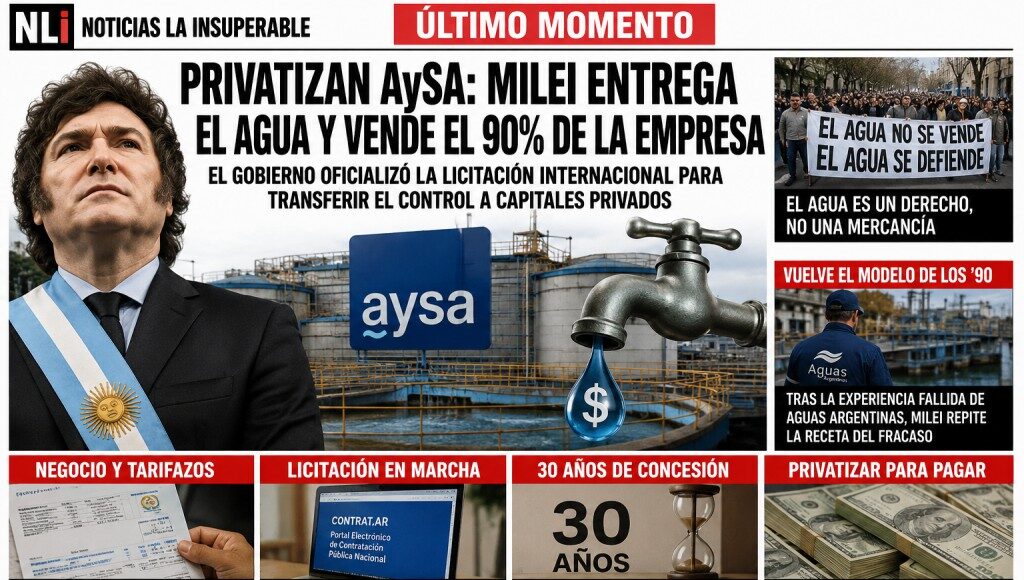
Argentina’s largest water and sanitation utility provider, Agua y Saneamientos Argentinos (AySA), is set to become the latest in the long line of state-run firms privatized by libertarian President, Javiar Milei.
The final bid of US$340.2 million was submitted on 8 October 2026, by a multinational consortium of Argentine, Brazilian, and Dutch firms, giving them a 90 per cent share ownership, the other 10 per cent remaining in union hands.
The contract is valid for 30 years and can be extended for an additional decade. The schedule calls for the signing before the end of the year, while the new operator is scheduled to have full control by February 2027.
Though it marks Milei’s most profitable sale since the privatization push began, it falls roughly 30 per cent short of the US$500 million projected by the economy ministry.
AySA had long been on Milei’s list for privatization. It provides water and sanitation services to 14 million people in Buenos Aires City and the 26 districts of Buenos Aires Province, making it one of the most important public infrastructure companies in Argentina. It also has a history of strong union engagement and influence, and is thus a threat to Milei’s anti-union agenda.
The Sindicato Gran Buenos Aires de Trabajadores de Obras Sanitarias (SGBATOS) is the union that represents the workers of AySA, and the sanitary workers of Buenos Aires more broadly; its general secretary, José Luis Lingeri, has held the role since 1984.
Now we privatize, now we don’t
SGBATOS has held a 10 per cent share in AySA since 1993, when the first privatization of the water and sanitation services of Buenos Aires occurred. The original state utility, Obras Sanitarias de la Nación (OSN), was sold to a private consortium led by the French company Suez, with the Catalan company Aguas de Barcelona (Agbar) and Vivendi as partners, creating Aguas Argentinas.
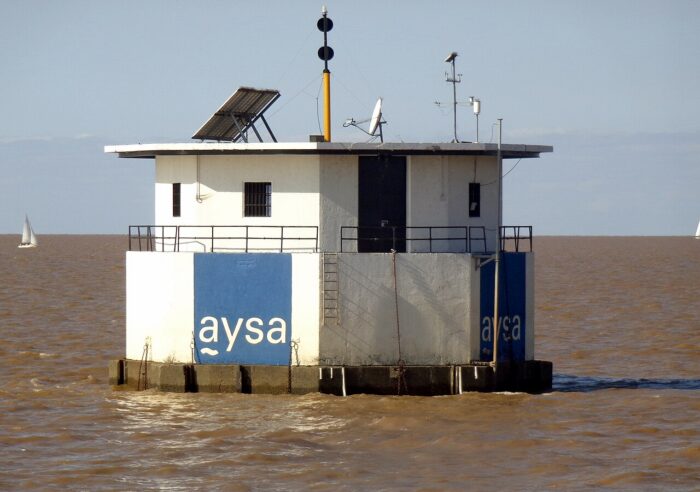
As part of this 1993 privatization, eligible former employees of OSN who transferred to Aguas Argentinas were granted access to a 10 per cent employee share-ownership scheme under Argentina’s State Reform Law No. 23.696 and the statutory mechanism, Programa de Propiedad Participada (PPP).
Then, Néstor Kirchner assumed office in 2003, campaigning on an agenda of economic restructuring and ‘productive capitalism’, looking to create ‘un país en serio’ (a serious country).
In his first year he began negotiation with Suez over the future of Aguas Argentinas, calling not for nationalization but for improved services and investment, as outlined in the original 1993 contract.
This original contract required $4 billion of investment during the 30 years of the concession, an amount that was raised to $5 billion years later, but the consortium had only invested $1.5 billion in the first 10 years of service. He also highlighted the presence of nitrate in certain parts of the water system, low water pressure, and rising costs.
For the next three years there were intensive negotiations between the government and the companies. Eventually, in 2005, talks collapsed and Suez stepped away. In 2006 the contract was rescinded, and AySA was created. Carlos Humberto Ben, previously the Deputy Director of Aguas Argentinas, became the new director of AySA, and José Luis Lingeri stayed on as union leader.
The government assumed control of 90 per cent of the shares, and the workers, via SGBATOS, held on to their 10 per cent, giving them some continued influence in decision making at the board level.
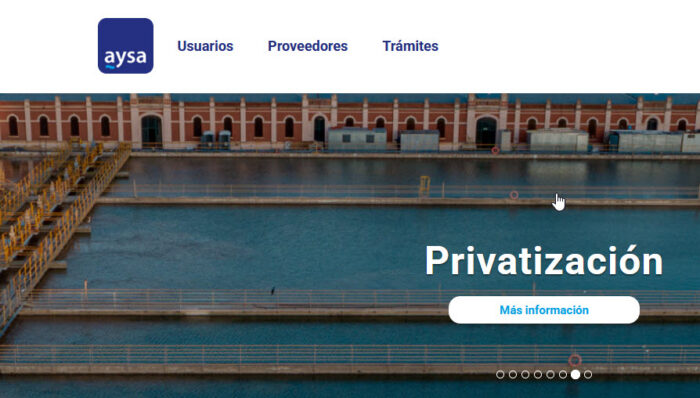
For the next 20 years AySA was a nationalized company. Its performance through this time was met with mixed reviews. It successfully increased piped drinking water coverage from 76 per cent in 2006 to 85 per cent in 2022, as well as increasing sewer coverage from 57 per cent to 72.6 per cent through the same period.
But the government claims AySA received over US$13.4 billion in Treasury transfers between 2006 and 2023 and water losses reached 42 per cent. Milei has used these figures to justify privatization.
The Wider Picture
The privatization of AySA comes at a crucial time for Milei and his party, Libertad Avanca. His term is coming to an end, with elections set for October next year, but his radical politics of deregulation have struggled to satisfy a population increasingly beset with high prices and financial insecurities.
Though the previously massive annual inflation rates, at their peak 211 per cent, have fallen to a smaller, but still huge, 33.5 per cent, social and economic problems remain acute.
Critics point out that wage compression and reduced consumer purchasing power have accompanied the noted drop in inflation, meaning that day-to-day life has become anything but easier.
Gerardo Maria Martinez, 52, works full time at Ezeiza International Airport, loading and unloading goods for import and export. Struggling monthly, he signed up for Uber and now spends five evenings a week driving around the city.
‘It’s worse now,’ he says, ‘everything is more expensive, the basic things, the supermarkets, it’s impossible’.
This feeling of insecurity from high prices has only been compounded by a difficult job market and increasingly limited worker rights.
A recent poll, conducted by Management & Fit consultancy firm, found that 19.8 per cent of respondents identified unemployment as Argentina’s main problem. This feeling is supported by the statistics, which show that unemployment rose through the second quarter of 2026, to 7.9 per cent.
In step with the rise in unemployment, the informal job market, ‘trabajo en negro’, rose to 44.2 per cent during the first quarter of 2026, up from 42 per cent in the same period of last year. Informal workers suffer from financial and health insecurities, with significantly worse pay and social protection benefits when compared with formal workers.
Meanwhile, there is widespread anger caused by the proposed repeal of a land law which caps foreign ownership of rural Argentinian land at 15 per cent. Milei wants to rescind the law, signed in 2011, removing the cap entirely. This proposal has inspired a difficult legal battle, which is currently ongoing.
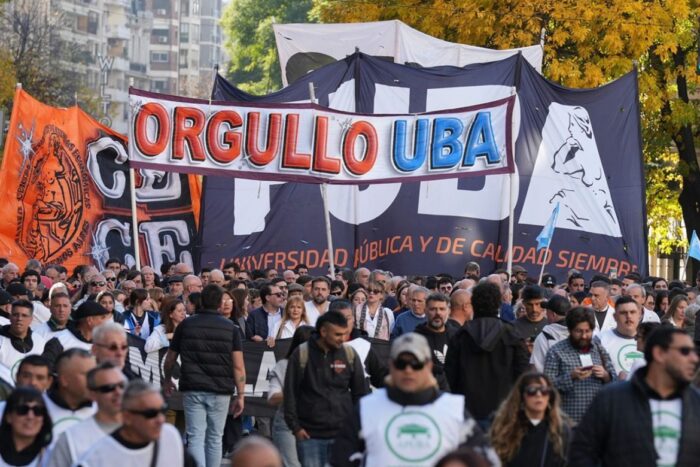
Universities, too, have come under attack. Under Milei, funding to public universities plummeted by 40 per cent, cutting real wages, derailing infrastructure projects, and leading to waves of staff resignations. The supreme court later intervened, ordering the government to fund Universities, but serious damage had already been inflicted.
Meanwhile, talks of building vast foreign data centres, increased external mining contracts, and a rapidly expanding importation culture inspire further frustration, piling increased pressure on the government; all this in a nation known to be apprehensive of globalism, an ideology championed by Juan Perón, and the Peronist movement.
For some, the recent news of AySA privatization, sold to Rowing SA (Argentina), Arcos Saneamento e Participações SA (Brazil), PHX Aqua AR BV (Netherlands) and Transclor SA (Argentina), is further evidence of Milei’s wish to sell off the nation.
Las Malvinas son nuestras?
However, his supporters say Milei is creating an internationally competitive country, with powerful allies like the US lending a hand. They also point to the ongoing debates surrounding Argentina’s claim to the Falklands / Malvinas islands and mining and oil exploration contracts.
The Sea Lion oil fields, located about 220 kilometers north of the islands, hold an estimated 1.7 billion barrels of oil, with extraction planned to begin by early 2028. The operation is primarily led by Navitas Petroleum (an Israeli-listed firm) and Rockhopper Exploration (a UK firm).
The licenses for the project were granted by the British-administered Falkland Islands government. Illegitimate in the eyes of Argentina, the project has been labelled an ‘illegal plundering of national resources’ within its maritime territory.
In tandem with this, Milei has restarted debates surrounding Argentina’s actual claim to the islands’ sovereignty. In a fiery speech at the UN on September 23, 2026, he labelled the organization ‘useless’ and called on the UK to reenter negotiations.
These claims have been backed in vague terms by Trump, who mentioned he may be ‘re-evaluating’ the US position regarding the islands. The seriousness of these statements is debatable, but the recent announcement of the ‘Andes-Atlantic Corridor’, the wider ‘Donroe Doctrine’, and existing ideological kinship between the US and Argentine Presidents have raised serious questions.
In Argentina, however, many have attacked these calls as little more than populist politics, examples of hypocrisy.
In all these various disputes, the historic cry of political corruption rings out. Milei promised to end the corruption of Argentinian politics, to take down ‘la casta’ (the caste), as he called it, but has continually become embroiled in corruption scandals of his own. The $Libra scandal of early 2025, the ANDIS Bribe affair, and the resignation of Manuel Adorni, have all damaged the government’s image.
La patria no se vende
The popular response to all these events has been a vast wave of protest and civil action.
The ‘foreignization’ of land mentioned above, and the general courting of foreign billionaires has spurred demonstrations across the country. Under the slogan ‘la patria no se vende’ (the homeland is not for sale) thousands have taken to the streets.
Threats to workers’ rights have also triggered protest. In response to a restrictive labour law signed in February, which, among other things, cuts redundancy payments, extends the working day without overtime pay, and limits the right to strike, workers and trade unionists staged a 24-hour general strike, the fourth general strike since Milei took power. Afterwards, demonstrations continued around the country.
The largest protests occurred after the cuts in university funding, the fifth such national demonstration taking place on 15 October. 1.5 million people around the nation took to the streets, an estimated 600,000 in Buenos Aires city alone. Smaller, continuous protests occur weekly, like the Pensioner Marches, which are held every Thursday outside Congress.
However, a formidable opposition leader, with broad political support, national appeal, and a succinct vision of the future has yet to emerge.
The Peronist movement, the dominant ideology of Argentine politics since the 1940s, is divided. The Justicialist Party, the movement’s largest, is still led by Cristina Fernández de Kirchner. But, the ex-President, who also served as Vice President under Alberto Fernández, and is the widow of Néstor Kirchner, is currently serving a 6-year sentence, under house arrest, for corruption charges. As it stands, she’s banned from holding public office, so, unless the Argentine courts overrule the decision, she will not be able to run.
Despite this, she continues to wield substantial influence over the party and the movement. Any endorsement she issues would be a double-edged sword, securing the support of her base, while alienating the numerous groups that reject her.
The most likely candidate for opposition leader is current Buenos Aires Province governor, and Fernández de Kirchner’s ex-economy minister, Axel Kicillof. Though Kicillof has not yet formally announced he is running, it’s as good as certain. ‘Count on me,’ he declared at a rally in September, so that ‘Argentina has an alternative that allows us to end this model… that allows us to begin a different chapter’.
Kicillof’s relationship with Fernández de Kirchner is complicated: once close allies, their relationship has come under strain in the last few years, causing tension within the Peronist base.
Kicillof offers a clear political break from Milei, He worked on nationalization projects and secured price controls during his stint as economy minister, and has been consistent in his condemnation of the current administration. As it stands, he’s the most popular prospective candidate amongst Peronists, with a recent poll suggesting he maintains a 41 per cent positive image rating, with 58 per cent of those identifying as Peronists or Kirchnerists favouring him as their presidential candidate.
Sergio Massa, who lost to Milei in the 2023 elections, is another possibility. A centrist figure, Massa has historically acted as a bridge between differing Peronist ideologies, building coalitions designed to appeal to moderate voters. But his defeat in 2023, his record as economy minister under Alberto Fernández, when yearly inflation peaked, and his perceived divisiveness amongst leftist groups, weakens his Presidential prospects.
Juan Grabois and Guillermo Moreno are also important figures in the movement, but their prospects for candidacy are remote .
In a recent interview Steven Levitsky, a professor of Latin American Studies at Harvard University said of the upcoming election ‘right now, Peronism is positioned as the most viable alternative’ to Milei. What this Peronism will look like, and who will steer the ship, is yet to be determined.
But other opposition figures, outside the Peronist movement, have also registered increasing support. The popularity of Myriam Bregman, for example, risen massively over the last few years. Bregman is a lawmaker for The Partido de los Trabajadores Socialistas (PTS), and part of the Frente de Izquierda y de los Trabajadores–Unidad (FIT-U) coalition. A Trotskyist champion of worker rights, LGBTQ+ rights, and the environment, Bregman topped a set of May polls as the politician with the best image in the country.
In a recent speech in Córdoba, Bregman stood in front of a crowd of 7,000 and criticized the Milei government, the Peronist movement and shined a light on feminist, worker, and student struggles across Argentina and South America.
‘We are a part of a much larger struggle, a collective struggle’ she said, ‘we are going to fight on all fronts, including the electoral one; we are not going to give them anything… we are proud feminists, socialists, internationalists and revolutionaries’.
Despite Bregman’s popularity, and the FIT-U’s strong performance in the 2025 midterm elections, they face an uphill battle if they are to rival the Peronist movement; not least because the broader left coalition struggles with ideological infighting.
These are but a few of the many questions facing Argentine politics as we go into election year.
If Milei can prove his arch-capitalist agenda is working, and demonstrate a tangible improvement in the lives of ordinary Argentinians, and if the current opposition, whether Peronist or not, remains divided, his re-election remains possible.
But, if people like airport worker Gerardo, who have had to take on more work, cut back on essentials, and limit important recreational activities, if such ordinary workers continue to feel that Milei’s ideas fail them, the political experiment which began not long ago, may soon come to an end.
Main image: composite from Noticias la Insuperable.