
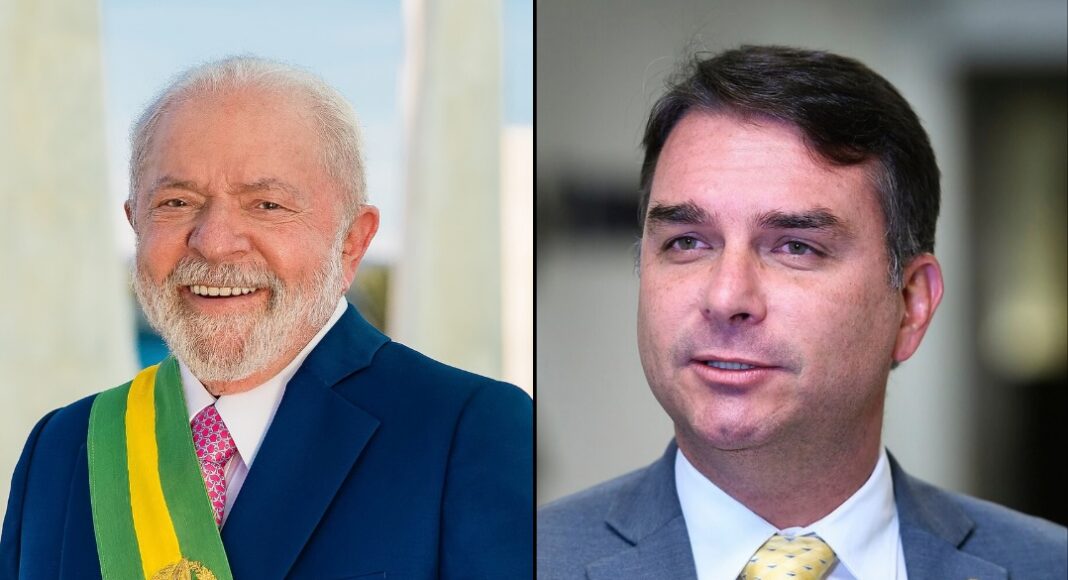
The first round of Brazil’s presidential election on 4 October, gave a slim majority to right-wing candidate Flávio Bolsonaro. LAB’s Brazil expert Sue Branford examines the disastrous outlook for the country, and especially for the Amazon, if Bolsonaro wins the run-off on 25 October.
To the consternation of all on the left, the far-right presidential candidate, Flávio Bolsonaro, finished first in Brazil’s presidential race on Sunday (4 October), winning 47 per cent of the votes against 45 per cent for Lula, the country’s left-of-centre president.
Although history suggests that those topping the poll in the first round win in the second, Lula, a veteran politician, has shown great skill throughout his life in building coalitions. If he can weave new alliances to gain the votes of most of those who voted for the ten eliminated candidates, he could still top the poll in the run-off on 25 October.
Even if Lula pulls off this remarkable feat, he will face a hostile Congress, where there is no second round. If Lula fails, the erosion of democracy will forge ahead, unopposed.
There is no doubt that, if Bolsonaro wins, Brazilian democracy will be under serious threat. Flávio is the eldest son of Jair Bolsonaro, who was president from 2019 to 2023 and is serving a 27-year prison sentence for, among other crimes, plotting a coup after losing the 2022 election. The failed coup included riots in Brasília on 8 January 2023, where, following Lula’s inauguration, the mob of Bolsonaro supporters attacked and severely damaged the buildings of Congress, the Supreme Court and the Presidency, hoping to provoke a military coup and issuing credible death threats to Lula and his Vice President, Geraldo Alckmin.
An uncharismatic and insipid politician, Flávio has said that, if elected, his first measure will be to release his father but, to do this, he will need Congressional approval. This may be possible because right-wing parties, including parties from the extreme right, did better than expected in the elections for Congress, where there is no second round. Many support Bolsonaro.
Jair Bolsonaro is an exceptionally unpleasant and dangerous politician. He has links to Rio de Janeiro’s militias and is suspected of corruption – from a scheme to misappropriate public funds in the Rio de Janeiro legislative assembly to receiving funds from Daniel Vorcaro, the protagonist of the biggest financial fraud in Brazilian history, involving the 2025 collapse of Banco Master with serious implications for public funds and pensions.
Flávio Bolsonaro has publicly expressed support for the militias, calling them ‘crime-fighting patriots’ and saying that they are ‘welcome’ in the city. He has done this even though the militias have a fearful record – they have committed serious crimes, including extortion, drug-trafficking and murder, and have been involved in violent acts against those who resist their control. His personal and political networks include figures directly linked to the militias.
If Bolsonaro triumphs, Brazil, Latin America’s powerhouse, will join Latin America’s steady march to the right, a trend championed by US President Donald Trump. Trump clearly wants to reclaim Latin America as the US’s ‘backyard’, emphasising a return to the Monroe Doctrine (renamed by Trump himself as the Donroe Doctrine) by which the US warned European powers in 1823 not to interfere in the affairs of the Americas, strengthening the exclusions in 1904.
Flávio Bolsonaro has already made it clear that, if elected, he will deepen links with Donald Trump by aligning Brazil’s economic and political interests with those of the US and has expressed support for the so-called Shield of the Americas, a US-led international coalition established in March 2026 by Trump.
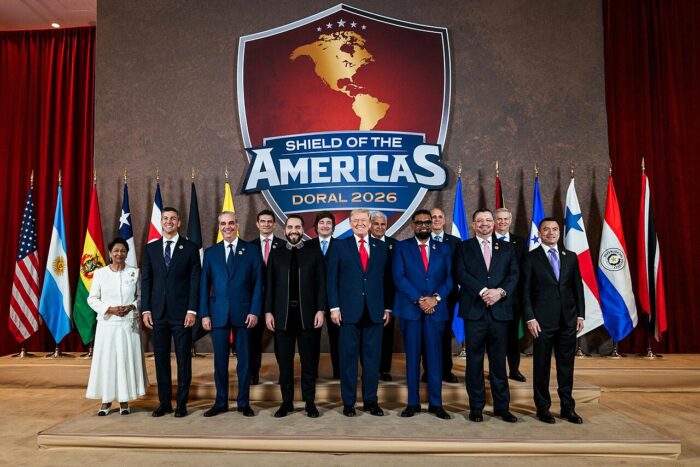
This Shield claims to be fighting crime and insecurity but it prioritizes almost exclusively military solutions, ignoring the root causes, such as poverty and social insecurity.
It is really an attempt by Trump to reassert control in what he sees as the US backyard. It is a drive to prevent the region forging close military and political links with China, with which Latin America already has profound economic relations. China is Brazil’s largest trading partner.
Congress and the Supreme Court
Bolsonaro’s right-wing Liberal Party (PL) also emerged as the biggest winner in Congressional elections. It won 121 of the 513 seats in the Chamber of Deputies and 19 of the 54 Senate seats, making it the largest party in both houses. This means that, if elected, Bolsonaro will enjoy a healthy working majority in the next Congress.
Whoever is elected President, the new Congress will be extremely reactionary – opposed to environmental protection, opposed to measures to protect minorities and opposed to measures which protect or advance human rights. Congressional support may be enough to allow Bolsonaro to achieve his aim of granting amnesty to his father.
Worse still, the Senate’s pro-Bolsonaro bloc may be able to scrape together the 54 votes needed to impeach the Supreme Court justices who convicted Bolsonaro. This would be a serious infringement of the autonomy of the Supreme Court, one of the pillars of Brazilian democracy.
In any case, if Bolsonaro wins the Presidency, he may be able to appoint four new Supreme Court judges, all of whom will back him. With two of the 11 judges already part of the pro-Bolsonaro faction, he will have a majority there, whether or not the other judges are impeached.
Over the past four years, the Supreme Court has blocked some of Congress’s unconstitutional moves and excesses. If the Court loses its independence, Brazilian democracy will be seriously threatened.
Will the Amazon reach a tipping point?
Under the Donroe Doctrine and the right-wing governments of Peru, Colombia, Ecuador and now potentially Brazil, nearly all of the Amazon will be held hostage to a project based on the limitless exploration of nature.
One of the most serious consequences of the election results is that, whoever wins the presidential runoff, for the next four years Congress will be hostile to attempts to push through policies to deal with the country’s environmental, climate, Indigenous and human rights crises, and is likely to further weaken the inadequate legislation that is currently in place.
The Amazon region is undergoing rapid deforestation. The forest, which used to be an important carbon sink, is already emitting more carbon than it absorbs, a clear sign that it is close to the tipping point, that will trigger a process of savannization.
It was one of the regions which gave strongest backing to Bolsonaro, with support most marked in municipal districts that have experienced widespread deforestation. For instance, he won 84 per cent of the vote in Novo Progresso, a region plagued by land theft. The land thieves know that, with a Bolsonaro government, they will not be held to account for the crimes they have committed.
As those of us who have reported from the Amazon region are well aware, people living there know the consequences of what they are doing. But very few people are willing to make the huge personal sacrifice needed to oppose what is going on in isolation, without support from Brasília, particularly if it is evident that by itself this will change nothing.
The only significant difference can be made by governments. This year, under Lula, deforestation in the Amazon has fallen to its lowest level for a decade. He has promised to end deforestation by 2030, a highly ambitious target. But such action is urgently needed if the tipping point is to be avoided.
The Amazon forest plays a key role in stabilizing the world’s climate. Upsetting this equilibrium risks hurtling the world into an unprecedented climate emergency. While there have been serious threats at other times in Latin America’s history to commodify nature (such as the drive to bring cattle ranching to the Amazon), the consequences today lead to the very real risk of human extinction across the entire planet – a frightening prospect that is absent from electoral debate.
This is an edited version of an article prepared for Red Pepper. The author is grateful to Stanton Geyer for his suggestions.
Main image: Composite image of President Luiz Inácio Lula da Silva and Senator Flávio Bolsonaro. The photograph of Lula was taken by Ricardo Stuckert for the Palácio do Planalto on 16 February 2023 and is licensed under Creative Commons Attribution 2.0 (CC BY 2.0). The photograph of Flávio Bolsonaro was taken by Edilson Rodrigues/Agência Senado during an interview in Brasília on 12 May 2022 and is licensed under Creative Commons Attribution 2.0 (CC BY 2.0). Both photographs have been cropped and combined for this article.
Sources: Wikimedia Commons, “Foto oficial de Luiz Inácio Lula da Silva (estreita).jpg” and “Entrevistas Diversas (52068540141).jpg”.