
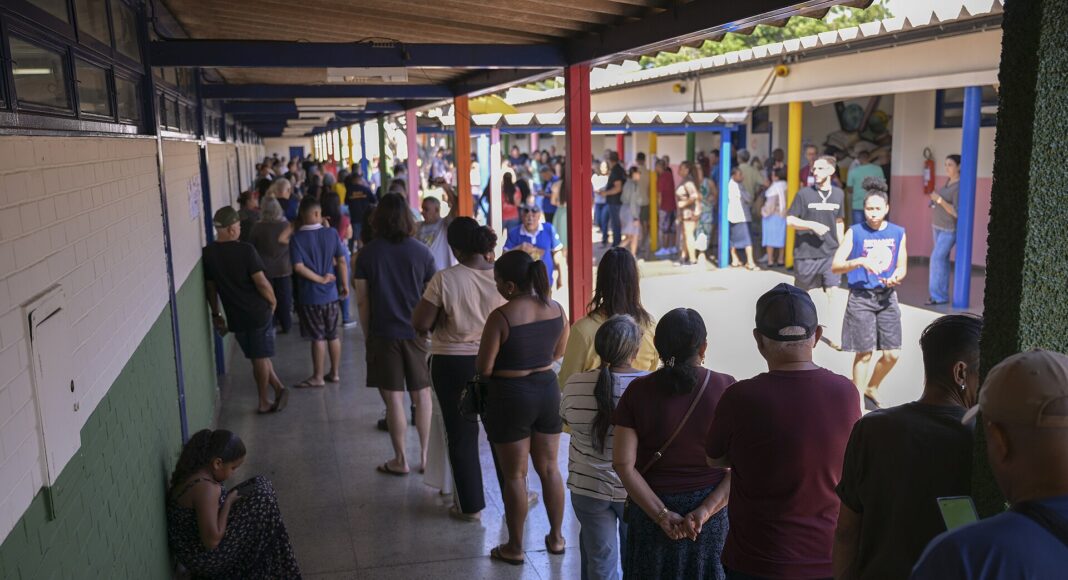
Flávio Bolsonaro won 47.03 per cent of valid votes in Brazil’s 4 October presidential first round, against Lula’s 45.16 per cent, a margin of just over 2.2 million votes. They will meet again on 25 October. A Datafolha survey conducted on 6-7 October put Flávio at 49 per cent and Lula at 45 per cent of total voting intentions for the runoff, a technical tie based on its margin of error.
The voters behind Flávio are hardly one political bloc. Some remember the corruption scandals of Lula’s earlier presidencies. Others worry about public debt, organized crime, or the place of religion in politics. Some are simply tired of the Workers’ Party (PT), which has governed Brazil for most of the period since 2003.
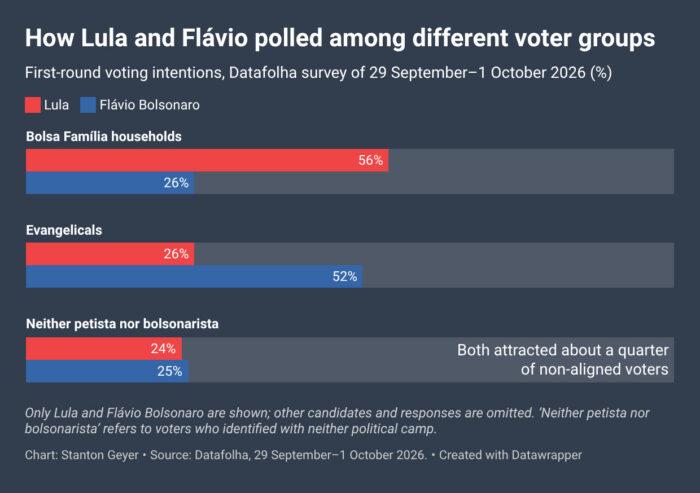
Before the first round, Datafolha found Flávio leading among evangelical voters and Lula among households receiving Bolsa Família benefit transfers. Roughly a quarter of respondents identify with neither petismo nor bolsonarismo. An AtlasIntel/Arko survey found that nearly 38 per cent of those rejecting Lula had previously voted for PT. Asked why they would not vote for him, 85.9 per cent cited corruption or his complicity in it. Respondents could give multiple answers.
Those complaints deserve examination. But the Lula of anti-PT political rhetoric has grown into something much larger than any single politician: a thief behind every scandal, the spender responsible for Brazil’s fiscal troubles, and the president supposedly more interested in criminals than their victims. The evidence points to a radical mischaracterization.
The corruption that stuck
PT’s corruption scandals deserve no whitewashing. During Lula’s first presidency, the mensalão scheme led to the conviction of senior party figures, including his former chief of staff, José Dirceu. The later Petrobras scandal exposed bid-rigging and kickbacks involving construction firms, executives, and politicians across several parties. Lula was never a defendant in the mensalão case, although the corruption among his close political allies remains a serious stain on his government.
Lula himself was convicted in 2017 over a beachfront apartment prosecutors alleged had been renovated by a contractor for his benefit. He denied owning it and spent 580 days in prison. His conviction helped keep him out of the 2018 election, which Jair Bolsonaro won. The judge in the case, Sérgio Moro, had repeatedly denied having political ambitions. Nevertheless, he accepted an offer to become justice minister on 1 November 2018, just four days after Bolsonaro’s presidential victory.
In 2021, Brazil’s Supreme Federal Court (STF) annulled Lula’s convictions because the Curitiba court lacked jurisdiction. It separately found Moro legally partial in the apartment case. Two years earlier, leaked messages suggested that Moro was privately advising prosecutors on investigative strategy, identifying potential leads, and proposing ways to rebut Lula’s defence. Though the rulings did not resolve the underlying corruption allegations, Lula’s convictions no longer stood. The political fallout, however, remains.
In Brazilian political comment sections, Lula remains ladrão (thief), ex-presidiário (former prisoner), or descondenado (a derisive reference to his annulled convictions). The mensalão, Petrobras, and newer scandals merge into a familiar portrait of a man supposedly responsible for every crooked deal in Brasília. Yet corruption is hardly a PT invention. Fernando Collor’s presidency collapsed amid a corruption scandal in 1992, while the Supreme Court struck down the opaque ‘secret budget’ operated during Jair Bolsonaro’s presidency. Lula has questions to answer about the people he governed with and the arrangements his administrations tolerated. And further about the campaign he led this year. But the obscene caricature goes considerably further, while leaving out the judicial misconduct that helped shape his experience in prison.
Who is made to pay?
Anger over living costs is understandable. In August 2026, 82 per cent of Brazilian households carried debt, the highest proportion since records began in 2010. Nearly 30 per cent were behind on payments, rising to 38.8 per cent among families earning less than three times the minimum wage. A steady job offers little reassurance when credit card bills and loan repayments keep eating into household income.
Yet Brazil’s employment and poverty figures tell a different story from the one of an economy collapsing under Lula. Unemployment stood at just 5.3 per cent in the three months to August, a record low for that period of the year. An Ipea study found that 2024 brought Brazil’s best household-survey results for income, poverty, and inequality since 1995. The improvements began in 2021, with gains from both employment income and social transfers, including Bolsa Família.
There is a genuine fiscal problem. Gross government debt reached 82.9 per cent of GDP in August. Nominal interest accrued across the public sector totaled R$1.182 trillion over the preceding 12 months, compared with a 2026 Bolsa Família allocation of R$158.6 billion. These are different accounting measures, and neither explains the debt on its own. Brazil would come about 25th in a table of countries ranked by Debt-to-GDP ratio, below the US, France, Canada, Spain and the UK. The Senate’s fiscal watchdog, however, warns that rising mandatory expenditure, particularly pensions and benefits tied to the minimum wage, could undermine Brazil’s spending framework from 2028 forward.
There’s a common, troubling accusation that Lula ‘buys’ the poor through Bolsa Família. The suspicion goes beyond campaign rhetoric: an AtlasIntel/Arko survey found that 45.7 per cent of respondents who rejected Lula believed he wanted Brazilians to be dependent on the state. But a household whose food budget improves because of Bolsa Família has a perfectly understandable reason to value the programme. Governments routinely receive electoral credit when their policies benefit voters. Why should that become evidence of political dependence when the beneficiaries are poor?
And after more than two decades, the cash transfers have become an integral part of Brazilian social protection. In 2021, under Jair Bolsonaro, the Constitution was amended to guarantee a basic family income for Brazilians in vulnerable circumstances, subject to rules set by law. In June 2026, even Flávio called Bolsa Família a right acquired by the Brazilian people. The programme may still earn Lula votes, but recipients increasingly regard it as an entitlement rather than a politician’s favour.
Whoever wins this year’s presidential run-off will have to take difficult fiscal decisions. Cuts to social programmes, changes to pensions, taxes, and tax privileges would distribute the costs very differently. Those choices deserve far more scrutiny than the suggestion that pro-poor policies are responsible for the country’s debt.
Crime and the price of ‘order’
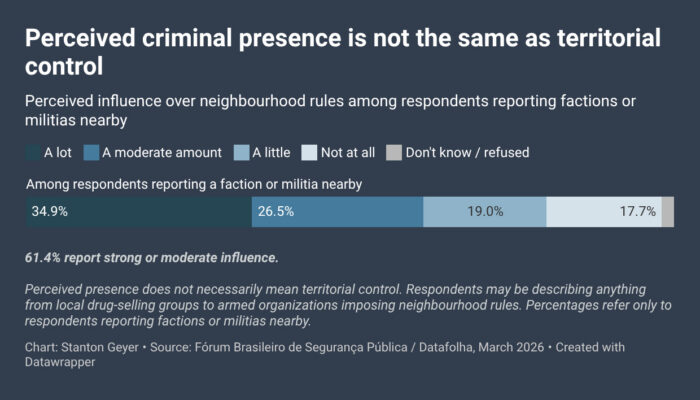
For millions of Brazilians, organized crime is hardly an abstract campaign issue. A Datafolha survey commissioned by the Fórum Brasileiro de Segurança Pública found that 41.2 per cent of respondents aged 16+ reported criminal factions or militias operating in their neighbourhoods. Among those reporting the presence of such groups, 61.4 per cent said they exercised strong or moderate influence over local governance. These are perceptions, ranging from awareness of nearby criminal activity to experience of these groups exercising substantial control over daily life.
Brazilians have good reason to demand effective policing. In October 2025, a massive operation against Comando Vermelho in Rio left 121 people dead, including four police officers. A subsequent Datafolha survey found that 57 per cent of residents in Rio and its metropolitan area considered the operation a success. Yet 77 per cent also agreed that investigating crimes and arresting suspects mattered more than killing them. Families of those killed demanded investigations into possibly unlawful deaths.
There has been a long history of repressive and sometimes unlawful policing in urban favelas, including documented extrajudicial killings, with young Black men disproportionately affected. Police violence is itself part of Brazil’s security crisis. According to the 2026 Brazilian Public Security Yearbook, police killed 6,602 people in 2025, the highest figure in the series. Black Brazilians accounted for 82 per cent of those deaths.
The presidential candidates both propose attacking criminal finances and targeting gang leadership. Lula puts greater emphasis on intelligence-sharing, federal coordination, and investment in poorer neighbourhoods. Flávio wants longer sentences, to lower the age of criminal responsibility from 18 to 16, and five new maximum-security prisons. He also proposes classifying major criminal factions as terrorist organizations.
Flávio’s approach risks turning an already difficult security problem into a more militarized confrontation, with the worst consequences falling on communities already living with gang violence and aggressive policing. The governments of Daniel Noboa in Ecuador and Nayib Bukele in El Salvador offer warnings of where such policies can lead: serious human rights abuses under both, even as their records on reducing violence have differed sharply.
On 7 October, Flávio signalled a return to easier access to firearms, invoking self-defence, although he did not specify which regulations he would change. The concern about weapons reaching criminals is hardly theoretical. That same day, federal police arrested serving and former police officers suspected of supplying rifles and pistols to Rio’s Terceiro Comando Puro faction. Investigators also alleged that police intelligence had been passed to the group.
Brazil has its own homegrown evidence that steady, intelligence-led policing and prevention like that favoured by Lula does work. Pernambuco’s Pacto pela Vida combined coordinated policing, intelligence, and monitoring of violent crime, helping reduce homicides between 2007 and 2014. In Belo Horizonte, the Fica Vivo! programme paired targeted enforcement with youth and community work, achieving a 69 per cent reduction in average homicides during its first six months in the pilot neighbourhood of Morro das Pedras.
Jair Bolsonaro spent years dividing Brazilians between the cidadão de bem, the upright, law-abiding citizen, and the bandido. Yet organized crime and state power are not always neatly separated. People living under gang intimidation deserve protection from criminal groups and from abuses by those sent to fight them. A promise of ‘order’ should be judged by whether it delivers that protection, not simply by how many people the police can kill or imprison.
The Bolsonaro movement returns
Jair Bolsonaro cannot stand in this election. The Superior Electoral Court barred him in 2023 for abusing political power, and in September 2025 the STF convicted him of crimes arising from his attempted coup d’état and assassinations across Lula’s government. He was sentenced to prison for 27 years and three months. Former ministers and senior military officers were convicted alongside him.
Flávio proposes restoring his father’s political movement to the presidency, and faces fewer institutional obstacles in its way. He has promised a presidential pardon for Jair and supports legislative amnesty for those convicted over the 8 January 2023 attacks. His Liberal Party (PL) will hold 121 seats in the Chamber of Deputies and 28 in the Senate from 2027, including 19 newly elected senators.
Flávio has also backed impeaching multiple Supreme Court justices. In August, he named Alexandre de Moraes, Flávio Dino, and Cristiano Zanin, accusing them of misconduct in proceedings against his father. On 8 October, he renewed his attack on Moraes, claiming that nearly 50 senators supported impeaching Supreme Court justices. With 54 Senate votes required for removal, the strengthened congressional Right could give these efforts considerably greater weight.
As a Rio state deputy, Flávio Bolsonaro honoured former policeman Adriano da Nóbrega, whom he and Jair visited in prison in 2005. Prosecutors later linked Adriano to the Rio das Pedras militia and the Escritório do Crime killing group. Flávio employed Adriano’s mother and wife, while investigators traced suspected rachadinha salary kickbacks through Adriano’s accounts. The criminal investigation against Flávio was closed after key evidence was annulled, though a civil case against former staff members continues. Flávio denies wrongdoing but defended Adriano again in August 2026, calling him an exemplary police officer.
Flávio negotiated financing for a lavish Jair Bolsonaro biopic with Daniel Vorcaro, whose Banco Master is accused of selling R$12.2 billion in fictitious loans to the publicly owned Banco de Brasília, with estimated losses to the public purse of at least R$5 billion. Investigators traced at least US$12.3 million (R$63 million) in payments towards a film whose future box-office takings were claimed to exceed Brazil’s biggest domestic hits. Why was a banker at the centre of a multibillion-real fraud investigation financing a Bolsonaro film, and what did he expect in return?

Rio’s militias have roots in police-linked death squads dating back to the military dictatorship. Serving and former officers later built criminal networks controlling neighbourhoods, businesses, and local services, leaving residents vulnerable to the very people meant to protect them. Lula’s governments faced serious corruption scandals, but the Bolsonaro family’s record raises further questions: Flávio’s direct links to organized crime, his dealings with a banker at the centre of a nationwide, multibillion-real fraud scheme, and Jair’s convicted coup and assassinations conspiracy.
Global implications of this election
The Bolsonaro family’s relationship with Donald Trump raises questions about Brazilian sovereignty. Flávio has sought closer ties with Washington, including over criminal-gang designations and strategic minerals. His brother Eduardo was convicted of attempting to pressure Brazil’s judiciary through US intervention on Jair’s behalf. The Bolsonaro movement has already shown a willingness to seek foreign pressure against domestic institutions when those institutions obstruct its interests.
The consequences extend to the Amazon. Under Lula, the area flagged by Deter deforestation alerts fell 36 per cent in August 2025-July 2026 compared with the preceding monitoring year. Lula still supports controversial oil exploration, and Indigenous organizations have challenged him over slow demarcations. The Articulação dos Povos Indígenas do Brasil backs his re-election while demanding stronger territorial protections and an end to fossil-fuel expansion.
Flávio, meanwhile, has promised to stop new Indigenous-land demarcations. His programme proposes weakening environmental licensing requirements, revising the responsibilities of federal protection agencies, and expanding extractive activity. With a stronger congressional Right behind him, those proposals could threaten territories that Indigenous communities are already struggling to defend.
Lula has serious failures to answer for. PT’s corruption history, Brazil’s fiscal outlook, and his government’s contradictions over oil and Indigenous rights warrant continued criticism. Yet the portrait of Lula peddled by his enemies makes him responsible for all the country’s ills and for many things over which he had no control.
The Bolsonaro movement’s attempt to overturn the 2022 election is documented in criminal judgments. Flávio wants to pardon his father, has supported impeaching Supreme Court justices involved in his prosecution, and defended the 1964 military takeover while praising a dictatorship-era torturer. With a strengthened congressional Right behind him, he now proposes closer cooperation with Donald Trump’s government, expansion of extractive industries in the Amazon and elsewhere, and treating Brazil’s major criminal factions as terrorist organizations. These are concrete positions with implications for judicial independence, civil liberties, public safety, public finances, the environment, and Brazil’s sovereignty. Their consequences would reach far beyond the Bolsonaro family.