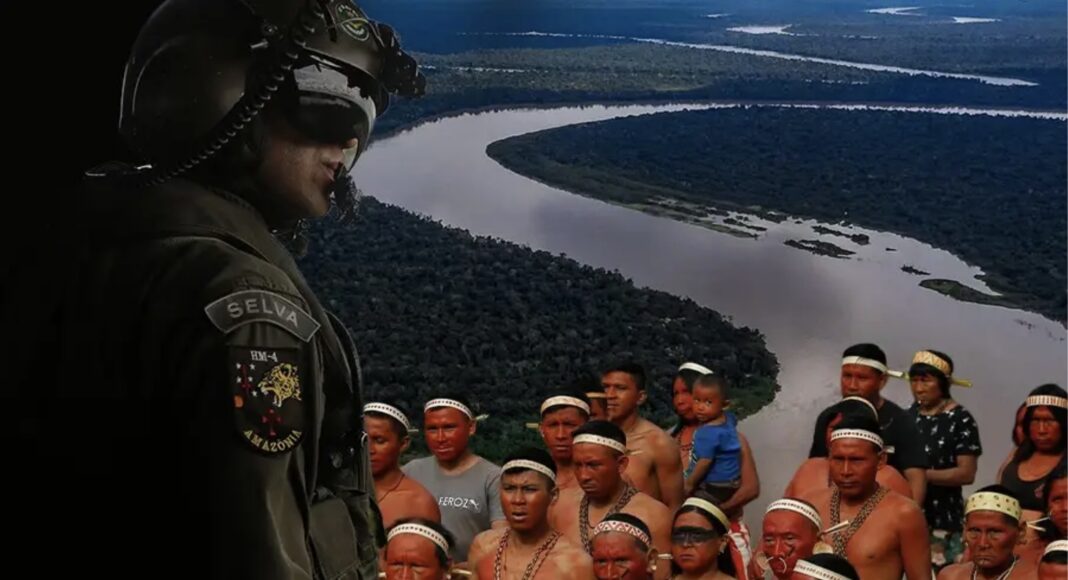
Competition for critical minerals and trade routes is drawing the Amazon deeper into global struggles over resources and military power. Writing in March 2026, Bruno Malheiro examines how US imperial ambitions, trade with China, and Brazil’s political choices put Amazonian territories under pressure. He argues that defending the region requires both national sovereignty and the right of Indigenous Peoples and traditional communities to determine the future of their territories. This article was translated for LAB by Stanton Geyer. You can read the original, published by Amazônia Latitude in Portuguese, here.
The international order is undergoing profound instability. The system established after the Second World War, built around multilateral institutions and broadly, though not universally, shared rules for managing conflicts, is under growing strain. Intensifying regional conflicts, disputes over strategic resources, and rivalries between major powers suggest a shift towards greater competition and militarization in international politics.
In this context, geopolitical competition between the United States and China is progressively reshaping global trade, technology and energy flows, and infrastructure networks. While Beijing expands its influence through investment, production chains, and logistical corridors, Washington seeks to preserve its strategic primacy by mobilizing military alliances, security policies, and instruments of economic pressure.
This struggle is not confined to the major powers. It reorganizes territories, economies, and production systems across the world, especially in regions with concentrations of resources considered essential to contemporary technological and military transformations.
Against this backdrop, the Amazon is taking on a more central role in global geopolitics. Traditionally discussed primarily for its environmental and climatic importance, the region is increasingly framed in strategic terms. Critical minerals, global supply chains, logistical routes, and energy security are becoming central categories in international documents and political agendas.
The Amazon is thus coming to occupy a crucial position in the material reorganization of the world economy. Its territories are becoming places where global commodity flows, logistical infrastructure, and mineral reserves essential to the technological and military industries of the 21st century converge.
In this process, the region is becoming a real laboratory for the geopolitical strategies of resource plunder that structure contemporary global competition.
A system in ruins and a geopolitics of rubble
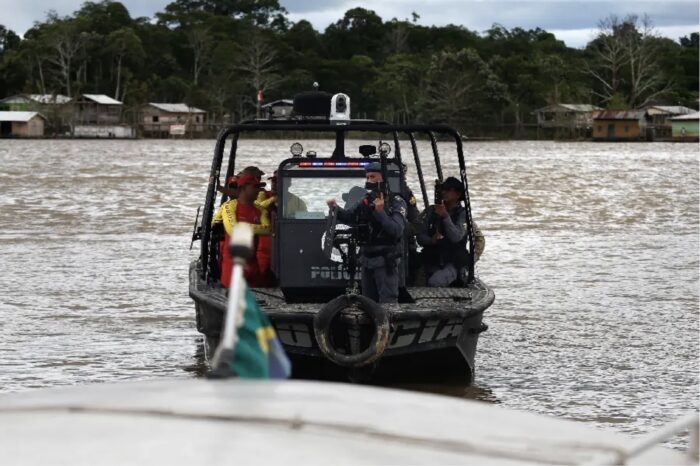
The post-war system of multilateral institutions for mediating conflicts is falling into complete ruin as US imperialism realigns in response to its gradual loss of global primacy. Multilateral institutions are being replaced by force, military might, plunder, and the normalization of state terrorism. There is no shortage of violence to demonstrate this geopolitics of rubble, which seeks not to build order but to manage disaster permanently.
Genocide in Gaza, with tens of thousands of women and children among the dead; the US invasion of Venezuela and the forcible arrest of President Nicolás Maduro, in an operation justified as dismantling a drug cartel whose existence as a unified organization is disputed; the invasion of Iran by Israel and the United States, whose opening days saw the killing of Supreme Leader Ali Khamenei, a strike on a girls’ school, and damage to a hospital!
Any ethical and legal standard, any concern for international law, any respect for peoples’ self-determination has fallen into ruin in the wake of the geopolitics of rubble produced by the necropolitical convergence between Benjamin Netanyahu and Donald Trump.
On one side, for Greater Israel to exist as a mystical and military entity, the surrounding region must be reduced to ashes, wiped off the map. On the other, a power facing challenges to its global primacy creates a military encirclement to undermine the alliances of its great economic nemesis, China. In doing so, it makes clear that if they can no longer be the Sun of the system, the whole world must sink into the half-light of war.
All this rubble may often seem distant from us, but it is closer than we imagine. If the empire’s loss of centrality is what turns the wheel of its violence, we can see that this loss is already a fact in Brazil, and in the Amazon in particular. Our most important trade relations are with China. We are therefore coming to occupy the centre of a geopolitical confrontation over strategic resources and trade routes.
The Amazon as a laboratory of war
The tensions that mark the world-system place an empire and its allies on one side, seeking to preserve the empire’s dominant position in the international system. Bound to Israel’s genocidal Zionist regime, that empire becomes an imperialist war machine. On the other side, China, Russia, Iran, and the trade alliances around BRICS+ challenge Western hegemony through competing political, economic, and military projects. A geopolitical struggle that manifests itself on different planes: technology, trade, military affairs, and energy.
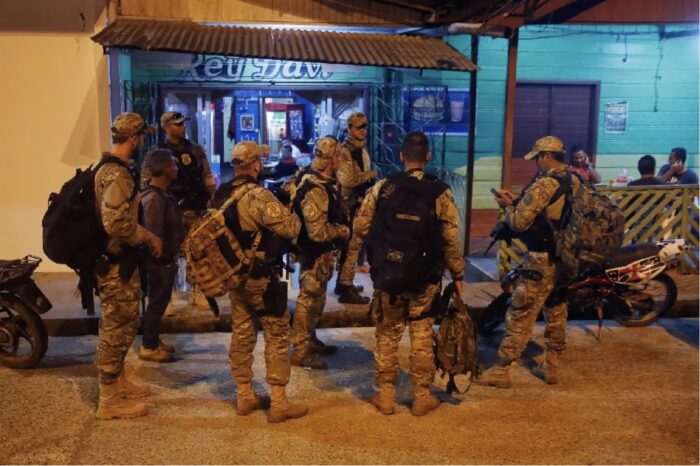
It is at this point that the Amazon takes up a new position on the geopolitical chessboard. The region holds important reserves of essential minerals and occupies a decisive geographical position between the Atlantic and the Pacific, connecting South American economies to global trade flows. We thus end up becoming a laboratory for the geopolitical strategies competing in the contemporary world.
For the forces led by China, the strategy lies in building influence through investment, trade, and infrastructure rather than military interventions or direct political pressure. The aim is to reorganize commercial and logistical flows worldwide, connecting regions producing raw materials to industrial centres and consumer markets. In South America, this offensive takes shape chiefly through expanding commodity trade and financing infrastructure projects. Since 2009, China has been Brazil’s largest trading partner in goods, consolidating an economic relationship that connects South American production to Asian industrial chains.
Given Brazil’s geoeconomic position, the Amazon becomes the sacrifice zone into which the markets for cattle, soya, and timber, and the mining and garimpo sectors, expand. Garimpo refers to artisanal and small-scale mining, which in the Amazon can involve highly mechanized and often illegal operations. The region has become a fundamental part of the commodity export routes connecting South America’s agricultural and mineral production to the Asian market.
Infrastructure projects associated with the so-called Arco Norte, including ports, waterways, and logistical corridors, have expanded to facilitate grain and mineral exports. We therefore know what it means to serve as a commodity distribution centre for China, and all the pain caused by new logistical routes that cross ancestral territories and carry our primary commodities towards export ports.
This dynamic connects the Amazon directly to transformations in the world economy. The territory is becoming a sacrifice zone that sustains the expansion of primary commodity exports and South America’s integration into global commodity chains.
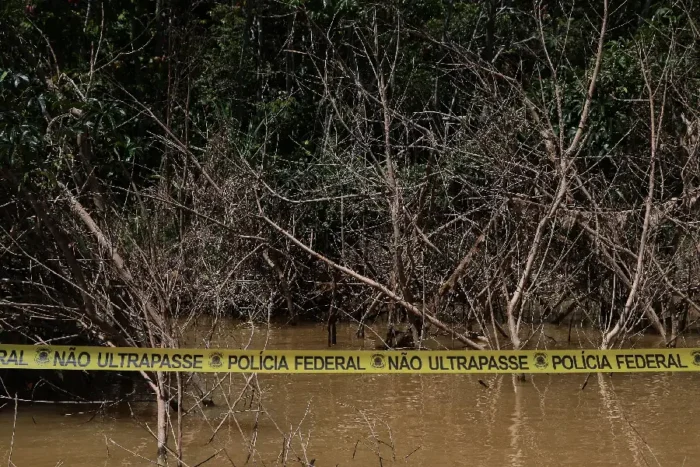
The violence and devastation involved in expanding these commodities and their associated logistical networks are undeniable. Brazilian governments of both the right and the left have chosen to pursue this expansion, with its associated violence, treating primary commodity exports as our only path to economic development.
It was our national sovereignty that produced deforestation, death, and climate chaos in the Amazon as a political and economic choice. This expansion was a choice made by Brazilian governments, not a policy imposed through Chinese military intervention.
On the US-led side of this geopolitical contest, control over routes and resources takes markedly different forms. The Amazon, like Latin America as a whole, continues to be treated as the United States’ strategic backyard, a region where US intelligence agencies have been involved in numerous modern military coups.
In other parts of the world, US attacks have been justified by claims that the targeted countries possess weapons of mass destruction. In Latin America, a different justification recurs. On 3 January 1990, US forces took Panama’s military ruler, Manuel Noriega, into custody. The justification was the same one invoked for the capture of Nicolás Maduro in Venezuela on 3 January 2026: involvement in drug trafficking!
The United States invoked the Cartel de los Soles, whose existence as a unified organization is disputed, to justify Maduro’s arrest, even though Trump had pardoned the former president of Honduras, Juan Orlando Hernández, who had been convicted of drug trafficking, demonstrating the fallacy of the justification.
The invasion of Venezuela serves as an initial laboratory for an empire’s use of military force, bypassing diplomacy in favour of violent territorial encirclement. Half of Venezuela’s territory lies within the Amazon biome. The country also holds roughly 19 per cent of the world’s proven crude oil reserves, according to OPEC’s 2025 Annual Statistical Bulletin, reserves over which the empire seeks to impose its dominance. This action also sought to weaken Venezuela’s strategic ties with Russia and China.
We are witnessing an escalation by a terrorist state that has already declared targets and openly acknowledged interventionist strategies. Treating Gustavo Petro, president of Colombia and the region’s most courageous leader in opposing fossil fuels, as a drug trafficker seems to be more than a message.
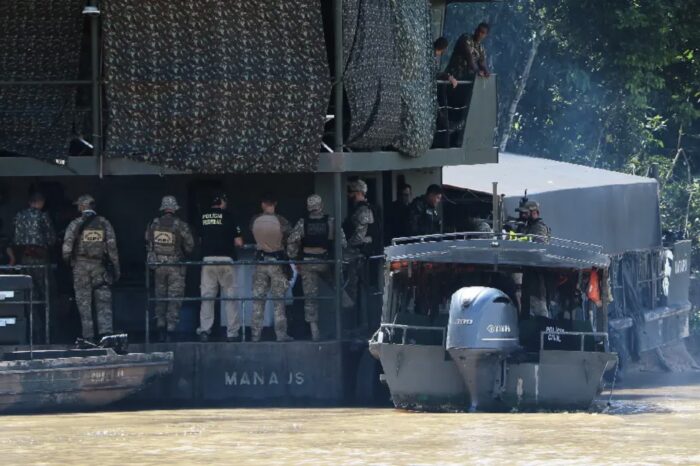
To place Brazil within this debate, we should mention the US designation of the Brazilian criminal factions Primeiro Comando da Capital (PCC – First Capital Command) and Comando Vermelho (CV – Red Command) as Foreign Terrorist Organizations, effective from 5 June 2026.
Led by figures such as Marco Rubio, this measure extends counterterrorism powers against organized crime and risks shifting the response towards the military sphere. By extending the reach of sanctions, the measure could enable US action against these groups beyond its borders, threatening Brazil’s sovereignty and national self-determination.
In the Amazon and other Brazilian regions with mineral reserves, this development intersects with an issue fundamental to the war industry: critical minerals. Their extraction can be just as polluting and generate socioenvironmental conflicts just as severe as those associated with non-critical minerals such as iron. The false sustainability narratives promoted by major corporations are gradually giving way to narratives of security and war, militarizing the mineral question.
This shift takes concrete form because critical minerals and rare earths constitute the nervous system and musculature of the contemporary arms industry. They bring about the transition from wars of attrition to wars of algorithmic precision.
Rare-earth elements are the soul of the high-performance permanent magnets that allow drone motors to be miniaturized and enable the functioning of positioning systems that give missiles surgical lethality, not to mention intelligence processing in state-of-the-art radar and sonar. Niobium also gains prominence as one of the elements that help maintain the structural integrity of fighter aircraft and armour under extreme conditions.
Brazil becomes a key component in this machinery of imperial survival because, according to the US Geological Survey’s own annual report, it holds the world’s largest niobium reserves, estimated at 14 million tonnes. As for rare earths, the country holds around 20 per cent of global reserves of these elements, and China, incidentally, controls around 80 per cent of their processing worldwide.
It is no coincidence that the US Critical Minerals Ministerial Summit, held on 4 February 2026, focused on breaking away from China-dominated mineral supply chains to create a preferential market involving the United States and its partners with stable investment and direct supply chains free from external disruption. On 2 February 2026, Trump also announced Project Vault, a roughly US$12 billion critical-minerals stockpile programme, including a loan of up to US$10 billion from the US Export-Import Bank, drawing on minerals extracted in countries holding these reserves.
Several statements from the current Trump administration demonstrate Brazil’s central role in the geopolitics of mining. The Amazon is central to this contest: one of the world’s principal reserves of rare earths and niobium lies at the Seis Lagos geological site in São Gabriel da Cachoeira, Amazonas state. The site is within Indigenous territory and an environmental protection area.
The site lies in the region known as Cabeça do Cachorro, in the wider border region adjoining Colombia and Venezuela, one country invaded by Trump and the other directly threatened.
For the empire, control of these mineral deposits is not merely a commercial matter but a guarantee that its war machinery will not suffer a ‘technological blackout’ in the face of Chinese production hegemony, turning the subsoil into a battlefield in the ongoing war.
We should also remember the decisive presence of Elon Musk’s Starlink in Brazil, particularly in the Amazon. As early as 2023, it served 90 per cent of municipalities in the Amazônia Legal, Brazil’s administratively defined Legal Amazon region. By 2025, that figure had already reached 100 per cent, according to the fixed broadband access system of Agência Nacional de Telecomunicações (Anatel – National Telecommunications Agency).
In many areas across the Amazon, the company provides the only possible connection. Naturally, control of communications infrastructure and digital connectivity systems has become a decisive factor, so expanding satellite communications services in the region shifts the balance of control over information flows and connectivity.
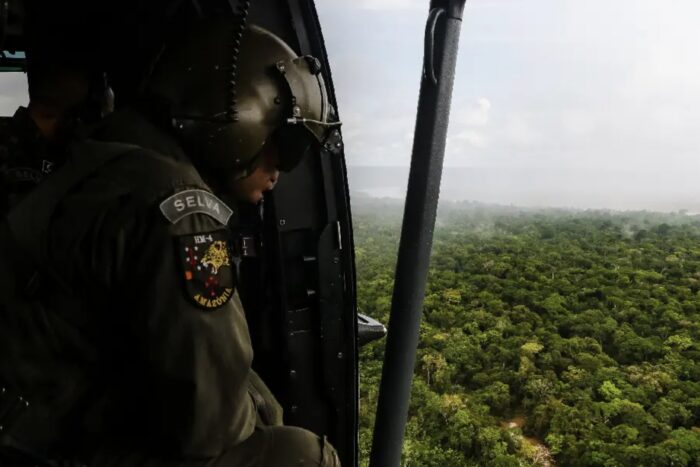
The available information gives us clear grounds to believe that, if the war intensifies, Brazil, particularly the Amazon, will not be safe from direct US intervention. We may see national sovereignty replaced by imperial control over our territory. Under such control, the ‘protection’ of the forest would serve merely as a green veneer for the seizure of minerals and the violent plunder of its vital energies. This would strip peoples and communities of all self-determination over their territories, while also extinguishing it at the national level.
The Amazon thus becomes a real laboratory for geopolitical experiments in wartime, a space where struggles over infrastructure, critical minerals, information control, and trade routes intersect.
Brazil, the Amazon, and war in the 2026 elections
Faced with this scenario, Brazil confronts a strategic dilemma. The country’s position in the global struggle is not predetermined but will be shaped by domestic political decisions. On one side is the possibility of a foreign policy based on active neutrality and the pursuit of strategic autonomy. This approach seeks to preserve the country’s ability to negotiate with different power blocs, avoiding automatic alignment with any one major power.
This is the tenor of Lula’s foreign policy, which has kept us out of direct conflict, although real threats from the US empire will at some point require a reassessment of Brazil’s alignments.
On the other side is Bolsonarism, the political movement associated with Jair Bolsonaro, which has always advocated direct alignment with the United States and the Western geopolitical axis. In the current context, this position tends to reinforce Brazil’s subordinate integration into the strategic chains defined by Washington and hasten a US military presence in Brazil.
Bolsonarism has openly advocated designating the PCC and CV as terrorist organizations and was a central pillar of Trump’s steep tariffs on Brazil. It has also consistently promoted a pro-arms stance, which, in the current context, means placing us at the centre of the war.
Once again, national elections will literally be a matter of life or death. Choices made in domestic politics will directly affect the future of the Amazon, which is more than a territory containing resources essential to war. It is home to Indigenous Peoples, traditional communities, and other Amazonian populations whose ways of life are deeply rooted in the living world.
The peoples of the Amazon must decide
The Amazon’s new geopolitical centrality poses a fundamental challenge for Brazil. The global struggle over critical minerals, infrastructure, and trade routes tends to intensify pressure on Amazonian territories. At the same time, the weakening of multilateral institutions and international law increases the risk of various interventions in the region.
In this context, the central question is not only who controls the Amazon’s resources, but who decides the territory’s fate. The defence of national sovereignty must be fundamental, particularly when that sovereignty is directly threatened and could be undermined by Bolsonarism’s return to power.
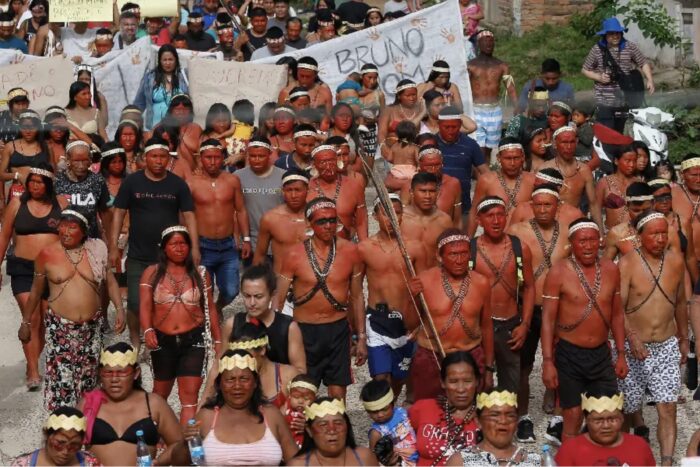
Yet we must insist on the principle of self-determination for the region’s peoples over their territories. This means recognizing the central role of Indigenous Peoples, traditional communities, and Amazonian populations in diplomacy. Far more than an arena of struggle between global powers, the Amazon must assert itself as a territory of democratic sovereignty.
Brazil’s response should lie in building an insurgent diplomacy, emanating not only from government offices but from the heart of the territories. Faced with the threat of sovereignty being undermined by the return of authoritarian logics, the true defence of the Amazon requires peoples’ self-determination to be the absolute standard for any international agreement.
By affirming that all the peoples of the Amazon — Indigenous Peoples, Quilombolas (members of traditional Black communities), and ribeirinhos (riverine communities) – are the legitimate diplomatic subjects, we take the Amazon out of the condition of a ‘battlefield’ and elevate it to the status of a global political subject. Only sovereignty rooted in life and ancestral memory can confront the limitless commodification of collective goods, the opening of sacrifice routes, and the violent lurch of an empire that, as it founders, seeks to reduce the diversity of Amazonian life to mere mineral ballast for war.
Bruno Malheiro is a writer, professor, screenwriter, and musician. He is an Associate Professor at the Instituto de Ciências da Educação (ICED – Institute of Education Sciences) of the Universidade Federal do Pará (Federal University of Pará). He is the author of Geografias do Bolsonarismo, co-author of Horizontes Amazônicos, co-screenwriter of the film Pisar Suavemente na Terra, and author of the musical album Segura o Céu.
Original publication credits: copy-editing and page production, Juliana Carvalho; editorial direction, Marcos Colón.
Translator’s note: Translated and edited for LAB by Stanton Geyer. The original Portuguese essay was published by Amazônia Latitude on 16 March 2026. This edition includes factual corrections, contextual clarifications, and additional source links supplied during editing. Later updates include the US terrorist designations of the PCC and Comando Vermelho, effective from 5 June 2026, and revised USGS niobium estimates. Dates and tenses have been adjusted where necessary. Unless explicitly updated, the political analysis and forecasts, including the discussion of Brazil’s 2026 elections, retain the original article’s March 2026 perspective.