As an offshore oil prospecting ship arrives in Montevideo, Mike Gatehouse interviewed Vito Mata who has been closely involved in campaigns of protest that aim to halt seismic exploration and subsequent drilling and production.
Uruguay’s ocean, fisheries and coastal communities are under threat, and they say the damage could be irreparable. While the country derives more than 90 per cent of its electricity from renewable resources, the government seems intent on encouraging big oil.
‘We’re not talking about one explosion or some minor disruption,’ says Vito Mata, ‘this ship will fire an air-cannon every few seconds, day and night, for 1,000 days.’ The explosions are used to generate seismic waves that map the geological strata below the seabed.
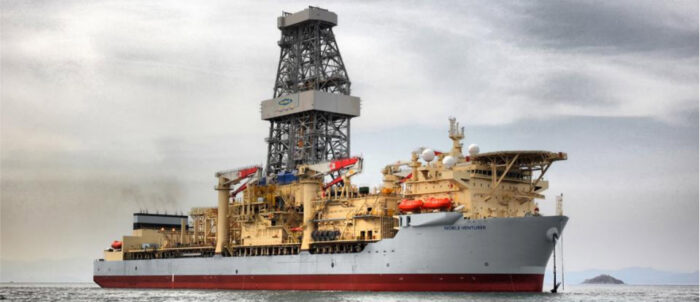
Vito, a campaigner with Asamblea por un Mar Libre de Petroleras, is talking about the BGP Prospector oil exploration ship which docked in Montevideo on Monday 2 February, and will shortly be joined by two support vessels.
The ships have been contracted from Viridien, an ‘advanced technology, digital and Earth data company’ by Chevron and Challenger Oil Group (CEG). CEG in its turn is an oilfield development company based in the Isle of Man, which has now sold to oil giant Chevron part of its interest in Block OFF1, 180 km off the coast, one of 7 ocean blocks within the Uruguayan Exclusive Economic Zone contracted to different oil companies. Other majors involved include Shell, YPF (Argentina), and APA (Apache).
CEG is like a mining ‘junior’ which gambles on a profitable find but sells on to one of the majors equipped to conduct serious exploration and eventually oil production. In the words of its CEO, Eytan Uliel, ‘Completion of the Area OFF-1 farmout is a game-changer for Challenger Energy. We’ve achieved an outcome that introduces Chevron, a recognized industry leader, as operator of the block, who will now commence with executing a considerable value-creating work program.’
Uruguay is the new oil frontier
There is no doubt that the prospect of lucrative finds off the coast of one of Latin America’s smallest countries is ‘having a moment’. According to TGS, which claims to be the world’s leading energy data company, ‘Uruguay emerges as a new frontier in offshore energy, drawing renewed interest in oil and gas exploration amidst its long-term green hydrogen goals’. As CEG says on its FaceBook page, ‘Our flagship assets are in Uruguay, a new global exploration hotspot, where we have assets with multiple billion-barrel prospects.’
A scan of oil industry websites shows that finds off Namibia, connected at some point in history to the South American mainland, have spurred intense interest in the potential of geological formations beneath the western Atlantic seabed. Another attraction of Uruguay, according to TGS, is ‘its potential reserves and stable economic and political environment, contrasting with neighboring regions marked by instability’.
It is likely, too, that a country with little previous experience of the rapacious world of offshore drilling concessions may be easier for big oil to manipulate. I ask Vito about this, and he says ‘What we have in Uruguay, ever since the dictatorship, is a kind of official policy that believes that the solution for our country consists in direct foreign investment. Every opportunity for direct investment gets red carpet treatment, with all sorts of exemptions from various fiscal requirements… and in consequence there is no attempt to measure what these investments might destroy. That happens with other things too, not just with oil… it’s a whole apparatus that results in our closing our eyes to the environmental effects of this.’
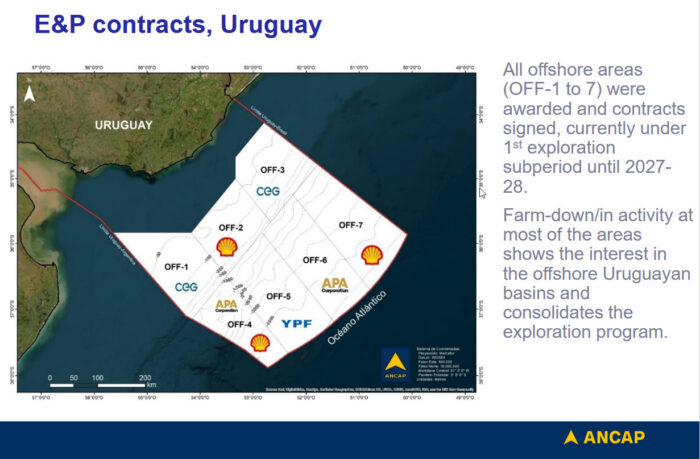
Industry figures suggest a potential for the northernmost Block OFF3, of up to 2 billion barrels of oil equivalent (Bboe) and up to 9 trillion cubic feet of gas (Tcfg). Uruguay’s national oil company ANCAP identified and auctioned seven blocks off the country’s coast (see map) in May 2020. ANCAP rates the probability of significant oil and gas finds at 5–25 per cent. It has now signed ‘multiclient contracts’ with four service companies, CGG, PGS, Searcher and TGS, to conduct large-scale 3D seismic exploration. Uruguay’s Ministry of the Environment must process the permit requests, together with others from US-major APA (formerly Apache) covering Blocks OFF1 and OFF4. There are also plans to drill an ultra-deep water exploration well in Block OFF6 in 2027.
The logistics base for all this activity is the port of Montevideo, where a large space has been provided for the exploration vessel and its support ships. It is less clear how or where the oil, if it is eventually extracted, would come ashore.
Against this excitement must also be set the fact that the earlier exploration of the area in 2012-14 found no viable reserves. Investors may yet get their fingers burned.
Disaster for coastal communities
All along Uruguay’s coast, local communities, tourist hotels, surfing clubs, fishing companies and cooperatives are deeply worried about this renewal of interest in exploiting the country’s oil potential. They remember the last time there was seismic prospecting off the coast, in 2012-14, which did not yield promising results for the oil companies.
Yet, as Vito tells LAB, ‘it led very quickly to very bad outcomes for coastal communities, for artisanal fishermen and even for the industrial fishing companies.’ Official figures from the National Bureau of Water Resources show a decrease of between 31 and 45 per cent in catches of the three main fish species, and these did not recover for four years.
The oil companies promised to compensate anyone whose livelihood had been impacted by the prospecting, but even today, 12 or 13 years later, ‘some people have received nothing’, says Vito. ANCAP was sued by 35 fishery companies, but it was very difficult for them to prove their case, because they were required to submit accurate figures for their catches for the previous five years. ‘How on earth have we come to this?’, asked Daniel Gilardoni, national Director of Water Resources in the Frente Amplio government from 2010-2017, ‘This is the sort of thing proposed by a banana republic or a dictatorship.’
Oceanographer Marcos Sommer has warned against the institutional obfuscation, the absence of integrated studies of cumulative impact and the exclusion of coast communities from decision making. He gives the example of the Argerich well drilled off Argentina in waters close to Uruguay’s zone, and the apparent reluctance of INCAP and the Uruguayan authorities to collect any data about its cross-border impacts.
Deep-sea prospecting involves using compressed air cannon to generate extremely powerful seismic waves to penetrate to the seabed and four or five kilometers below that. According to Vito, the oil companies like to use the analogy of the ultrasound scan a woman may receive in pregnancy, which causes her no harm.
The companies say, in classic greenwashing terms, that now they have taken every precaution, will suspend operations between April and November, ‘due to overlap with industrial fishing activity and seasonal environmental sensitivities’, and will have ‘onboard observers (marine biologists) and shutdown protocols for acoustic sources if cetaceans, turtles or pinnipeds are detected within defined safety radii.’ Whether the ‘observers’ will have the authority to suspend operations if there is any significant risk of damage remains unclear.
‘Many people worry about the turtles, whales and dolphins,’ says Vito, ‘creatures that are spectacular to watch and attract international interest and campaigning. But there’s something else, the plankton, which plays a vital role in the ecosystem, in the health of the sea and of the planet. Plankton is made up of unicellular creatures which produce photosynthesis, capture carbon and generate oxygen. Oceanographers have told us of every two breaths we humans take, one depends on the oxygen generated in the sea. More than 60 per cent of the oxygen on earth comes from the ocean.’
Studies in Australia show that the explosive soundwaves generated by the compressed air cannon can extend at least 1,200 metres in all directions, and that they immediately kill up to 40 per cent of the plankton within that range. These effects have been observed in South Africa and Australia, where similar offshore exploration was carried out.
No social legitimacy
Uruguayan campaigners have little trust in their own ANCAP, a minnow in the world of global oil companies. ANCAP promoted the licensing of the 8 ocean blocks within Uruguay’s area of maritime interest, contracts which, according to Asamblea por un Mar Libre de Petroleras, should be declared null and void because they have no licencia social, demonstrable social legitimacy, a requirement under Uruguay’s relatively progressive constitution.
ANCAP itself operates Uruguay’s only one small oil refinery. The pipeline carrying crude oil to it comes from a ‘boya’ -a floating oil jetty – at José Ignacio in Rocha department, and there have been several spillages and leaks at the jetty and from the pipeline. ‘Last year,’ says Vito, ‘signs of oil spills began to appear on the beaches. Yet the company said, “Ah, we don’t really know. It may be some passing ship that was washing out their tanks”, etc.’ They had to call in experts from Chile to repair leaks at the oil dock.
A recent statement by Nicolás Sanguinetti, commander of Uruguay’s Naval Air Force, reported an agreement reached with ANCAP to have planes on stand-by whenever tankers are unloading at the jetty, to detect any spillages and trigger efforts to contain them. Sanguinetti states, in terms very similar to those used by Asamblea por un Mar Libre de Petroleras, that ‘we cannot live without clean oceans’ and that protecting the ocean is a key task for every Navy.
Paradoxically, Uruguay has no need of oil to meet its own needs – the country is 97 per cent self-sufficient in energy, mainly derived from hydro- and solar-power. The move to licence offshore oil can only be explained by the potential for lucrative profits. The countryaccording to the extractivist mantra chorused across Latin America by governments of right and left, desperately needs new sources of income to finance its education, health and social security budgets. And the new oilfields, it is claimed, would create thousands of new jobs and yield cash income to finance coastal communities and pay for the modernization of the tourist industry.
The rising tide against oil exploration
Many in Uruguay are unconvinced. In February 2025 different NGOs, community, environmental and campaigning groups came together to found the Asamblea por un Mar Libre de Petroleras, the group with which Vito works. They were concerned for the survival of marine life in all its forms. They have proposed a medida cautelar, a precautionary injunction to halt exploration, and they are pushing for the cancellation of all the offshore oilfield licenses, arguing that these were granted without the due process required under Uruguayan law. During the recent feria period, when the country’s courts are in recess for vacations, there has been no progress. But campaigners remain hopeful that there will be a full hearing where they can present expert witnesses and that the courts will find in their favour.
When the BGP Prospector docked on 2 February, there was a large demonstration in La Plaza Independencia and a march through the old quarter of Montevideo, down to the port. ‘The important thing,’ Vito emphasizes, ‘is to show that this project does not have the permission of the people (licencia social)… Once you explain to people what is involved, he continues, people very quickly join our campaign.
Vito explains, ‘There is a law in Uruguay that designates our Exclusive Economic Zone (the area extending between 50 and 500 kms from the coast) as a sanctuary for whales and dolphins. And Clause 47 of the country’s constitution declares the environment as a factor of general concern which should prevail over purely economic considerations … In 2022 the Ministry of the Environment proposed extending the national system of protected areas. That’s all very fine, but once foreign capital arrives, it’s as though all of that is erased. We have a saying in Uruguay that what gets written with the hand gets rubbed out with the elbow.’
However there is a prior case of greater importance, which seeks to declare null and void the contracts which INCAP awarded to the oil companies, which cover the whole of the Exclusive Economic Zone and divided it into 7 blocks.’
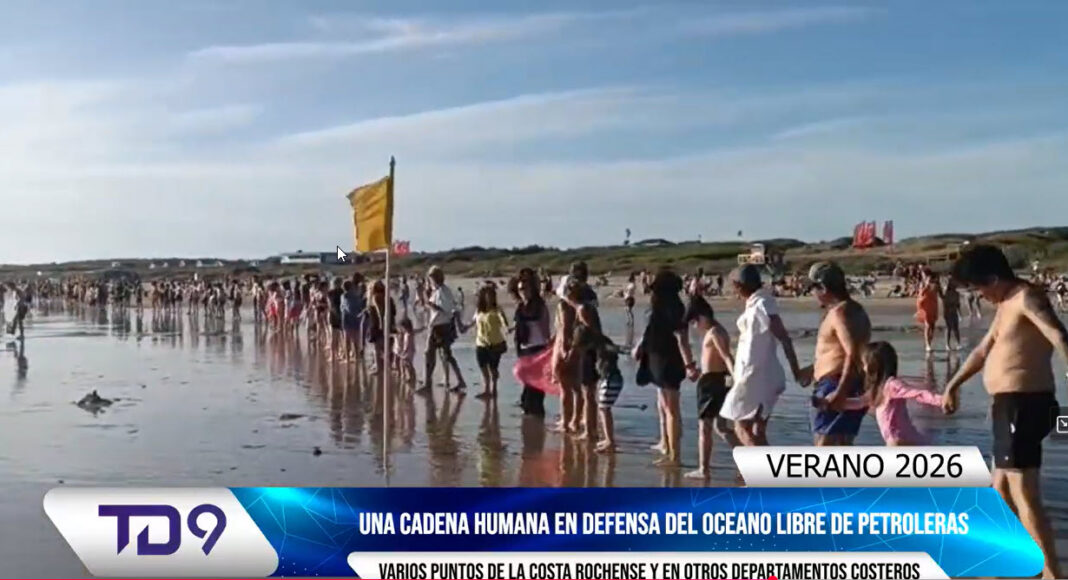
Human chain in defence of an ocean free from oil-wells, at Rocha, and various other points along the Uruguayan coast. Video: Chanel 9, 6 January 2026.
Campaigners realize, though, that nothing will happen without widespread popular demand and effective mobilization on the street.
‘In the coming months, will the campaign grow, and can it attract sufficient support to force changes in government policy?’ I ask.
‘We can’t be sure, but the level of mobilization has grown steadily over the past year’, Vito replies. He points to the success of a campaign against a water project in the Rio de la Plata several years ago, which forced the new government to back down. And another successful campaign against a big housing and tourism development at Punta Ballena in an ecologically sensitive area.
The PGP Prospector is likely to remain in Montevideo for the next month while they wait for the definitive permit from the Ministry of the Environment to start work. And in the same period, the campaign will grow, with human chain demonstrations all along the coast. ‘We are a rising tide,’ the campaigners say.
This article was edited on 17 February to add details about the oil spillage off José Ignacio and the poor results of the 2012-2014 exploration.