Environmental defender Alejandra Parra continues to oppose a waste-to-energy incinerator in the south of Chile, despite rising danger for activists.
Lautaro has all the makings of a tourist hotspot. Nestled among emerald lakes, ancient forests, and active volcanoes, it boasts South America’s oldest fish farm, the largest urban park in the Araucanía region, and a new role as the gateway to the UNESCO-listed Kütralkura Geopark.
But for the past decade, this small town has been known for something far less picturesque: household waste.

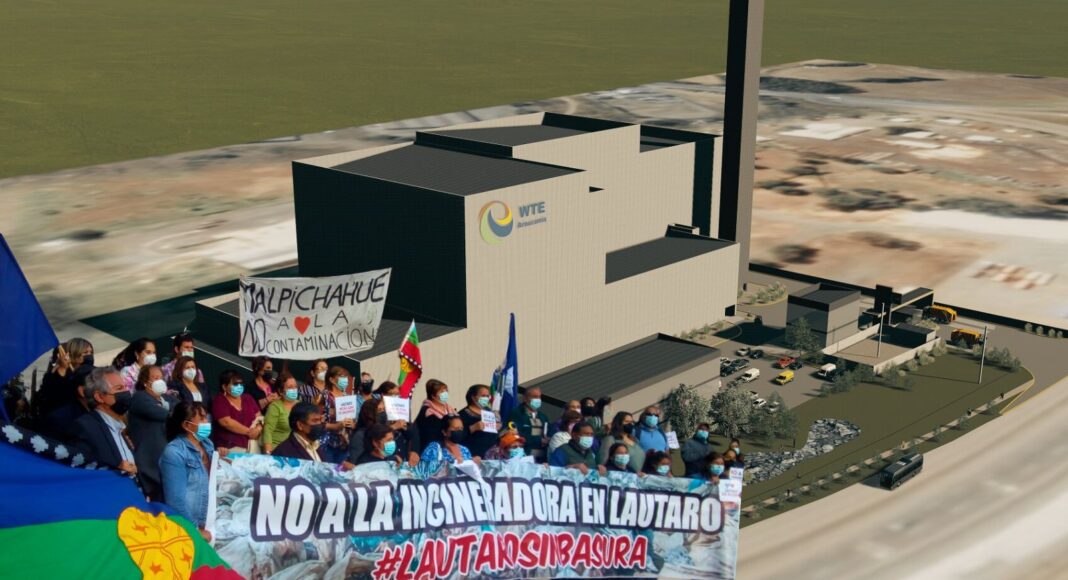
Since 2016, a group of regional businessmen led by Chilean construction executive Robert Wörner Muxica, has been pushing to install WTE Araucanía, Chile’s first waste-to-energy incinerator – and one of the earliest of its kind on the continent – in Lautaro.
Their pitch is straightforward: with landfill space running out, more than half the Araucanía region’s waste must be trucked up 160 kilometres north, to landfills in the Biobío region. The proposed plant could burn up to 200,000 tonnes of household waste annually, generating electricity for over 40,000 homes.
But most of Lautaro’s 41,000 residents aren’t convinced. They fear the incinerator’s toxic emissions will pollute the air, damage crops, and undermine greener alternatives like composting and recycling.
In fact, the town has fought the project with the same fierce resolve as its namesake: Lautaro – Leftraru in Mapudungun, the Mapuche language, meaning ‘swift hawk’ – the young warrior who famously led Indigenous resistance against the Spanish in the 16th century.
And they’ve already won – twice. In 2022, after more than 18,000 citizen observations were submitted, Chile’s Environmental Evaluation Commission (SEIA) unanimously rejected the project. The following year, the Committee of Ministers upheld that decision.
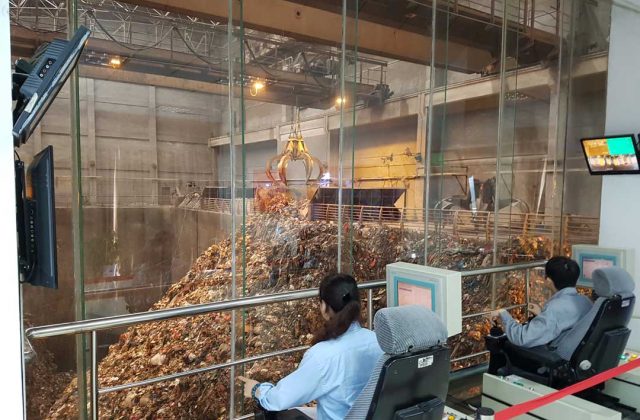

Yet backers of the waste-to-energy technology continue to push forward. The financial incentives are huge: incinerators profit from tipping fees, and Temuco, the regional capital just 31 kilometres away, produces half of Araucanía’s waste.
The businessmen have filed a legal challenge to the past rejections, at the Environmental Court of Valdivia, which held hearings in April. If their appeal – expected to be resolved in the coming months – is turned down again, their final option will be the Supreme Court.
Community rejection
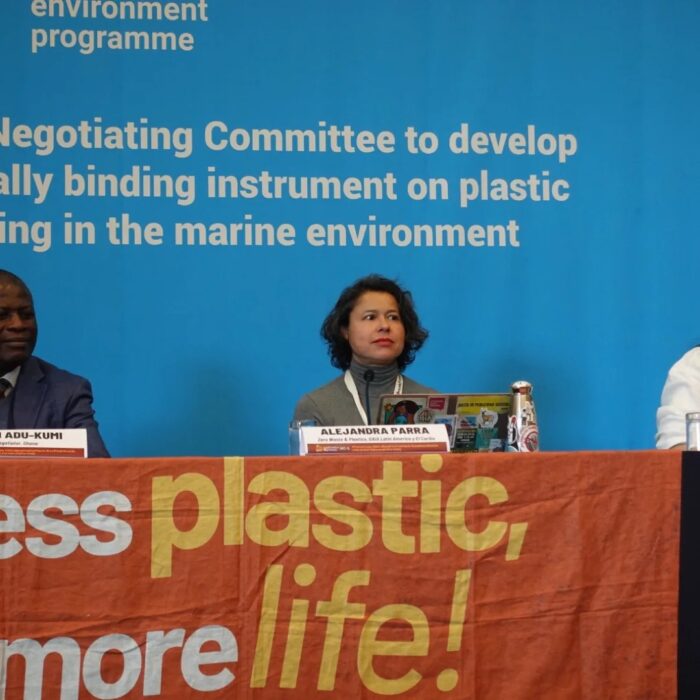
The highest-profile and leading critic of the WTE Araucanía project is Temuco-based biologist Alejandra Parra who is also the national coordinator for Zero Waste Alliance Chile which promotes sustainable management of solid waste.
Driven by the efforts of Parra and the Environmental Rights Action Network (RADA) she co-founded 19 years ago, more than 18,000 signatures against the incinerator were gathered locally over five years by citizens and civil society groups. Even Lautaro’s Environmental Commission has reaffirmed its rejection of the project.

Notably, Councilwoman Carmen Phillips, who supports Parra, is backed by the pro-business UDI party. Lautaro Mayor Ricardo Jaramillo and two other council members, from the business-friendly Renovación Nacional, have also publicly opposed the project. Jaramillo has admitted his position ‘has worked against me,’ but added: ‘any kind of friendship or closeness must be set aside – what prevails is my role as mayor.’
After the April hearing, Parra herself acknowledged that the ‘firm positioning of the Lautaro municipality – from the mayor to the councillors and environmental department professionals – has been fundamental in everything we have accomplished in this new phase of the struggle now nearing its end.’
Local Mapuche opposition
Parra also emphasized the strong support from Mapuche communities near Lautaro, particularly in the Malpichahue sector. These communities have joined marches and protests in Temuco and Santiago against the WTE Araucanía incinerator.
Comunidad Traipaiñán, just 2.5 kilometres from the proposed plant site, is among those most directly affected. Its president, Luis Tripaiñán, assumed the role after an accident forced him into early retirement from construction work.
‘We’re about 90 families here, mostly living off subsistence farming,’ he told Latin America Bureau, keeping a close eye on his toddler grandchild. ‘We have chickens, root vegetables, peaches, apples – some have pigs or lambs.’
The community is deeply concerned about dioxins from the incinerator. ‘We’ve heard they linger in the air and settle into soil and pastures,’ Luis said. “We’ve watched videos of incinerators in France and Spain – farmers can’t sell their eggs, people develop respiratory problems, and children are born with cancerous tumours.’
Traipaiñán generates minimal waste, reusing most food scraps to feed animals. Trash collection occurs only once a week.
No Indigenous consultation
Luis Tripaiñán also denounced what he calls the regional government’s racist treatment of Indigenous communities, particularly its decision to exempt the project from Indigenous consultation.
Eight Mapuche communities, including his own and two closest to the possible site, Juan Chavarría and Pancho Cayuqueo, formally requested consultation to give their ‘Prior, Free, and Informed Consent’ under ILO Convention 169, which guarantees this right. ‘They rejected our request, although we were never given a formal response,’ Luis said.

Working with Parra’s RADA and other local groups, he added, has been far more effective.
The region has lived through this kind of environmental injustice before. The previous landfill, launched in 1992 – before ILO 169 was ratified – was located in Boyeko, just 14 kilometres from Temuco and adjacent to 30 Mapuche communities. Parra was one of the activists who helped shut it down in 2016 after denouncing the Chilean government for environmental racism at the United Nations.
‘People still can’t drink the water there,’ Luis said. He fears similar damage from the incinerator – especially airborne pollution. ‘I remember the Chaitén eruption in 2008. The ash reached as far as Santiago. What worries me is what happens to future generations. Money comes and goes. Environmental damage stays.’
Pushing ‘Zero Waste’
Parra, along with her network RADA and other local environmental groups, isn’t simply opposing a waste management solution without offering alternatives. As national coordinator for the Zero Waste Chile Alliance, she has spent a decade promoting a ‘Zero Waste’ model that prioritizes reducing, reusing, and recycling over incineration or landfill.
At the same February meeting in Lautaro that triggered the online abuse, Parra presented a Roadmap Toward Zero Waste, arguing that separating compostable and recyclable materials at the source could reduce up to 80 percent of waste transported to the Biobío region.
The defamatory video rejected this idea: ‘The zero-waste model has failed even in more developed places, such as San Francisco,’ the narrator claimed.
But a recent Zero Waste Europe report contradicts this, showing that many European cities are moving beyond recycling to focus on prevention, reuse, and repair. Successes include Tallinn’s 92 percent reuse rate, Slovenia’s reduction in single-use cups, and a 20 percent drop in landfill use in Zagreb.
‘The excuse that Chile lacks resources for such initiatives is no longer acceptable,’ said Parra. Take the case of Melipeuco, a small town in the same province as Lautaro, where a local Zero Waste initiative has reduced waste by 70 percent in just a few years through municipal composting and waste separation.
Though Melipeuco has only 1,000 residents, Araucanía’s governor René Saffirio Espinoza believes its model is scalable. ‘Reducing waste from 3,800 to 1,300 tons in just over a year through composting is exactly what we want to replicate across the region,’ he said during a visit last April.
Lautaro’s mayor, Jaramillo, has already taken steps in that direction. Last August, he travelled to Santiago to seek investment for a communal composting plant.
Business backlash
Supporters of the incinerator remain relentless, as seen in recent social media messaging from WTE Araucanía, the business lobby Multigremial Araucanía, and a newer platform called Clean Solution Now:
‘Did you know that the waste La Araucanía produces each year equals 134,000 Olympic swimming pools?’; ‘We must act on SCIENTIFIC EVIDENCE, not political PRESSURE’; and ‘Araucanía, one of Chile’s three POOREST regions, can’t keep wasting job opportunities.’
These messages have echoed through mainstream newspapers, radio, and TV, manufacturing a sense of urgency that leaves little room for long-term solutions, Parra said.
Chile’s most influential daily, El Mercurio, has also voiced scepticism. In May, it published a 12-page insert titled “Chronicle for the Future,” accusing environmental NGOs of stalling development while lobbying for looser environmental permit regulations currently under debate in Congress.
Parra dismissed the criticism: ‘In the case of WTE Araucanía, it’s the company that has caused delays by repeatedly requesting deadline extensions.’ As of publication, WTE Araucanía had not replied to multiple requests for comment.
Smear tactics
With so much at stake, anonymous promoters of the controversial incinerating plant escalated their tactics earlier this year. In February, Alejandra Parra was targeted in an online smear campaign.
The attack came just days after Parra addressed Lautaro’s Municipal Environmental Commission, warning about toxic, carcinogenic emissions from incinerators that accumulate in ecosystems and ultimately impact human health, particularly through breast milk.
The video, which has no clear source, appeared in a comment made by a personal Facebook account on a post by Araucanía Diario, on the regional outlet’s Facebook page. Over a display of seven photographs of Parra, a voiceover denounced her as ‘an activist who spreads alarmist lies without scientific evidence, trying to stop a safe and modern solution to the waste crisis’.
It then posed a leading question: ‘How long will Alejandra Parra continue manipulating the truth and endangering Lautaro’s future with lies?’
Without evidence, the video also linked her to imprisoned Mapuche leader Héctor Llaitul, associated in the video with ‘violence and arson’ in the region.
Parra said she didn’t feel personally afraid, but filed a complaint in early March after growing concern from friends and family.
Women defenders under attack
Karina Riquelme, who heads a team of eight lawyers representing Parra, said ‘a smear campaign trying to paint Alejandra as “anti-development” is extremely dangerous as it stirs hostility toward people defending environmental rights.
‘What a lot of people don’t understand is that environmental defenders aren’t working for their own personal gain but for the community as a whole.’
What a lot of people don’t understand is that environmental defenders aren’t working for their own personal gain but for the community as a whole.
Smear campaigns can also escalate. Last November, a 72-year-old Mapuche leader and forest defender Julia Chuñil disappeared without trace in the southern Los Ríos region, where longstanding conflict pits Indigenous Mapuche communities against multinational timber firms and state forces.
Despite widespread protests against insufficient investigation, alongside online ‘Where is Julia?’ marches and online campaigns, the fate of Chuñil remains unknown. Riquelme has become involved in her case, representing her son, Pablo San Martín Chuñil, who feared he was being framed after authorities reportedly planted false evidence.

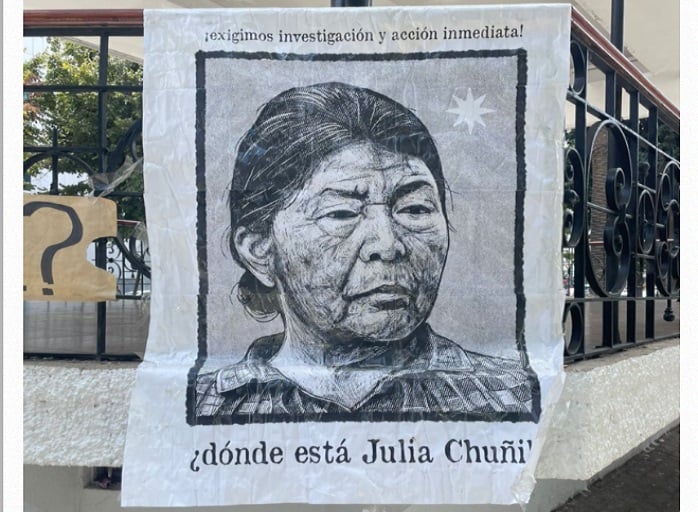
Julia’s case is far from isolated. The highest-profile cases in recent years include Mapuche activist Macarena Valdés who in 2018 was found hanging in her home in Tranguil, in the southern commune of Panguipulli, Los Ríos. Although authorities deemed it a suicide, her supporters suspect she was murdered for trying to prevent Austrian multinational RP Global from running high-voltage power cables through her community.
In 2021, trans Mapuche artist Emilia Bau was shot dead in the same region by a private security guard while defending Indigenous territory from real estate developers. Riquelme herself has experienced serious harassment and covert police surveillance for defending Mapuche activists, most notably between 2016 and 2018.
More recently, a court ordered two environmental defenders in Biobío – Camila Arriagada and Arnoldo Cárcamo – in May, to stop publicly criticizing a mining project, raising concerns about future freedom of expression of activists.
Testing Escazú in Chile
According to the Escazú Ahora Foundation, attacks on environmental defenders surged in Chile in 2024, with physical violence tripling compared to the year before. Women made up over 70 percent of victims, particularly in the southern Biobío, Los Lagos, and Los Ríos regions.
Attacks on environmental defenders surged in Chile in 2024, with physical violence tripling compared to the year before. Women made up over 70 percent of victims.
Parra’s complaint could be one test for how adequately the Chilean state protects environment defenders, a commitment it made in 2022 when it ratified the Escazú Agreement in 2022. Parra was officially recognized as a Human Rights Defender by Chile’s National Human Rights Institute (INDH) in 2023.
Although the Public Prosecutor’s Office was ordered to investigate in early March where the defamatory video came from, Riquelme said that the investigation so far has shown little rigour: ‘We haven’t had any updates.’
As for the pending decision from the Environmental Court, Parra remains cautiously hopeful. ‘At the start, even close allies said the company would win, as it often does,’ she said. ‘We’ve won twice. We hope to win again.’