Greeting Lula’s remarkable victory in the second-round of Brazil’s presidential election on 25 October, Sue Branford argues that it was ‘largely achieved because his supporters took to the streets’
Lula’s victory in the Brazilian presidential victory on Sunday 25 October was narrow – 52 per cent of the valid votes against 48 per cent for Flávio Bolsonaro, the son of the far-right, former president Jair Bolsonaro. Bolsonaro has already called for the result to be annulled because of an ‘unacceptable’ two-hour extension to the voting time, but this is certain to be denied as millions saw Bolsonaro on Brazilian television supporting the call for an extension.
It was a remarkable turn-around, not only because Bolsonaro had won the first round but because of widespread anti-Lula bias in the mass media. The social media giant Meta, which owns Facebook, WhatsApp and Instagram, is facing accusations before Brazil’s top election authority, the Superior Electoral Court (TSE), that it suppressed Lula’s content and favoured material promoting Bolsonaro.
Moreover, US president Donald Trump and US secretary of state Marco Rubio had worked aggressively to put a Bolsonaro back in power. In May of this year Flávio Bolsonaro met with Trump, Rubio, and vice-president J.D. Vance at the White House. Trump later described the Brazilian lawmaker as a ‘smart young man, who loves his country very much.’
The Trump government also sought to use its trade policy to undermine Lula. In July it imposed 25 per cent tariffs on Brazilian exports to the USA, claiming that the country imposed ‘unfair trade practices’, a charge it has never substantiated.
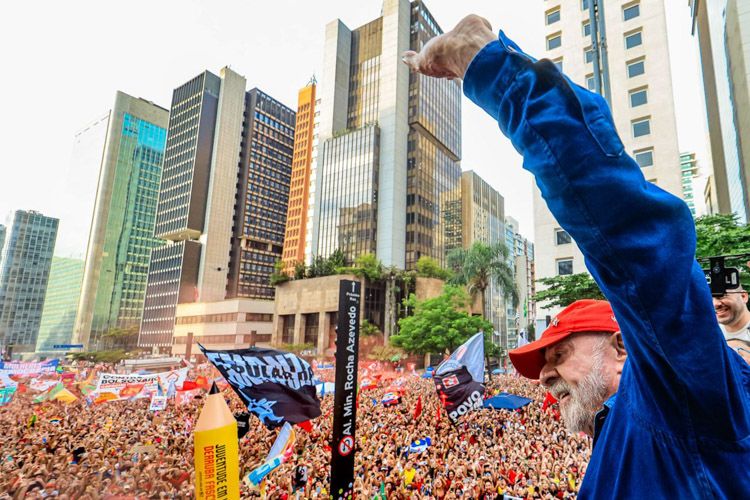
Lula’s remarkable victory was largely achieved because his supporters took to the streets on Saturday 24 October. More than one million people streamed on to Copacabana beach in Rio de Janeiro, many of them wearing red clothes and waving flags. Their actions encouraged people all over the country to overcome their inertia and get to the polling stations. His supporters also used a WhatsApp channel with millions of followers, entitled Lula’s army, to encourage people to vote.
It was a remarkable demonstration of the power of ordinary people, even in the age of mass media. These Brazilians realised that what was at stake was not the normal swing of the political pendulum with a left-wing candidate being replaced by a right-winger. Bolsonaro’s father is a vicious criminal, sentenced last September to 27 years of imprisonment for planning a coup. If Flávio had been elected, he would wreaked havoc on Brazil’s democratic institutions and encouraged the widespread devastation of the Amazon forest.
Lula’s victory has been welcomed by progressive leaders all over the world.
Mexican president Claudia Sheinbaum congratulated Lula on X, saying ‘Long live democracy, the people of Brazil won’.
US senator Bernie Sanders hailed Lula’s ‘extraordinary re-election victory’, saying the Brazilian president has ‘stood up’ for workers and democracy and will continue to do so for the next four years.
The Canadian president, Mark Carney, said in a congratulation post to Lula: ‘Let us seize this opportunity to strengthen [our relations] further – to create new promising commercial prospects, protect the environment, and ensure greater prosperity for both our populations.’
Right-wing leaders have remained silent. An indication of the bitterness they feel at Lula’s unexpected victory came from US President Donald Trump’s son, Donald Trump Jr, who referred to the two-hour voting time extension: ‘If a conservative government in Brazil did this, everyone in the mainstream press in America would lose their minds, but I guess they’re just choosing to be silent because it’s all for the cause.’
Lula’s victory is important not just for Brazil but because it shows that the recent seemingly inexorable rise of the right in Latin America is not unstoppable. The shift to the right began in February 2019 with Nayib Bukele’s victory in El Salvador. It accelerated with Javier Milei’s presidential run-off victory in Argentina in November 2023. In 2024 the election of Panama’s José Raúl Mulino and the reelection of President Luis Abinador in the Dominican Republic continued this trend. However, it was 2025 that produced the greatest number of elected right-wing leaders – Daniel Noboa in Ecuador in April, Rodrigo Paz in Bolivia in October, Nesry Asfura in Honduras in November, and José Antonio Kast in Chile in December.
The trend continued this year with the victories of Keiko Fujimori in Peru and Abelardo de la Espriella in Colombia. This has brought to 12 the number of right-wing governments in Latin America (Argentina. Bolivia, Chile, Colombia, Costa Rica, Dominican Republic, Ecuador, El Salvador, Honduras, Panama, Paraguay and Peru). With Lula’s victory, the region now has four left-leaning countries (Brazil, Guatemala, Mexico and Uruguay).
Lula’s victory came on the eve of his birthday. On 27 October he will be 81, too old to be considering a further term. One of his most urgent tasks as president will be to encourage the emergence of younger left-wing political leaders.
This article was originally prepared for Red Pepper.
Main image: from website of PT Brasil