Jan Rocha details some of the manouevres by Lula’s opponents to prevent poorer people from voting. Yet people power frustrated the attempt, producing a clear result greeted by relief by governments around the world and some support from most Latin American countries except for Argentina.
Election day began calmly as voters made their way to the polls all over Brazil. Answering the Lula campaign’s call for everyone, young and old to vote. In Brazil it is only compulsory for 18-60 year olds to vote, yet countless 80, 90 and even centenarians were wheeled or helped into the polling stations.
But then reports began arriving of the absence of buses to take people to their polling stations, often several miles away, in the city of Salvador. Videos showed garages full of buses while people waited in vain at bus stops. Soon it became clear that this was also happening in other cities including São Paulo. In Belem, only one ferryboat sailed and thousands were unable to get to the island of Marajo or towns upriver. It became clear that this was an orchestrated attempt to sabotage the election, affecting mainly poorer voters who depend on public transport, which, under electoral law, was supposed to be provided free.
It became clear that this plan had been put into action because the Bolsonaro campaign realized that Lula could win, in spite of eve of election polls predicting victory for Flávio.
Petition to the TSE and Supreme Court
The PT then petitioned the TSE, the Superior Election Tribunal, to order the buses to be run, and extend voting hours. But Kassio Nunes Marques, the TSE president, did nothing. Several hours passed, with more and more reports of buses massed in garages, or hidden in side roads. In desperation, the PT then applied to the Supreme Court to intervene. They did, but by now it was almost 5 p.m., the official closing deadline. Supreme Court justice Cristiano Zanin ordered polling stations to remain open for a further 2 hours. Some did, but many had already formally closed and sealed the voting urns which meant they could no longer be opened. A few voters registered their votes on paper. But many who did manage to get to the polling station were turned away.
In this way, the Brazilian elections, for years hailed as an example of efficiency and speed because of the electronic voting machines, descended into chaos. The arrest of Salvador`s transport secretary was ordered but, perhaps anticipating this, he had gone to Paris.
Counting went ahead and showed that Lula had won by a comfortable margin of over 4 million votes. Only 35,000 votes were cast during the extended voting time, too small a number to affect the outcome.
Joyous crowds in São Paulo
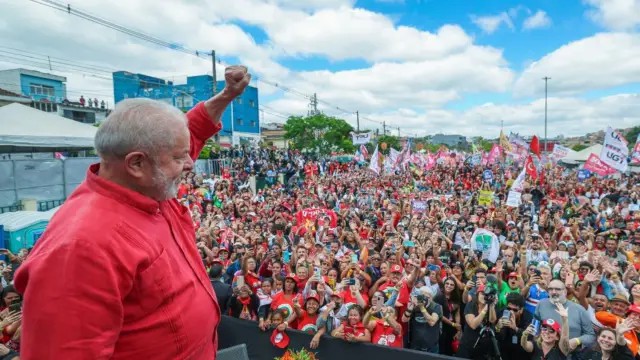
In São Paulo, Avenida Paulista quickly filled with ecstatic Lula supporters, cheering, singing and chanting. Speaking to the gigantic crowd from atop a trio eletrico, Lula gave pride of place to congressman Andre Janones, whose 10 million strong ‘Lula army’, which had worked day and night sending messages, urging people to vote, inventing slogans, had been an essential element of the PT candidate’s victory. Lula, his voice hoarse and at times inaudible, thanked the people for his victory, acknowledging the number of elderly voters who had turned out, although not obliged to vote . Videos showed people in their 80s, 90s, and even centenarians being wheeled into polling stations to vote for Lula. This vast effort to turn out the vote, providing boats for indigenous people in the Amazon, solidarity car lifts in the cities, had paid off, in spite of the sabotage efforts by the Bolsonaro camp.
Lula outlined plans for his new government, but it didn’t matter what he said or whether anyone could hear him – he was cheered enthusiastically by the crowd who just wanted to celebrate their incredible victory and the defeat of the far right.
Supporters exhibited a list of those who had been defeated by Lula: META, the USA, the betting companies, the militias, Faria Lima (Brazil`s Wall St), Vorcaro, the banking fraudster, and of course Flávio Bolsonaro.
Gloom in camp Bolsonaro
In Brasilia the defeated candidate stood amid the litter of the planned victory celebration, surrounded by glum-faced supporters, but instead of congratulating the winner, he vowed to get the election result annulled. Claiming fraud because the voting period had been extended, apparently forgetting that his own party also had requested an extension, because of the bad weather in the south.
Flávio’s defeat may convince trump that the Bolsonaros are a lost cause. Without Flávio to pardon him, Jair will remain in prison. Flávio himself is under investigation for money-laundering after receiving a huge donation to finance the biopic of his father, Dark Horse. The donor was disgraced banker Daniel Vorcaro, also currently in prison accused of fraud and various other crimes. At the end of 2026 Flávio’s mandate as a senator, and therefore his parliamentary immunity will end.
International relief vs silence from Trump
Lula’s victory has been greeted with relief by many countries, as a shining example of how democracy can stand up to the far right and defeat it with people power.
Every other South American country, including those run by right-wing governments, have queued up to congratulate Lula, because they know how much they need the biggest country in the region. Except of course for Argentina’s Milei who has recently taken every opportunity to hurl personal insults at Lula.
So far US president Donald Trump has not commented on an election result, which he must have found hard to digest.
Lula will not have an easy task in his fourth term as president, but from a global point of view his victory represents a last chance to save the Amazon from total destruction, and therefore save the world’s climate from disastrous overheating.
The lesson that must be learned from the campaign that resulted in his victory is that people power allied to social media works; that people, young and old, must turn out, on the streets and on the networks.
Main image: Lula addressing supporters in final election rally on Avenida Paulista, São Paulo. Photo: Richardo Stuckert/PT