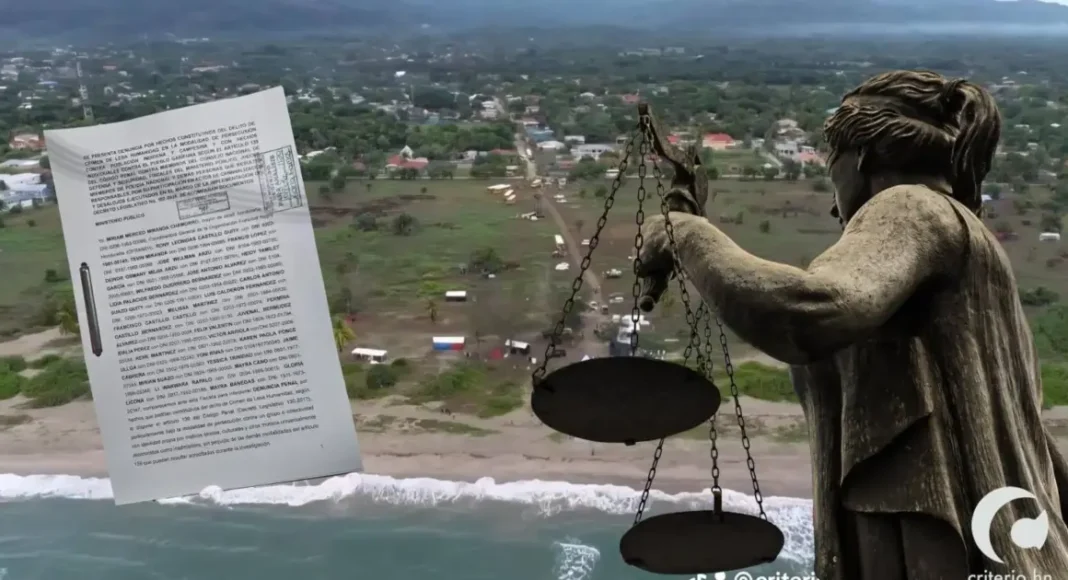
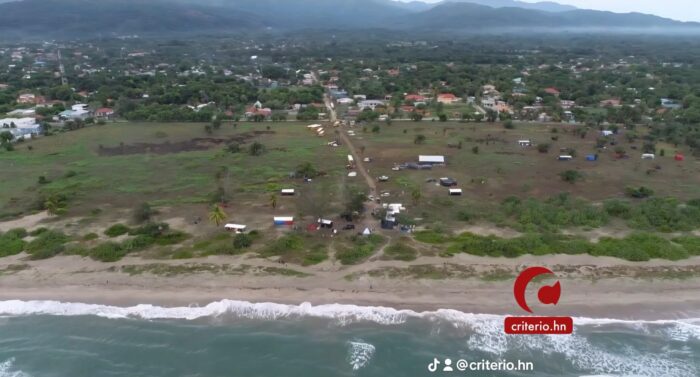
In July 2026, Honduran police evicted the Garifuna community of San Juan, Tela, from land protected by rulings of the Inter-American Court of Human Rights. It was the first eviction under a new law promoting agribusiness. Now they have joined other Garifuna, Indigenous, and campesino leaders in filing a criminal complaint for crimes against humanity against President Nasry Asfura and members of his National Defence and Security Council. Five San Juan land defenders, meanwhile, have been charged with usurpation.
On 6 July 2026 members of the Garifuna community of San Juan, Tela, Honduras, were evicted from their land as part of a government initiative to expand the country’s agro-industrial sector within the framework of the Law for the Strengthening and Protection of the Agro-industrial Sector (107-2026).
San Juan is one of four Garifuna communities that won rulings in which the Inter-American Court of Human Rights (IACtHR) found the State of Honduras responsible for violating their collective property rights. The State has still not carried out the required land regularization.
In response to the evictions, a group of Garifuna and leaders of other Indigenous and campesino communities have filed a complaint against government officials involved in the criminalization and evictions, which they deem persecution on ethnic and cultural grounds, and which they argue constitute crimes against humanity.
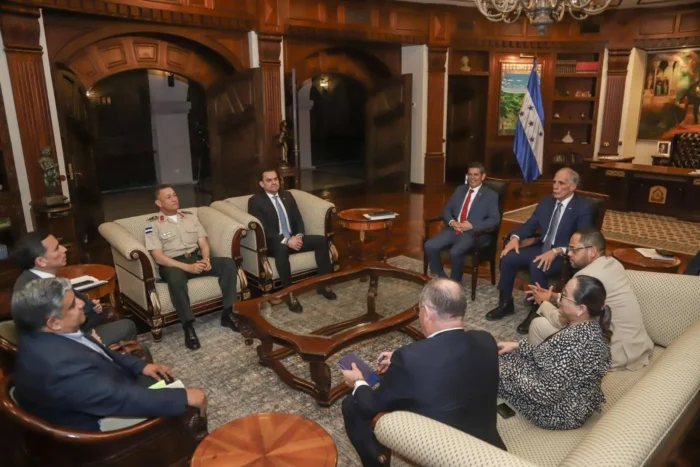
Among the government officials accused are members of the National Defence and Security Council, which is chaired by the President, Nasry Asfura. The Council is composed of the president of the Legislative Branch, Tomás Zambrano; the president of the Judicial Branch, Wagner Vallecillo; the Attorney General, Pablo Emilio Reyes Theodore; the head of the Secretariat of Security, Gerzón Onan Velásquez Aguilera; and the head of the Secretariat of Defence, Enrique Rodríguez Burchard. Likewise, prosecutors and other officials who have participated in the criminalization and evictions carried out within the framework of Decree 107-2026 are also included in the complaint.
After filing the complaint, Miranda said, ‘We are not criminals, we are not terrorists. They are the terrorists, they are the criminals, they are the murderers. Why are they the ones hunting down our people? Why do they persecute them? Why are they always ready to repress the people? Do you know why, compañeros and compañeras? Because they are afraid of the people. They are afraid that one day this people will call them to account.’
Miranda and other Garifuna leaders have camped out before the Supreme Court of Justice for a month, demanding that the IACtHR rulings be respected, and that the government’s criminalization of the defenders be stopped, noting that – unlike the government officials – the Garifuna leaders believe in the rule of law, in democracy, and that ‘the law must prevail over barbarism’.
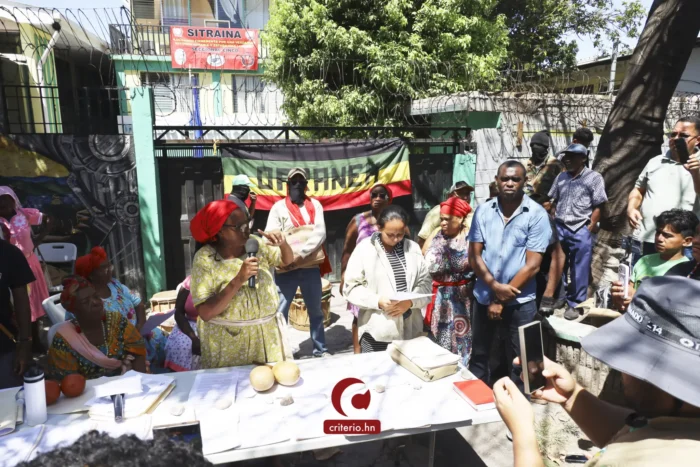
Miranda pointed out that despite a widespread campaign seeking to portray the Garifuna as hostile to dialogue, it was the government officials who were in fact attempting to provoke the Garifuna into committing violent acts. Speaking on the steps of the Public Prosecutor’s Office, she asserted, ‘They will not achieve their goal. We are civilized […] They want to see us as animals. They want to see us as if we want, or are looking for, violence.’
On 9 September 2026, the Alianza Campesina, Indígena, Garífuna y Popular de Honduras (Peasant, Indigenous, Garifuna, and Popular Alliance of Honduras) read a public declaration before the Instituto Nacional Agrario (INA – National Agrarian Institute), demanding the cessation of evictions and the dismissal of the institute’s director, Javier Talavera. The declaration was made amid tension over police threats to remove the protestors.
Custodial sentences for crimes against humanity in Honduras
For crimes against humanity, the Honduran penal code carries punishments ranging from 30 years to life imprisonment, loss of nationality, and absolute disqualification from holding public office for the same duration. Article 139 establishes that this crime is committed when any of the acts listed in the law are part of a widespread or systematic attack against the civilian population, with full knowledge of the attack. These actions include the persecution of an identifiable group or collective based on political, racial, national, ethnic, cultural, religious, gender, or other grounds recognized as unacceptable under international law.
This article was first published by Criterio. It was translated and republished, with permission, by LAB. You can donate to Criterio here.